
AgentRecall
by AkbarDizaji
README.md
# AgentRecall
[](https://github.com/AkbarDizaji/AgentRecall/actions/workflows/ci.yml)
[](https://codecov.io/gh/AkbarDizaji/AgentRecall)
[](https://tensorblock.co/mcp/servers/github-akbardizaji-agentrecall-9b7529bd)
[](https://glama.ai/mcp/servers/AkbarDizaji/AgentRecall)
**A local-first memory for AI coding agents.** AgentRecall turns the feedback and
failures you run into while coding into reusable rules, then serves the right
ones back — on the command line or directly to Claude Code over MCP. Everything
stays on your machine: no cloud sync, no web UI, no API keys.
## Contents
- [What it does](#what-it-does)
- [Install](#install)
- [Quick start](#quick-start)
- [Using AgentRecall](#using-agentrecall)
- [Command reference](#command-reference)
- [User Preferences](#user-preferences)
- [Standing Rules](#standing-rules)
- [Project DNA](#project-dna)
- [Seed Packs](#seed-packs)
- [Career Impact Pack](#career-impact-pack)
- [Capture pipeline](#capture-pipeline)
- [Interactive Memory](#interactive-memory)
- [Activity Notices](#activity-notices)
- [Turn Memory Summary](#turn-memory-summary)
- [Claude Code integration](#claude-code-integration)
- [Configuration](#configuration)
- [Development](#development)
## What it does
- **Turns feedback into structured rules.** Each correction is parsed into a
`trigger`, `rule`, `do`, `do_not`, `reason`, and `applies_to`, and validated —
not stored as a raw note.
- **Ranks what to surface.** `search` scores rules by keyword + a deterministic
concept graph (e.g. *refund* relates to *money* — not vector embeddings)
+ scope + confidence, then buckets results into **must-follow**,
**suggested**, and **warnings** within a token budget. An `IEmbeddingProvider`
extension point exists for hybrid search, but ships as a no-op — ranking is
keyword + concept based and fully local until you configure one.
- **Applies universal constraints every turn.** Style/tone/quality rules that
belong on *every* task are captured as [standing rules](#standing-rules) and
injected regardless of keyword relevance.
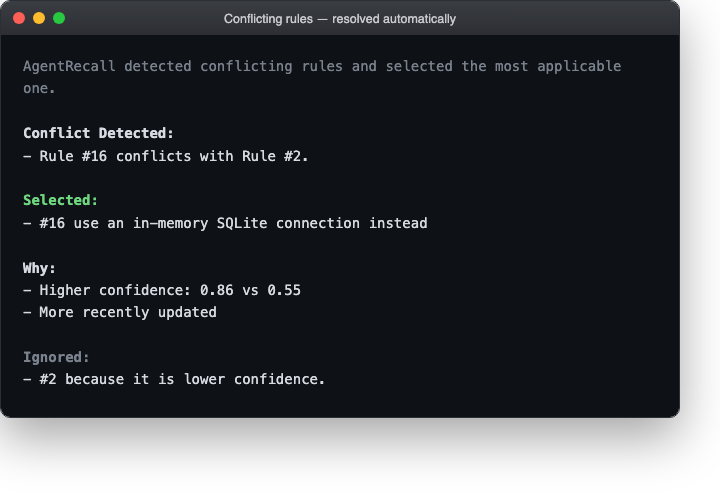
- **Resolves conflicts automatically.** When rules disagree, the policy engine
picks the effective one by scope, explicit supersede, priority, recency, then
confidence.
- **Learns from failures.** Build/test/lint logs feed back in; repeated
failures raise a rule's confidence and can auto-promote the fix.
- **Compresses its own memory.** Duplicate and overlapping rules are detected
and merged, with originals kept as an audit trail.
- **Measures retrieval quality.** A bundled eval reports Precision@1/@3 and
Recall@5, and fails CI on a regression.
- **Injects deterministically.** A gated Claude Code hook prepends relevant
rules to context on every matching prompt — not just when the model
remembers to ask.
## Install
AgentRecall is a .NET global tool. Install the [.NET SDK](https://dotnet.microsoft.com/download)
(8+), then:
```bash
dotnet tool install -g AgentRecall
agentrecall --version
```
**PATH.** A fresh install often isn't on `PATH` in your current shell, so
`agentrecall` can report "command not found" right after installing — the tool
fixes its own PATH on first run and prints a one-time notice, so a new terminal
picks it up automatically. If the very first invocation is the one that fails,
either open a new terminal or use the bootstrap script below, which installs
**and** fixes PATH in one step:
```bash
# macOS / Linux
curl -fsSL https://raw.githubusercontent.com/AkbarDizaji/AgentRecall/main/scripts/install.sh | bash
```
```powershell
# Windows (PowerShell)
iwr -useb https://raw.githubusercontent.com/AkbarDizaji/AgentRecall/main/scripts/install.ps1 | iex
```
You can also fix PATH any time with `agentrecall setup`. Update/remove later
with `dotnet tool update -g AgentRecall` / `dotnet tool uninstall -g AgentRecall`.
### Enable Claude Code integration
`agentrecall init` only creates the database. **Recall and capture inside Claude
Code need a separate, one-time step in each project** — it wires the
`UserPromptSubmit`/`PreToolUse`/`Stop` hooks into `.claude/settings.json` and
appends the `CLAUDE.md` guidance block (merged in, never overwritten):
```bash
agentrecall claude-code init
```
**Re-run this after every AgentRecall upgrade**: if the guidance block has
drifted from what the new version ships (e.g. a newer capture-judge or
document-opportunity contract), the re-run refreshes it in place — a no-op
when it's already current.
Forgot to run it? `agentrecall doctor` checks for this in any git repository
and tells you how to fix it (`--fix` wires it automatically):
```
⚠ Claude Code hooks: not wired for this project — automatic recall/capture won't run
fix: agentrecall claude-code init
```
### Dev containers
A global tool lives under `~/.dotnet/tools`, which is wiped on container
rebuild. `agentrecall devcontainer init` does everything `claude-code init`
does, plus keeps a dev container's reinstall step in sync — run it instead
when you use one:
```bash
agentrecall devcontainer init
```
Dev-container scaffolding itself is separate and **opt-in**: if a
`devcontainer.json` already exists it's wired in automatically; if not, none
is created — pass `--create` to generate one that reinstalls AgentRecall,
persists data on a named volume, and re-registers the MCP server on every
rebuild.
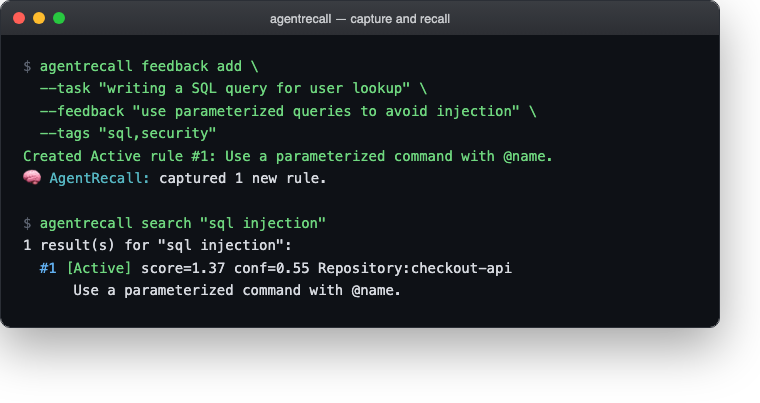
## Quick start
```bash
# 1. Create the local database (~/.agentrecall/agentrecall.db by default)
agentrecall init
# 2. Teach it something you learned
agentrecall feedback add \
--task "writing a SQL query" \
--feedback "use parameterized queries to avoid injection" \
--tags "sql,security"
# 3. Recall it later
agentrecall search "sql injection"
```
That's the whole loop: **capture → recall.**
## Using AgentRecall
**Capture feedback** — `--task` and `--feedback` are required; the rest add
context that improves matching:
```bash
agentrecall feedback add \
--task "writing a SQL query for user lookup" \
--feedback "use parameterized queries to avoid injection" \
--bad-output "string-concatenated SQL" --fixed-output "a parameterized command with @name" \
--scope-level Repository --scope-value my-repo --tags "security,sql"
```
**Search and read rules**, ranked by relevance, status, and confidence:
```bash
agentrecall search "sql injection"
agentrecall rules list
agentrecall rules show 1
```
**Curate.** Captured rules are **Active** by default. Rules move through a
small set of lifecycle states:
| State | Meaning |
| --- | --- |
| `Draft` | Not yet validated. |
| `Pending` | Awaiting your approval (see [Capture pipeline](#capture-pipeline)). |
| `Active` | Live and searchable — the default for captured rules. |
| `Promoted` | Active and elevated in ranking. |
| `Superseded` | Replaced by a newer rule (kept for the audit trail). |
| `Retired` / `Archived` | Excluded from search and dedup. |
```bash
agentrecall rules promote 1 # Active → Promoted
agentrecall rules approve 1 # Pending → Active
agentrecall rules supersede 1 2 # replace rule 1 with rule 2
agentrecall rules archive 3 # hide from search
```
Prefer to review before a rule counts? Capture with `--pending`, or set
`AutoApproveFeedback: false` to make it the default.
**Learn from failures.** Failures that match an existing rule raise its
confidence and can auto-promote the fix:
```bash
agentrecall import build-log ./build.log
agentrecall import test-log ./test.log
agentrecall import lint-log ./lint.log
```
**Learn from PR review comments.** Each comment that reads as a reusable
correction becomes a **pending** rule (tagged `pr-review`); praise/questions/nits
are skipped. Add `--accepted` if you've already acted on the comments, so they
land as **Active** rules directly:
```bash
gh pr view 42 --json comments > comments.json
agentrecall import pr-comments ./comments.json --task "PR #42: add refunds" --scope-value my-repo
```
**Evaluate retrieval quality** against a bundled dataset (a throwaway store —
your real database is never touched). Exits non-zero on a regression below
baseline; the same check runs as a unit test:
```bash
agentrecall eval retrieval
agentrecall eval retrieval --dataset ./my-eval.json
```
## Command reference
| Command | Description |
| --- | --- |
| `init` | Create the local data directory and database. |
| `setup` | Ensure the .NET tools directory is on your PATH (runs automatically on first use). |
| `claude-code init` | Wire AgentRecall's hooks + CLAUDE.md guidance for Claude Code — no dev container involved (optional `[path]`). |
| `devcontainer init` | Same wiring as `claude-code init`; `--create` also scaffolds a dev container (optional `[path]`). |
| `feedback add` | Record feedback and extract a rule from it. |
| `search "<query>"` | Search rules by keyword (`--scope-level`, `--scope-value`, `--limit`). |
| `rules list` | List all rules (`--status <status>`). |
| `rules show <id>` | Show a single rule in detail. |
| `rules approve <id>` | Move a Pending rule to Active. |
| `rules approve --all-pending [--session <id>]` | Approve every rule awaiting capture approval in one chat (defaults to the most recent). |
| `rules promote <id>` | Promote a rule. |
| `rules supersede <oldId> <newId>` | Replace one rule with another (versioned). |
| `rules archive <id>` | Archive a rule (excluded from search). |
| `rules archive --all-pending [--session <id>]` | Reject (archive) every rule awaiting capture approval in one chat. |
| `import build-log / test-log / lint-log <file>` | Ingest failures. |
| `import pr-comments <file>` | Capture PR review comments as rules (`--task`, `--scope-level`, `--scope-value`, `--tags`, `--accepted`). |
| `inject-context "<task>"` | Build agent-ready context (must-follow, warnings, preferred/anti-patterns). |
| `dna` | Summarise the repo's engineering personality (`--markdown`, `--json`, `--top <n>`, `--scope-level`, `--scope-value`, `--output <file>`). |
| `eval retrieval` | Evaluate retrieval quality (`--dataset <path>`); non-zero exit below baseline. |
| `activity last` / `activity list` | Show recent activity notices (`--json`, `--limit <n>`). |
| `turn-summary --last` | Aggregated Turn Memory Summary for the last turn (`--json`, `--detailed`, `--compact`). |
| `seed list` / `show <pack>` / `install <pack>` / `remove <pack>` / `status` | Manage seed packs (`--active`, `--suggested`, `--force`, `--json`). |
| `career impact --last` / `career journal --last` / `career status` | Career-impact pack commands (`--json`, `--detailed`, `--file <path>`). |
| `cleanup pending-noise` | Archive noisy Pending rules from before source/outcome-aware capture (dry run by default; `--apply`, `--json`, `--tag`, `--status`). |
| `doctor` | Check database/schema, PATH, Claude Code hook wiring, and the installed version; read-only by default (`--fix`, `--json`, `--offline`, `--project <path>`). |
| `finalize-turn` / `finalize-turn status` | Run or inspect turn finalization (`--json`, `--hook`). |
| `capture-status --last-turn` | Alias for `finalize-turn status`. |
| `mcp` | Run the MCP server over stdio (for Claude Code). |
| `status` | Show where data is stored. |
| `help`, `version` | Usage / installed version. |
Run `agentrecall help` any time for the same list.
## User Preferences
Explicit, durable statements about how *you* want the assistant to behave
(*"answer short and simple"*, *"don't ask me too many questions"*) are captured
as a `UserPreference` or `CommunicationPreference` — separate from repository
conventions and engineering lessons:
- **High confidence, user scope.** Captured at ≈0.9 confidence and stored
globally (not per-repository), since it applies to you everywhere.
- **Normalized, not verbatim.** *"always answer caveman form"* becomes durable,
bounded guidance; overbroad absolutes are dropped, intent is kept.
- **Unsafe preferences are refused** — one that conflicts with correctness or
honesty (*"always agree even if I'm wrong"*) is never stored.
- **Response language is never decided by AgentRecall.** A stated language
preference is captured verbatim as a general preference; it does not choose a
default language for the model.
```bash
agentrecall feedback add --task "how to answer me" \
--feedback "From now on, answer short and simple, add examples only if needed."
agentrecall rules explain <id> # Type: CommunicationPreference, evidence, scope, confidence
```
## Standing Rules
Most rules are **contextual** — retrieved by relevance to the task at hand.
That structurally misses **universal constraints** (*"don't leave unnecessary
comments"*, *"always run the formatter"*): they share no keywords with most
tasks, so they'd never clear the relevance floor. A rule carrying the
`AlwaysApply` flag is delivered on **every** task instead, as must-follow
guidance (or a warning, if it's a prohibition).
`AlwaysApply` (delivery: standing vs. contextual) and `ScopeLevel` (where a rule
is true: `Global`/`Language`/`Repository`/path) are orthogonal — a standing
rule is usually `Global`, but the two are independent properties.
A rule becomes standing when: it's a preference (always standing), the capture
judge flags it as a universal style/process/quality constraint, or you keep
making the same correction (the repeated-correction backstop promotes it).
Standing rules show as `[standing]` in the Turn Memory Summary.
The standing band is **capped at 5 highest-confidence rules per prompt** so it
stays prominent instead of becoming wallpaper; anything beyond the cap falls
back to ordinary relevance ranking rather than being dropped.
Good standing rules are universal and actionable (*"Run the formatter before
finishing a change"*). Bad ones are contextual guidance in disguise (*"Use
`Money` value objects in the billing service"* — scope it to billing instead)
or vague absolutes (*"Never use inheritance"* → prefer *"favor composition over
inheritance"*, kept contextual).
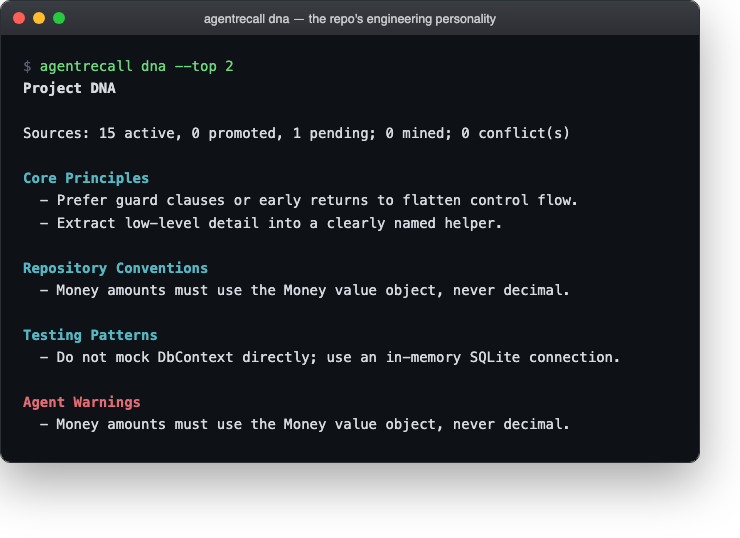
## Project DNA
A single, onboarding-ready summary of a repository's *engineering
personality* — conventions, patterns, risks, and recurring lessons — meant to
get a new developer or agent productive in under five minutes. It reads the
same data as the rest of AgentRecall (active/promoted rules, retrieval
frequency, mined lessons, conflicts) and organizes it into fixed sections: Core
Principles, Repository Conventions, Testing Patterns, Architecture Patterns,
Error Handling, Feature Gates/Authorization/Security, Common Mistakes, Agent
Warnings, Stale or Risky Knowledge.
Unlike `search` (which rule matches *this* task?) or `report` (metrics), DNA is
a **curated, deterministic narrative** of the whole corpus — no LLM calls, no
embeddings, same inputs always produce the same output.
```bash
agentrecall dna # human-readable
agentrecall dna --markdown --output PROJECT_DNA.md # for onboarding docs
agentrecall dna --json # stable, snake_case JSON
```
Commit the Markdown output as `PROJECT_DNA.md`/`CONTRIBUTING.md`, or paste
`agentrecall dna` into an agent's context at the start of a session.
## Seed Packs
Optional **starter engineering memories** — curated rules that give an agent
useful instincts before a project has accumulated its own. They're opt-in per
pack, never installed automatically, and removable at any time.
```bash
agentrecall seed list # available packs, installed or not
agentrecall seed install tidy-first # install as Active (default)
agentrecall seed install tidy-first --suggested # install as Pending instead
agentrecall seed remove tidy-first # archive the pack's rules
```
- **Active by default**, at moderate confidence (~0.65); marked with source
`BuiltInSeed` and a `[seed]` marker in the Turn Memory Summary.
- **Ranked below learned rules** — your own repository conventions and
corrections always outrank and win conflicts against seed rules, and a seed
rule is never injected as must-follow. Capped at two per prompt unless the
task is itself about tidying/refactoring.
- **Not absolute** — reject or archive a seed rule that doesn't fit; that
lowers its confidence like any learned rule.
- **Idempotent** — installing only adds rules, never edits/deletes yours;
reinstalling never duplicates or resurrects a removed rule without `--force`.
The built-in `tidy-first` pack has ten rules on separating behavior-preserving
cleanup from behavior change (guard clauses, naming, extraction, scoping a
tidy). It's original, paraphrased guidance — no copied book, article, or
third-party text.
## Career Impact Pack
The `career-impact` seed pack helps you notice and document promotion-worthy
engineering work — impact, evidence, metrics, stakeholders, ADRs — as coaching
guidance, not project facts. It installs like any other seed pack:
```bash
agentrecall seed install career-impact
agentrecall career impact --last # last turn's candidate
agentrecall career journal --last # promotion-ready entry, on demand
agentrecall career status # pack/mode and the last candidate
```
It's **low-token by design**: a cheap, deterministic end-of-turn detector (no
LLM, no embeddings, no network) decides whether a turn was significant; full
impact/journal detail generates only on demand or when a significant candidate
already exists.
- **`SignificantOnly` by default.** `AgentRecall.CareerImpactMode` can also be
`Silent` (never auto-run) or `Always` (surface lower-confidence candidates).
- **Never spams.** The automatic summary is at most five bullets plus a
pointer, and is human-visible only — never fed back into model context.
- **Retrieval is capped**, like any seed pack — ranked below learned rules.
It's original, paraphrased career-impact coaching guidance — no copied book,
article, or third-party text.
## Capture pipeline
Recall is deterministic through the `UserPromptSubmit` hook. **Capture** — what
gets remembered — runs through a separate pipeline each time a turn finishes:
```
Stop hook → finalize-turn → semantic capture judge verdict → validate
→ map by confidence → store / suggest / skip / reinforce / supersede
→ structured summary
no verdict? → Stop hook blocks → agent calls submit_capture_judgment
→ turn finalized from that verdict → next Stop lets the turn finish
```
**The semantic capture judge decides, not keyword heuristics.** A word like
"validation" or "auth" appearing in a sentence is never enough on its own to
capture anything.
- **Explicit save/do-not-save requests are always respected**, even for narrow
or stylistic rules — and always bypass the approval gate below (the user
already said yes).
- **Confidence maps to outcome:**
| Confidence | Outcome |
| --- | --- |
| `≥ 0.80` | Captures (still Pending your approval — see below) |
| `0.55 – 0.79` | Suggests a Pending rule |
| `< 0.55` | Skips |
- **Duplicates are reinforced, not duplicated**; an explicit supersede replaces
the prior rule.
- **The judge is the agent, and the Stop hook enforces that it answers.**
AgentRecall makes no network/LLM calls itself, so the verdict comes from the
session model — either as a `judgment` object on the `finalize-turn` payload or
through the `submit_capture_judgment` MCP tool. Claude Code's native Stop
payload carries no such field, so a substantive turn that reaches Stop unjudged
is **blocked once** with a reason asking for the verdict; the turn resumes,
submits it, and finalizes from it. A `Skip` verdict is a complete answer.
- **A turn nobody judged captures nothing** — there is no keyword fallback, ever.
"Unjudged" is recorded distinctly from "the model judged it as not worth
keeping", and from "asked and never answered". AgentRecall asks at most once
per turn (`AgentRecall.MaxJudgmentRequestsPerTurn`), so an unanswered ask costs
the memory, not the turn. Set `AgentRecall.JudgmentEnforcementMode` to `Off` to
never block, or `Always` to ask on every turn that has a prompt.
- **Source and outcome matter as much as wording.** Documentation, tool
instructions, command output, and logs are not captured merely because they
were read — only when paired with an observed agent failure, a user
correction, an explicit save, or a confirmed repository convention. A bare
code fact is never auto-captured (it's recoverable from the repo via search).
Repeated corrections raise confidence and favor capture.
- **Privacy.** The raw transcript is not stored by default — only a content
hash, resulting rule ids, and skip reasons (`StoreTurnTranscript: true` to
keep it for debugging).
**Every capture defaults to pending your approval.** Even a `≥0.80` capture
isn't stored Active outright — it's parked Pending and surfaced in the Turn
Memory Summary under **Awaiting your approval**, with the rule's description
and a reply instruction:
```
Awaiting your approval:
- #42 Do not mock DbContext directly
Reply `yes`/`no` for a rule above, or `yes to all` to approve every rule
awaiting approval in this chat.
```
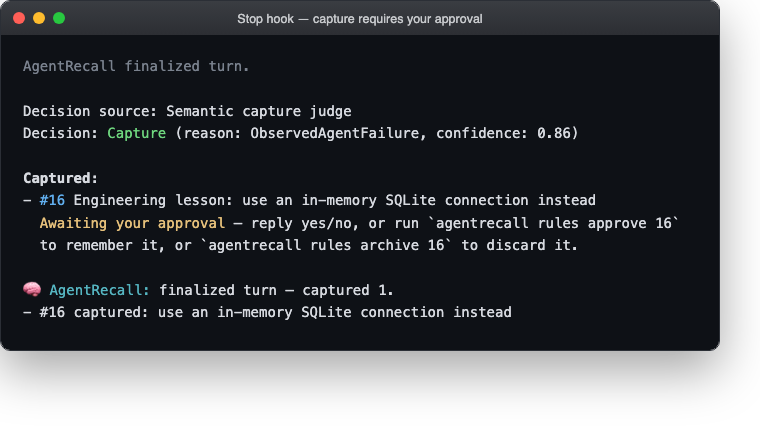
Reply in chat and Claude calls `resolve_pending_capture` (`approve`/`reject`
for one rule, `approve_all`/`reject_all` for everything still pending in the
conversation — scoped by the host's session id, so "yes to all" only ever
resolves the current chat, not an unrelated one). No terminal prompt, no
blocking: this is the same conversational pattern as the document-opportunity
flow. Prefer the CLI directly? `agentrecall rules approve <id>` /
`archive <id>`, or `--all-pending [--session <id>]` for the bulk form.
Set `AgentRecall.InteractiveMemoryMode: Silent` to skip this gate globally —
every capture is then stored per the judge's own decision immediately, exactly
as before this gate existed. See [Interactive Memory](#interactive-memory).
**Ask AgentRecall, don't guess.** The agent should never speculate about
whether something was captured — it's one command away:
```bash
agentrecall finalize-turn status # or: agentrecall capture-status --last-turn
agentrecall activity last # what AgentRecall did last, in general
```
`agentrecall devcontainer init` scaffolds a `CLAUDE.md` contract requiring the
agent to check status first and only offer manual capture when nothing was
captured **and** you explicitly ask. If an agent still says "the Stop hook may
have captured it", update the tool (`dotnet tool update --global AgentRecall`)
and re-run `agentrecall devcontainer init` to refresh the Stop hook and
guidance.
**Cleaning up old noise.** For Pending rules created before source/outcome-aware
capture existed, `cleanup pending-noise` finds and archives them (dry run by
default, never touches Active/Promoted/user-edited rules):
```bash
agentrecall cleanup pending-noise # dry run
agentrecall cleanup pending-noise --apply # archive the noisy ones
```
## Interactive Memory
One config option, `AgentRecall.InteractiveMemoryMode`, governs asking the
user across two different surfaces:
- **The Stop-hook capture-approval gate** (see
[Capture pipeline](#capture-pipeline)) — the default for every automatic
capture, chat-relayed since a hook can't block for a keystroke: yes/no per
rule, or "yes to all" for the chat.
- **Manual `feedback add`** — when the capture judge is unsure
(`SuggestCapture`), AgentRecall can **ask** right there instead of silently
parking a Pending rule — but only when a terminal is attached; hooks, pipes,
and MCP never block waiting for input:
```
🧠 AgentRecall: possible lesson detected.
[y] Remember [n] Ignore [v] View details
```
| Value | Stop-hook capture gate | Manual `feedback add` |
| --- | --- | --- |
| `Auto` (default) | Asks for every capture | Asks only on ambiguous (`SuggestCapture`) results |
| `Ask` | Same as `Auto` — everything there is already asked | Same as `Auto`, plus downgrades a borderline auto-capture to a prompt |
| `Silent` (**global bypass**) | Stores immediately per the judge's decision, no prompt | Parks Pending with no prompt |
Approve or ignore later the normal way:
```bash
agentrecall rules list --status Pending
agentrecall rules approve <id> # remember one
agentrecall rules archive <id> # ignore one
agentrecall rules approve --all-pending [--session <id>] # "yes to all" from a terminal
agentrecall rules archive --all-pending [--session <id>] # "no to all" from a terminal
```
## Activity Notices
AgentRecall tells you what it's doing — what it fetched, captured, skipped,
resolved — with a recognizable badge, e.g. `🧠 AgentRecall: captured 1 new
rule.` This is kept **human-facing only**, separate from the model-visible
context, so notices never bloat the token budget.
Verbosity is independently configurable: `ActivityNoticeLevel`
(`Verbose`/`Normal`/`Silent`, default `Verbose`) for CLI/status notices, and
`HookNoticeLevel` (`Normal`/`Silent`, default `Normal`) for the single line the
`UserPromptSubmit` hook injects alongside rules.
```bash
agentrecall activity last # the latest notice
agentrecall activity list # recent notices, newest first
agentrecall activity list --json --limit 20
```
## Turn Memory Summary
At the end of each turn, AgentRecall prints **one aggregated summary** of
everything it did — rules used, captured, suggested, skipped, remembered/
ignored, errors — instead of many scattered notices. It's human-visible only
(never re-injected into model context) and bounded (short titles, capped item
counts).
`AgentRecall.TurnSummaryLevel` = `Silent` | `Compact` (default) | `Detailed`.
```bash
agentrecall turn-summary --last # at the configured level
agentrecall turn-summary --last --detailed # force grouped detail
agentrecall turn-summary --last --json
```
## Claude Code integration
Register the MCP server once:
```bash
claude mcp add agentrecall agentrecall mcp
```
| Tool | What it does |
| --- | --- |
| `inject_context` | Given a task, return ranked/conflict-resolved rules bucketed into must-follow, suggested, warnings. |
| `resolve_rules` | Decide which of several matching rules to follow, resolving conflicts/supersessions. |
| `compress_memory` | Merge duplicate/overlapping rules (dry run by default). |
| `get_relevant_context` | Keyword-based rules to know before starting a task. |
| `get_project_rules` | Rules that always apply here (project → promoted → active). |
| `get_reminders` | A short checklist for a kind of work. |
| `capture_status` | The last turn-finalization result — the answer to "did AgentRecall capture anything?". |
| `resolve_pending_capture` | Approve/reject one rule awaiting capture approval, or every rule pending in the chat (`approve_all`/`reject_all`). |
| `search_rules` | Find rules relevant to a query. |
| `suggest_feedback_candidate` | Detect whether a message is a reusable correction. |
| `capture_feedback` | Save a correction in one step (`pending=true` to require approval). |
| `add_feedback` | Record feedback with full task/scope context. |
| `import_pr_comments` | Capture PR review comments as pending rules. |
Each rule returns as `trigger`, `rule`, `do`, `do_not`, `reason`, `applies_to`,
`confidence`, `status`. The server speaks JSON-RPC 2.0 over stdio, logs only to
stderr, and behaves identically installed or run from source.
**Registering the server only makes tools available** — the agent still has to
call them. Add this to your `CLAUDE.md`/`AGENTS.md` to make it default
behavior (or let `agentrecall devcontainer init` scaffold it for you):
```markdown
## Memory (AgentRecall)
- **Before** coding/refactoring/reviewing/debugging, call `inject_context` with
the task. Follow must-follow rules and heed warnings.
- **When the user corrects you**, call `suggest_feedback_candidate`, then
`capture_feedback` for reusable lessons.
- **After a PR review**, pass comments to `import_pr_comments`.
- **When a capture shows "Awaiting your approval"**, relay it to the user and
wait for yes/no (or "yes to all"), then call `resolve_pending_capture`.
```
**For deterministic injection**, wire a Claude Code hook instead of relying on
the model to choose to call a tool — hooks run before the model responds,
every time the gate matches:
```json
{
"hooks": {
"UserPromptSubmit": [
{ "hooks": [ { "type": "command", "command": "PATH=$HOME/.dotnet/tools:$PATH agentrecall hook user-prompt-submit" } ] }
],
"Stop": [
{ "hooks": [ { "type": "command", "command": "PATH=$HOME/.dotnet/tools:$PATH agentrecall finalize-turn --hook" } ] }
]
}
}
```
On each prompt this gates on `HookKeywords` (dev-shaped prompts only, no cost
otherwise), retrieves rules scoped to the repository, and prepends a compact
`## AgentRecall Technical Context` block (Must Follow / Warnings / Preferred
Patterns / Anti Patterns / Source Rules — empty sections omitted). It never
blocks Claude Code: on error it logs to stderr and injects nothing.
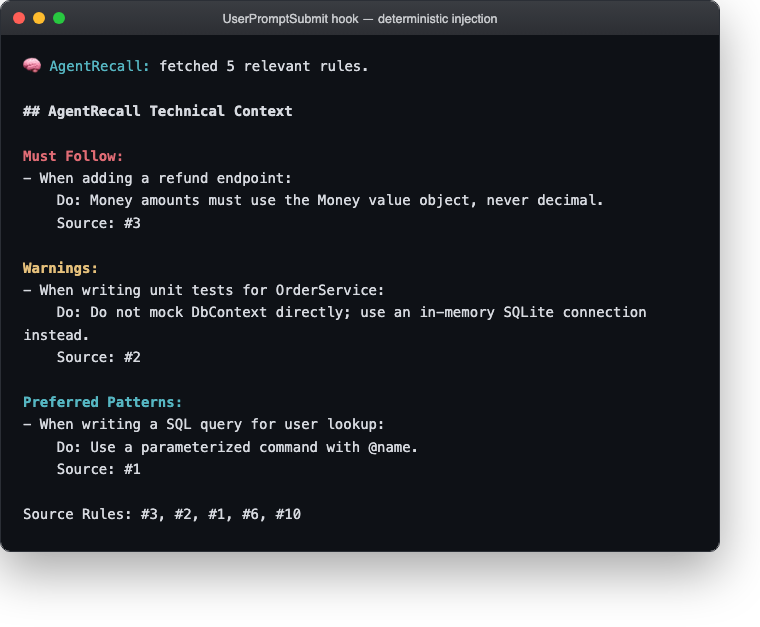
Troubleshoot by running the hook by hand:
```bash
echo '{"prompt":"Write Moq tests for OrderService","cwd":"'"$PWD"'"}' \
| agentrecall hook user-prompt-submit
```
An empty result means the gate didn't match, the hook is disabled, or nothing
was relevant. `claude --debug` shows hook execution inside Claude Code.
## Configuration
AgentRecall reads an optional `agentrecall.json` from the current directory,
then environment overrides prefixed `AGENTRECALL_` (e.g.
`AGENTRECALL_AgentRecall__LogLevel=Debug`). Data lives in one SQLite database
under `DataDirectory` — backing up or moving your memory is copying that
folder.
```json
{
"AgentRecall": {
"DataDirectory": "~/.agentrecall",
"LogLevel": "Information",
"AutoApproveFeedback": true,
"ActivityNoticeLevel": "Verbose",
"HookNoticeLevel": "Normal",
"TurnSummaryLevel": "Compact"
}
}
```
| Setting | Default | Purpose |
| --- | --- | --- |
| `DataDirectory` | `~/.agentrecall` | Where the SQLite database lives. |
| `LogLevel` | `Information` | Log verbosity. |
| `AutoApproveFeedback` | `true` | `false` makes every capture start `Pending`. |
| `ActivityNoticeLevel` | `Verbose` | CLI activity notice verbosity: `Verbose`/`Normal`/`Silent`. |
| `HookNoticeLevel` | `Normal` | Verbosity of the single line the prompt hook injects: `Normal`/`Silent`. |
| `TurnSummaryLevel` | `Compact` | End-of-turn summary verbosity: `Silent`/`Compact`/`Detailed`. |
| `HookEnabled` | `true` | Master switch for the `UserPromptSubmit` hook. |
| `HookKeywords` | dev-task words | Words/phrases that mark a prompt as dev work. |
| `HookMaxRules` | `5` | Max rules injected per prompt. |
| `HookIncludePending` | `true` | Whether Pending rules may be injected, so a repeat can be recognized and reinforced. |
| `HookPendingCap` | `1` | Max Pending rules injected per prompt when `HookIncludePending` is true. |
| `TurnFinalizerEnabled` | `true` | Master switch for `finalize-turn`. |
| `CaptureJudgeMode` | `Semantic` | `Off` disables automatic Stop-hook capture entirely. |
| `StoreTurnTranscript` | `false` | Persist the raw transcript with each finalization. |
| `MaxCandidatesPerTurn` | `5` | Max lessons captured from one turn. |
| `MaxCandidateCharacters` | `1000` | Per-candidate length cap. |
| `CaptureAutoConfidence` | `0.5` | Minimum confidence to auto-capture without explicit acceptance. |
| `FinalizerShowUserNotice` | `true` | Emit a Stop-hook notice after a turn. |
| `SuppressDuplicateNotices` | `true` | Stay silent when only a duplicate was reinforced. |
| `InteractiveMemoryMode` | `Auto` | `Ask`/`Silent` change whether ambiguous captures prompt you. |
| `CareerImpactMode` | `SignificantOnly` | `Silent`/`Always` for the career-impact pack's auto-summary. |
| `CareerImpactSummaryLevel` | `Compact` | `Detailed` for the career-impact auto-summary. |
## Development
```bash
git clone https://github.com/AkbarDizaji/AgentRecall.git
cd AgentRecall
dotnet build && dotnet test
dotnet run --project src/AgentRecall.Cli -- init # run without installing
```
See [`ARCHITECTURE.md`](ARCHITECTURE.md) for solution layout and design, and
[`CONTRIBUTING.md`](CONTRIBUTING.md) for the contribution workflow, coding
conventions, and how to cut a release.
This server cannot be deployed
Maintenance
ActivityMaintained
ResponsivenessResponsive