
VeoMCP
# VeoMCP
<!-- mcp-name: io.github.AceDataCloud/mcp-veo -->
[](https://pypi.org/project/mcp-veo/)
[](https://pypi.org/project/mcp-veo/)
[](https://www.python.org/downloads/)
[](https://opensource.org/licenses/MIT)
[](https://modelcontextprotocol.io)
A [Model Context Protocol (MCP)](https://modelcontextprotocol.io) server for AI video generation using [Veo](https://deepmind.google/technologies/veo/) through the [AceDataCloud API](https://platform.acedata.cloud?utm_source=github&utm_medium=referral&utm_campaign=evergreen&utm_content=veo_mcp_readme_platform).
Generate AI videos from text prompts or images directly from Claude, VS Code, or any MCP-compatible client.
## Features
- **Text to Video** - Create AI-generated videos from text descriptions
- **Image to Video** - Animate images or create transitions between images
- **Multi-Image Fusion** - Blend elements from multiple images
- **1080p Upscaling** - Get high-resolution versions of generated videos
- **Task Tracking** - Monitor generation progress and retrieve results
- **Multiple Models** - Choose between quality and speed with various Veo models
## Tool Reference
| Tool | Description |
|------|-------------|
| `veo_text_to_video` | Generate AI video from a text prompt using Veo. |
| `veo_image_to_video` | Generate AI video from one or more reference images using Veo. |
| `veo_get_1080p` | Get the 1080p high-resolution version of a generated video. |
| `veo_get_task` | Query the status and result of a video generation task. |
| `veo_get_tasks_batch` | Query multiple video generation tasks at once. |
| `veo_list_models` | List all available Veo models and their capabilities. |
| `veo_list_actions` | List all available Veo API actions and corresponding tools. |
| `veo_get_prompt_guide` | Get guidance on writing effective prompts for Veo video generation. |
## Connect: hosted OAuth, API token, or local stdio
The hosted endpoint is `https://veo.mcp.acedata.cloud/mcp`. Choose one route for the MCP client:
| Route | When to use it | Credential setup |
|---|---|---|
| Hosted OAuth | The client supports remote MCP OAuth | Add only the URL, then sign in to AceDataCloud and approve access. No token needs to be pasted into client configuration. |
| Hosted API token | The client cannot finish OAuth, or you need an explicit integration credential | Send an AceDataCloud API token in the `Authorization: Bearer …` header. Keep it in a local secret store or environment variable. |
| Local stdio | The client runs a local MCP process | Install `mcp-veo` and pass `ACEDATACLOUD_API_TOKEN` to that process. It still calls the AceDataCloud API. |
The hosted service advertises OAuth metadata and Dynamic Client Registration (DCR). **DCR registers the client application; it is not an API key.** OAuth signs you in and the client sends the resulting Bearer token; it may reuse or create an API credential for the account. Browser sign-in still requires an AceDataCloud account. The hosted service can be metered: review [current service documentation](https://platform.acedata.cloud/documents/veo-mcp?utm_source=github&utm_medium=referral&utm_campaign=evergreen&utm_content=veo_mcp_readme_quick_start) and displayed pricing before a real operation. Do not configure both an OAuth login and a fixed `Authorization` header for the same server.
### Hosted OAuth examples
- **Claude and Claude Desktop chat:** Add a remote custom connector in `Customize → Connectors → Add custom connector`, enter `https://veo.mcp.acedata.cloud/mcp`, select sign-in, and choose **Register automatically** if Claude asks how to register its OAuth client. Complete consent. Claude Desktop's local `claude_desktop_config.json` is a separate setup. [Claude connector guide](https://support.claude.com/en/articles/11175166-get-started-with-custom-connectors-using-remote-mcp).
- **Claude Code:** `claude mcp add --transport http --scope user veo https://veo.mcp.acedata.cloud/mcp`, then `claude mcp login veo`. Check `/mcp`. [Claude Code MCP guide](https://code.claude.com/docs/en/mcp).
- **Cursor:** Add a remote server with only `https://veo.mcp.acedata.cloud/mcp`. For a project, merge the entry below into `<project>/.cursor/mcp.json`; for personal use, use `~/.cursor/mcp.json`. [Cursor MCP guide](https://cursor.com/docs/mcp).
- **VS Code / Copilot:** Run **MCP: Add Server**, select HTTP, enter `https://veo.mcp.acedata.cloud/mcp`, then finish the browser sign-in. New portable workspace configs use `<project>/.mcp.json`; the VS Code-specific format below uses `<project>/.vscode/mcp.json` or the user profile. Check **MCP: List Servers**. [VS Code MCP setup](https://code.visualstudio.com/docs/agent-customization/mcp-servers).
- **Codex:** `codex mcp add veo --url https://veo.mcp.acedata.cloud/mcp`, then `codex mcp login veo`. Its user settings are in `~/.codex/config.toml`. [Official Codex MCP guide](https://developers.openai.com/codex/mcp/).
Cursor project config (OAuth):
```json
{
"mcpServers": {
"veo": {"url": "https://veo.mcp.acedata.cloud/mcp"}
}
}
```
VS Code-specific workspace config (OAuth):
```json
{
"servers": {
"veo": {"type": "http", "url": "https://veo.mcp.acedata.cloud/mcp"}
}
}
```
### Hosted API token
<!-- BEGIN TOKEN ONBOARDING -->
1. Open [Ace Data Cloud → Applications](https://platform.acedata.cloud/console/applications?utm_source=github&utm_medium=referral&utm_campaign=evergreen&utm_content=veo_mcp_readme_api_key). Sign in, or register an account first.
2. Find **General application**. If it has not been created, choose **Initialize General Application**. A general key can use the services available to your account; a dedicated application's key is limited to its service. Check the required service/model access and [current pricing](https://platform.acedata.cloud/models?utm_source=github&utm_medium=referral&utm_campaign=evergreen&utm_content=veo_mcp_readme_models).
3. Copy the **API Key** from the application card, or open **Keys / Manage Keys → Create** to create a separate key for this integration. Give it a recognizable name so you can revoke or rotate it independently.
4. When creating a key, review **Expiration Time**, **Set Usage Limitation**, and **Allowed APIs**. Enable only the restrictions you need, allow the operations you will call, then click **Create** and copy the token from the key list. Task lookup does not grant permission to submit a generation. Confirm the application's balance can cover your first request; any trial allowance is whatever your account currently displays.
5. Copy only the token value, without quotation marks, spaces, or `Bearer `. An API Key / API Token field expects this raw value; only a manually configured HTTP `Authorization` header needs the `Bearer ` prefix. A `platform-...` account-management token cannot replace a generation API key.
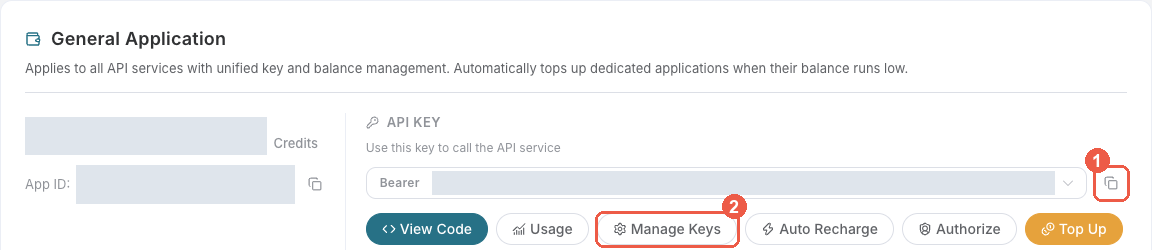
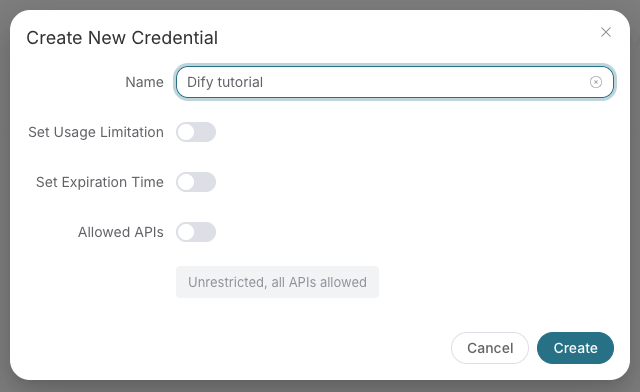
Save the key in the client's credential store or the environment variable shown below. Never put it in a prompt, shared workflow, screenshot, or Git commit. If authentication fails, check the full copied value, application/service access, expiration, usage limit, and balance before creating another key.
<!-- END TOKEN ONBOARDING -->
A fixed Bearer header bypasses OAuth. If the header is invalid, remove it before trying browser sign-in; keep the saved credential private.
For Claude Code, the shell expands the token when you add the server; treat the saved user MCP config as a secret:
```bash
export ACEDATACLOUD_API_TOKEN='YOUR_API_TOKEN'
claude mcp add --transport http --scope user veo https://veo.mcp.acedata.cloud/mcp \
--header "Authorization: Bearer $ACEDATACLOUD_API_TOKEN"
```
For a Claude Code project config, put a variable reference in `<project>/.mcp.json` and set that variable in the environment that launches Claude Code:
```json
{
"mcpServers": {
"veo": {
"type": "http",
"url": "https://veo.mcp.acedata.cloud/mcp",
"headers": {"Authorization": "Bearer ${ACEDATACLOUD_API_TOKEN}"}
}
}
}
```
Cursor uses a different environment-variable syntax in `~/.cursor/mcp.json` or an uncommitted project config:
```json
{
"mcpServers": {
"veo": {
"url": "https://veo.mcp.acedata.cloud/mcp",
"headers": {"Authorization": "Bearer ${env:ACEDATACLOUD_API_TOKEN}"}
}
}
}
```
In VS Code, run **MCP: Open User Configuration** and merge this server plus its masked input; `${input:...}` is for VS Code's user/workspace format and is not portable to the Agent Host `.mcp.json` format:
```json
{
"inputs": [
{"id": "acedata-veo-token", "type": "promptString", "description": "AceDataCloud API token", "password": true}
],
"servers": {
"veo": {
"type": "http",
"url": "https://veo.mcp.acedata.cloud/mcp",
"headers": {"Authorization": "Bearer ${input:acedata-veo-token}"}
}
}
}
```
For **Cline**, use its MCP configuration UI or CLI file `~/.cline/data/settings/cline_mcp_settings.json`; its remote transport value is `streamableHttp`. For **JetBrains AI Assistant**, add a remote URL from **Settings → Tools → AI Assistant → Model Context Protocol (MCP)**. For **Zed**, use a `context_servers` entry with the URL only for OAuth or add a local Bearer header. These clients have different configuration schemas; follow their current UI rather than copying another client's JSON. [Cline](https://docs.cline.bot/mcp/mcp-overview) · [JetBrains](https://www.jetbrains.com/help/ai-assistant/mcp.html) · [Zed](https://zed.dev/docs/ai/mcp).
### Local stdio
Install the package and give the local process an API token:
```bash
python -m pip install mcp-veo
export ACEDATACLOUD_API_TOKEN='YOUR_API_TOKEN'
mcp-veo
```
For Claude Desktop local MCP, merge this entry into the file opened by its developer settings (`~/Library/Application Support/Claude/claude_desktop_config.json` on macOS). `uvx` requires [uv](https://docs.astral.sh/uv/) on `PATH`:
```json
{
"mcpServers": {
"veo": {
"command": "uvx",
"args": ["mcp-veo"],
"env": {"ACEDATACLOUD_API_TOKEN": "YOUR_API_TOKEN"}
}
}
}
```
Keep this user-level file private. Self-hosted HTTP uses `mcp-veo --transport http --port 8000`; expose it only with suitable network and TLS controls. Local execution still calls the AceDataCloud API.
### Check before using the service
1. `https://veo.mcp.acedata.cloud/health` returning `{"status":"ok"}` checks endpoint reachability only.
2. Confirm that the MCP client loads tools. `veo_list_models` is a reference tool; it does not verify downstream API access or balance.
3. Use a documented service operation for an end-to-end check after reviewing [current service documentation](https://platform.acedata.cloud/documents/veo-mcp?utm_source=github&utm_medium=referral&utm_campaign=evergreen&utm_content=veo_mcp_readme_quick_start) and displayed pricing. If the result contains a task ID, call `veo_get_task` on that same ID until terminal success or failure. Do not resubmit the operation just to check progress.
For **401**, check which auth route the client used and whether the token or OAuth session is valid. A **403** may mean an account permission or content moderation failure; read the returned error. Insufficient balance and downstream service failures need their own diagnosis. A listed tool or submitted task does not prove a successful result.
## Available Tools
### Video Generation
| Tool | Description |
| -------------------- | -------------------------------------- |
| `veo_text_to_video` | Generate video from a text prompt |
| `veo_image_to_video` | Generate video from reference image(s) |
| `veo_get_1080p` | Get high-resolution 1080p version |
### Tasks
| Tool | Description |
| --------------------- | ---------------------------- |
| `veo_get_task` | Query a single task status |
| `veo_get_tasks_batch` | Query multiple tasks at once |
### Information
| Tool | Description |
| ---------------------- | ------------------------------ |
| `veo_list_models` | List available Veo models |
| `veo_list_actions` | List available API actions |
| `veo_get_prompt_guide` | Get video prompt writing guide |
## Usage Examples
### Generate Video from Text
```
User: Create a video of a sunset over the ocean
Claude: I'll generate a sunset video for you.
[Calls veo_text_to_video with prompt="Cinematic shot of a golden sunset over the ocean, waves gently rolling, warm colors reflecting on the water"]
```
### Animate an Image
```
User: Animate this product image to make it rotate slowly
Claude: I'll create a video from your image.
[Calls veo_image_to_video with image_urls=["product_image.jpg"], prompt="Product slowly rotates 360 degrees, studio lighting"]
```
### Create Image Transition
```
User: Create a video that transitions between these two landscape photos
Claude: I'll create a transition video between your images.
[Calls veo_image_to_video with image_urls=["img1.jpg", "img2.jpg"], prompt="Smooth cinematic transition between scenes"]
```
## Available Models
| Model | Text2Video | Image2Video | Image Input |
| ------------------------ | ---------- | ----------- | --------------------- |
| `veo3` | ✅ | ✅ | 1-3 images |
| `veo3-fast` | ✅ | ✅ | 1-3 images |
| `veo31` | ✅ | ✅ | 1-3 images |
| `veo31-fast` | ✅ | ✅ | 1-3 images |
| `veo31-fast-ingredients` | ❌ | ✅ | 1-3 images (fusion) |
**Aspect Ratios**:
- `16:9` - Landscape/widescreen (default)
- `9:16` - Portrait/vertical (social media)
## Configuration
### Environment Variables
| Variable | Description | Default |
| --------------------------- | ---------------------------- | --------------------------- |
| `ACEDATACLOUD_API_TOKEN` | API token from AceDataCloud | **Required** |
| `ACEDATACLOUD_API_BASE_URL` | API base URL | `https://api.acedata.cloud` |
| `ACEDATACLOUD_OAUTH_CLIENT_ID` | OAuth client ID (hosted mode) | — |
| `ACEDATACLOUD_PLATFORM_BASE_URL` | Platform base URL | `https://platform.acedata.cloud` |
| `VEO_DEFAULT_MODEL` | Default model for generation | `veo31-fast` |
| `VEO_REQUEST_TIMEOUT` | Request timeout in seconds | `180` |
| `LOG_LEVEL` | Logging level | `INFO` |
### Command Line Options
```bash
mcp-veo --help
Options:
--version Show version
--transport Transport mode: stdio (default) or http
--port Port for HTTP transport (default: 8000)
```
## Development
### Setup Development Environment
```bash
# Clone repository
git clone https://github.com/AceDataCloud/VeoMCP.git
cd VeoMCP
# Create virtual environment
python -m venv .venv
source .venv/bin/activate # or `.venv\Scripts\activate` on Windows
# Install with dev dependencies
pip install -e ".[dev,test]"
```
### Run Tests
```bash
# Run unit tests
pytest
# Run with coverage
pytest --cov=core --cov=tools
# Run integration tests (requires API token)
pytest tests/test_integration.py -m integration
```
### Code Quality
```bash
# Format code
ruff format .
# Lint code
ruff check .
# Type check
mypy core tools
```
### Build & Publish
```bash
# Install build dependencies
pip install -e ".[release]"
# Build package
python -m build
# Upload to PyPI
twine upload dist/*
```
## Project Structure
```
VeoMCP/
├── core/ # Core modules
│ ├── __init__.py
│ ├── client.py # HTTP client for Veo API
│ ├── config.py # Configuration management
│ ├── exceptions.py # Custom exceptions
│ ├── server.py # MCP server initialization
│ ├── types.py # Type definitions
│ └── utils.py # Utility functions
├── tools/ # MCP tool definitions
│ ├── __init__.py
│ ├── video_tools.py # Video generation tools
│ ├── info_tools.py # Information tools
│ └── task_tools.py # Task query tools
├── prompts/ # MCP prompts
│ └── __init__.py
├── tests/ # Test suite
│ ├── conftest.py
│ ├── test_client.py
│ ├── test_config.py
│ ├── test_integration.py
│ └── test_utils.py
├── deploy/ # Deployment configs
│ └── production/
│ ├── deployment.yaml
│ ├── ingress.yaml
│ └── service.yaml
├── .env.example # Environment template
├── .gitignore
├── Dockerfile # Docker image for HTTP mode
├── docker-compose.yaml # Docker Compose config
├── LICENSE
├── main.py # Entry point
├── pyproject.toml # Project configuration
└── README.md
```
## API Reference
This server wraps the [AceDataCloud Veo API](https://platform.acedata.cloud/documents/veo-videos?utm_source=github&utm_medium=referral&utm_campaign=evergreen&utm_content=veo_mcp_readme_documents_veo-videos):
- [Veo Videos API](https://platform.acedata.cloud/documents/veo-videos?utm_source=github&utm_medium=referral&utm_campaign=evergreen&utm_content=veo_mcp_readme_documents_veo-videos) - Video generation
- [Veo Tasks API](https://platform.acedata.cloud/documents/veo-videos?utm_source=github&utm_medium=referral&utm_campaign=evergreen&utm_content=veo_mcp_readme_documents_veo-videos) - Task queries
## Contributing
Contributions are welcome! Please:
1. Fork the repository
2. Create a feature branch (`git checkout -b feature/amazing`)
3. Commit your changes (`git commit -m 'Add amazing feature'`)
4. Push to the branch (`git push origin feature/amazing`)
5. Open a Pull Request
## Documentation
<!-- canonical-documentation -->
[Documentation](https://platform.acedata.cloud/documents/veo-mcp?utm_source=github&utm_medium=referral&utm_campaign=evergreen&utm_content=veo_mcp_readme_quick_start)
## License
MIT License - see [LICENSE](LICENSE) for details.
## Links
- [AceDataCloud Platform](https://platform.acedata.cloud?utm_source=github&utm_medium=referral&utm_campaign=evergreen&utm_content=veo_mcp_readme_platform)
- [Google Veo](https://deepmind.google/technologies/veo/)
- [Model Context Protocol](https://modelcontextprotocol.io)
- [MCP Python SDK](https://github.com/modelcontextprotocol/python-sdk)
---
Made with love by [AceDataCloud](https://platform.acedata.cloud?utm_source=github&utm_medium=referral&utm_campaign=evergreen&utm_content=veo_mcp_readme_platform)
TDQS
Scored across 8 tools
Most tools have distinct purposes (text-to-video, image-to-video, status checking), but veo_get_task and veo_get_tasks_batch overlap slightly in that both retrieve task status, just for different counts. Descriptions clarify the difference, so ambiguity is minimal.
All tools follow a consistent 'veo_<verb>_<noun>' pattern (e.g., veo_get_task, veo_list_models, veo_text_to_video). The verbs are descriptive and the pattern is uniform across all 8 tools.
With 8 tools, the server is well-scoped for a video generation MCP. Each tool addresses a core need: generation (text/image), task management (single/batch), model/prompt guidance, and resolution upgrade. No bloat or sparseness.
The tool set covers the core lifecycle: create (text/image), poll status (single/batch), and retrieve high-res output. A minor gap is no explicit cancellation or deletion tool for tasks, but that may not be critical for the domain.