
SSH MCP Server
The SSH MCP Server enables AI assistants to securely connect to and manage remote servers via SSH, supporting command execution, file transfers, and script automation across multiple simultaneous connections.
Connect (
ssh_connect): Establish SSH connections using password or key authentication, supporting IPv4/IPv6 and multiple named sessionsExecute commands (
ssh_execute): Run individual commands on a remote server with configurable timeoutsExecute scripts (
ssh_execute_script): Run multi-line scripts using various interpreters (bash, python, node, etc.) with working directory supportUpload & execute (
ssh_upload_and_execute): Upload a script and immediately execute it, with optional automatic cleanupUpload files (
ssh_upload_file): Transfer local files to the remote server via SFTP, with automatic remote directory creationDownload files (
ssh_download_file): Retrieve files from the remote server via SFTP, with automatic local directory creationList remote files (
ssh_list_files): Browse remote files and directories, with an option for detailed output (permissions, sizes)List connections (
ssh_list_connections): View all currently active SSH connectionsDisconnect (
ssh_disconnect): Cleanly close a specific SSH connection by its connection ID
Allows connecting to and executing commands on remote Linux servers, enabling tasks like system monitoring, process management, and file operations via SSH.
Enables secure remote access to macOS systems for command execution and file management through SSH connections.
Facilitates remote database management tasks such as creating and downloading database backups using mysqldump via SSH.
Allows for remote web server administration, including restarting NGINX services and deploying updated configurations.
Provides the ability to execute multi-line Python scripts and code blocks on remote servers to perform tasks like performance analysis.
Supports remote management of Ubuntu servers, including performing system updates and running administrative bash scripts.
Click on "Install Server".
Wait a few minutes for the server to deploy. Once ready, it will show a "Started" state.
In the chat, type
@followed by the MCP server name and your instructions, e.g., "@SSH MCP Serverconnect to my web server at 192.168.1.100 with username admin"
That's it! The server will respond to your query, and you can continue using it as needed.
Here is a step-by-step guide with screenshots.
SSH MCP Server



A cross-platform Model Context Protocol (MCP) server that provides SSH connectivity tools. This server enables AI assistants to securely connect to and execute commands on remote servers via SSH.
Features
Cross-platform compatibility: Works on Windows, macOS, and Linux
Multiple authentication methods: Username/password and SSH key authentication
IPv4 and IPv6 support: Connect to servers using either IP version
Multiple connections: Manage multiple SSH connections simultaneously
Comprehensive file operations: Upload, download, and list files via SFTP
Script execution: Run bash, python, and other scripts remotely
Secure: Uses the robust
ssh2library for secure connectionsMCP compatible: Works with Claude CLI, Claude Desktop, and other MCP clients
Installation & Setup
Quick Setup (Recommended)
Add to Claude CLI with one command (cross-platform):
npx @zibdie/ssh-mcp-server@latest --installThis auto-detects your OS and registers the MCP server with the correct configuration for your platform.
Or manually, if you prefer:
macOS/Linux:
claude mcp add ssh-mcp-server -- npx '@zibdie/ssh-mcp-server@latest'Windows:
claude mcp add ssh-mcp-server -- cmd /c npx @zibdie/ssh-mcp-server@latestWhy the difference? On Windows,
npxis a batch file (npx.cmd). Claude Code launches MCP servers using Node.jschild_process.spawn(), which cannot execute.cmdfiles directly. Thecmd /cwrapper tells Windows to run it through the command interpreter.Restart Claude CLI
Test the connection:
"Connect to my server at example.com with username myuser"
Alternative: Manual Installation
For Claude CLI
Install globally:
npm install -g @zibdie/ssh-mcp-serverAdd to configuration:
macOS/Linux: Edit
~/.config/claude/claude_desktop_config.json{ "mcpServers": { "ssh-mcp-server": { "command": "ssh-mcp-server" } } }Windows: Edit
%APPDATA%\Claude\claude_desktop_config.json{ "mcpServers": { "ssh-mcp-server": { "command": "cmd", "args": ["/c", "ssh-mcp-server"] } } }
For Claude Desktop
Install globally:
npm install -g @zibdie/ssh-mcp-serverAdd to configuration:
macOS: Edit
~/Library/Application Support/Claude/claude_desktop_config.json{ "mcpServers": { "ssh-mcp-server": { "command": "ssh-mcp-server" } } }Windows: Edit
%APPDATA%\Claude\claude_desktop_config.json{ "mcpServers": { "ssh-mcp-server": { "command": "cmd", "args": ["/c", "ssh-mcp-server"] } } }
Demo
Here's an example of the SSH MCP server in action, showing file upload capabilities:
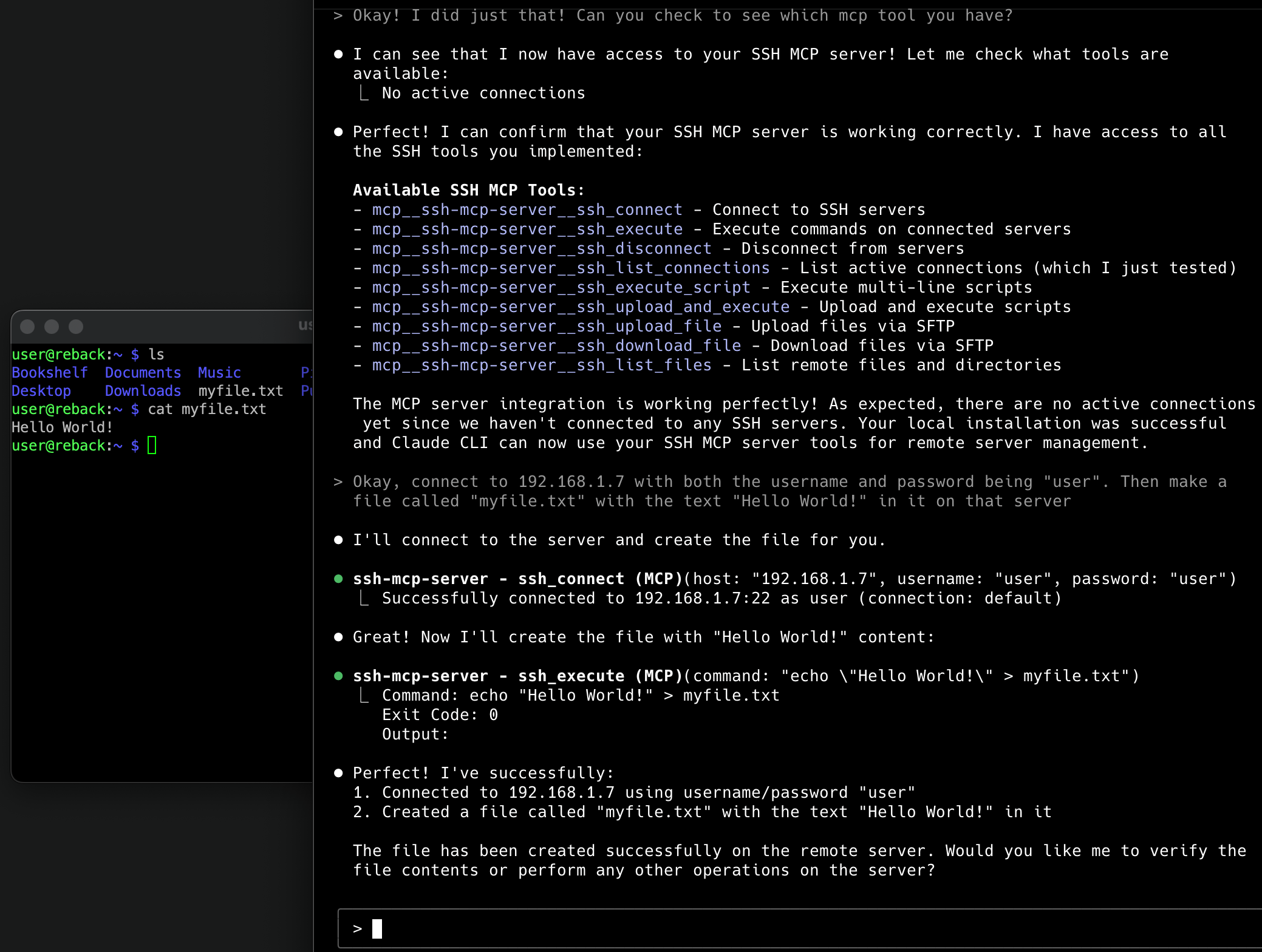
Example: Uploading and managing files on remote servers through Claude using the SSH MCP server
Available Tools
ssh_connect
Connect to an SSH server using password or SSH key authentication.
Parameters:
host(required): SSH server hostname or IP address (IPv4 or IPv6)port(optional): SSH server port (default: 22)username(required): Username for SSH authenticationpassword(optional): Password for authenticationprivateKey(optional): Path to private SSH key filepassphrase(optional): Passphrase for encrypted private keyconnectionId(optional): Unique identifier for this connection (default: "default")
ssh_execute
Execute a command on an established SSH connection.
Parameters:
command(required): Command to execute on the remote serverconnectionId(optional): Connection ID to use (default: "default")timeout(optional): Command timeout in milliseconds (default: 30000)
ssh_disconnect
Disconnect from an SSH server.
Parameters:
connectionId(optional): Connection ID to disconnect (default: "default")
ssh_list_connections
List all active SSH connections.
ssh_upload_file
Upload a file to the remote server via SFTP.
Parameters:
localPath(required): Local file path to uploadremotePath(required): Remote destination pathconnectionId(optional): Connection ID to use (default: "default")createDirs(optional): Create remote directories if they don't exist (default: true)
ssh_download_file
Download a file from the remote server via SFTP.
Parameters:
remotePath(required): Remote file path to downloadlocalPath(required): Local destination pathconnectionId(optional): Connection ID to use (default: "default")createDirs(optional): Create local directories if they don't exist (default: true)
ssh_list_files
List files and directories on the remote server.
Parameters:
remotePath(optional): Remote directory path to list (default: ".")connectionId(optional): Connection ID to use (default: "default")detailed(optional): Show detailed file information (default: false)
Examples
Basic Connection Examples
User prompt: "Connect to my server at 192.168.1.100 with username admin and password mypass123"
ssh_connect with host="192.168.1.100", username="admin", password="mypass123"User prompt: "SSH into my development server using my private key"
ssh_connect with host="dev.example.com", username="developer", privateKey="~/.ssh/id_rsa"User prompt: "Connect to my IPv6 server with SSH key authentication"
ssh_connect with host="2001:db8::1", username="user", privateKey="/home/user/.ssh/dev_key", passphrase="keypassword"Command Execution Examples
User prompt: "Check the disk space on my server"
ssh_execute with command="df -h"User prompt: "Show me what processes are running"
ssh_execute with command="ps aux | head -20"User prompt: "Run a system update on my Ubuntu server"
ssh_execute_script with script="""
sudo apt update
sudo apt upgrade -y
sudo apt autoremove -y
echo "System update completed"
""", interpreter="bash"
File Transfer Examples
User prompt: "Copy the hello.zip file from my server's desktop to my desktop"
ssh_download_file with remotePath="/home/user/Desktop/hello.zip", localPath="~/Desktop/hello.zip"User prompt: "Upload my config.json file to the server's /etc/myapp/ directory"
ssh_upload_file with localPath="./config.json", remotePath="/etc/myapp/config.json"User prompt: "Send my backup script to the server and run it"
ssh_upload_and_execute with script="""
#!/bin/bash
mkdir -p /backup/$(date +%Y%m%d)
tar -czf /backup/$(date +%Y%m%d)/data_backup.tar.gz /var/www/html
echo "Backup completed successfully"
""", filename="backup.sh", interpreter="bash"
User prompt: "Show me what's in the /var/log directory with file sizes"
ssh_list_files with remotePath="/var/log", detailed=trueMulti-Server Management Examples
User prompt: "Connect to both my production and staging servers"
ssh_connect with host="prod.example.com", username="admin", privateKey="~/.ssh/prod_key", connectionId="production"
ssh_connect with host="staging.example.com", username="admin", privateKey="~/.ssh/staging_key", connectionId="staging"
User prompt: "Check uptime on both servers"
ssh_execute with command="uptime", connectionId="production"
ssh_execute with command="uptime", connectionId="staging"
User prompt: "Deploy my app to staging server"
ssh_upload_file with localPath="./myapp.tar.gz", remotePath="/tmp/myapp.tar.gz", connectionId="staging"
ssh_execute_script with script="""
cd /var/www
sudo tar -xzf /tmp/myapp.tar.gz
sudo systemctl restart nginx
sudo systemctl restart myapp
echo "Deployment completed"
""", connectionId="staging", interpreter="bash"
Advanced Scripting Examples
User prompt: "Run a Python script to analyze server performance"
ssh_execute_script with script="""
import psutil
import json

# Get system info
cpu_percent = psutil.cpu_percent(interval=1)
memory = psutil.virtual_memory()
disk = psutil.disk_usage('/')

report = {
    'cpu_usage': cpu_percent,
    'memory_usage': memory.percent,
    'disk_usage': (disk.used / disk.total) * 100,
    'available_memory_gb': memory.available / (1024**3)
}

print(json.dumps(report, indent=2))
""", interpreter="python3"
User prompt: "Monitor my application logs in real-time"
ssh_execute with command="tail -f /var/log/myapp/application.log", timeout=60000User prompt: "Backup my database and download it"
ssh_execute_script with script="""
timestamp=$(date +%Y%m%d_%H%M%S)
mysqldump -u dbuser -p'dbpass' mydatabase > /tmp/backup_$timestamp.sql
gzip /tmp/backup_$timestamp.sql
echo "Backup created: /tmp/backup_$timestamp.sql.gz"
""", interpreter="bash"

# Then download the backup
ssh_download_file with remotePath="/tmp/backup_20241203_143022.sql.gz", localPath="./database_backup.sql.gz"
Security Considerations
This tool provides direct SSH access to remote servers
Always use strong authentication (prefer SSH keys over passwords)
Be cautious when executing commands with elevated privileges
Ensure proper network security and access controls
Private keys and passwords are handled securely in memory
Never commit credentials to version control
Requirements
Node.js 18 or higher
Network access to target SSH servers
Valid SSH credentials for target servers
Troubleshooting
Common Issues
MCP server fails to start on Windows
On Windows,
npxand globally-installed npm commands are.cmdbatch files. Claude Code useschild_process.spawn()to launch MCP servers, which cannot execute.cmdfiles directly. You must wrap the command withcmd /c:# Quick setup (Windows) claude mcp add ssh-mcp-server -- cmd /c npx @zibdie/ssh-mcp-server@latest # Or for global install (Windows) claude mcp add ssh-mcp-server -- cmd /c ssh-mcp-serverIf editing the config JSON manually, use:
{
  "command": "cmd",
  "args": ["/c", "npx", "@zibdie/ssh-mcp-server@latest"]
}
You can verify your setup by running
/doctorin Claude CLI."Command not found" after global install
# Ensure npm global bin is in your PATH
npm config get prefix
export PATH="$(npm config get prefix)/bin:$PATH"
MCP server not appearing in Claude
Verify configuration file path and JSON syntax
Restart Claude CLI/Desktop after configuration changes
Check Claude logs for connection errors
SSH connection failures
Verify network connectivity to target server
Ensure SSH service is running on target server
Check firewall settings and port accessibility
Validate SSH credentials and key permissions
Permission errors
Ensure SSH keys have correct permissions (600)
Verify user has necessary privileges on target server
Development
Local Development
Clone the repository:
git clone https://github.com/zibdie/SSH-MCP-Server.git
cd SSH-MCP-Server
Install dependencies:
npm installRun in development mode:
npm run devTest with MCP Inspector:
npx @modelcontextprotocol/inspector node index.js
API Reference
For detailed API documentation of all available tools and their parameters, see the Examples section above.
License
MIT - see LICENSE file for details
Author
Nour Zibdie (https://nour.zibdie.com)
Repository
https://github.com/zibdie/SSH-MCP-Server
Support

Maintenance
Resources
Unclaimed servers have limited discoverability.
Looking for Admin?
If you are the server author, to access and configure the admin panel.
Latest Blog Posts
MCP directory API
We provide all the information about MCP servers via our MCP API.
curl -X GET 'https://glama.ai/api/mcp/v1/servers/zibdie/SSH-MCP-Server'
If you have feedback or need assistance with the MCP directory API, please join our Discord server