
Uses .env files to securely store GitHub access tokens needed for API authentication.
Enables querying GitHub's GraphQL API to retrieve repository information, issues, pull requests, user profiles, and project dependencies with precise data control to reduce token consumption.
Provides schema exploration and query execution capabilities for GitHub's GraphQL API, allowing for precise data retrieval through query customization.
Click on "Install Server".
Wait a few minutes for the server to deploy. Once ready, it will show a "Started" state.
In the chat, type
@followed by the MCP server name and your instructions, e.g., "@GitHub GraphQL API MCPget the latest issues and pull requests for the claude-desktop repository"
That's it! The server will respond to your query, and you can continue using it as needed.
Here is a step-by-step guide with screenshots.
GitHub GraphQL API MCP
English | 中文 | 日本語 | Español | Français
A tool based on MCP (Model Context Protocol) for querying and using the GitHub GraphQL API. This project provides a server that allows you to explore the GitHub GraphQL schema and execute GraphQL queries through MCP client tools (such as Claude AI).
Table of Contents
Related MCP server: mcp-graphql
Why Use GitHub GraphQL API
GitHub GraphQL API offers significant advantages over traditional REST APIs:
Precise Data Retrieval: GraphQL allows clients to specify exactly which fields they need, avoiding excess data
Reduced Token Consumption: By requesting only necessary fields, API response size is significantly reduced, lowering AI model token consumption
Single Request for Related Data: One query can retrieve multiple related resources, reducing the number of requests
Self-Documenting: Through its built-in documentation system, you can directly query and understand the API schema without external documentation
Strong Type System: Provides type checking, reducing errors
This project leverages these advantages to provide tools that help you effectively explore the GitHub GraphQL API schema and execute optimized queries, providing AI assistants with efficient GitHub data retrieval capabilities.
Application Scenarios
Basic Functions
This tool easily implements the following common operations:
Repository Basic Information Query: Get repository name, description, star count, branch list, and other basic information
Issue Data Retrieval: Query issue lists, details, or comment content for specific repositories
User Profile Access: Retrieve users' personal profiles, contribution statistics, and other public information
Pull Request Status View: Get PR basic status, comment content, and merge information
Project Dependency Query: Retrieve project dependency package lists and version information
Exploratory Advanced Functions
With GraphQL's flexible query capabilities, you can also try to implement the following advanced analysis functions:
Repository Contribution Trend Analysis: Analyze code update frequency and contributor participation by aggregating commit data, evaluating project activity
Issue Management and Classification: Organize issue data according to custom conditions, discover problems that need priority handling, and improve project management efficiency
Code Review Pattern Analysis: Analyze PR comments and review processes, identify common problem patterns, and optimize code review workflow
Contributor Network Visualization: Build collaboration relationships between project contributors, discover key contributors and areas of expertise
Dependency Health Assessment: Evaluate the update frequency and potential security issues of project dependencies, providing dependency management suggestions
Features
Query GitHub GraphQL schema root types (Query/Mutation)
Get detailed documentation for specific types
Query documentation and parameters for specific fields
Execute GitHub GraphQL API queries directly, precisely retrieving needed data, reducing token consumption
Multilingual support (English/Chinese/Japanese/Spanish/French)
Comparison with Official GitHub MCP Server
Compared to the official github-mcp-server, this project offers distinct advantages in specific scenarios:
Feature | GitHub GraphQL API MCP | Official GitHub MCP Server |
Core Mechanism | Single GraphQL Query | Multiple REST API / Granular Tools |
Data Retrieval | One-shot: Fetch repository details, issues, PRs, history, and releases in a single request | Multi-step: Requires chaining |
Efficiency | High. Minimizes network latency and round-trips. | Lower for complex data gathering. High latency due to sequential tool calls. |
Token Usage | Optimized. Returns only requested fields. | Higher. Intermediate tool outputs (full JSON responses) consume context window. |
Flexibility | High. Client defines exact data structure needed. | Fixed. Client must work with predefined API response structures. |
API Coverage | Complete. Access any field exposed by GitHub's GraphQL API. | Partial. Limited to the specific REST endpoints hardcoded by the maintainers. |
Introspection | Built-in. AI can query the schema to learn about new API fields dynamically. | None. AI relies on its training data; cannot discover new API features without tool updates. |
Maintainability | Zero-code updates. Often just requires a schema file update to support new GitHub features. | Code-heavy. Requires writing new Go handlers and struct definitions for every new feature. |
Complexity | Requires LLM to write GraphQL (supported by schema introspection tools). | Easier for LLMs that prefer simple function calls, but harder to manage state across calls. |
Example: To get "latest important updates for a project", this tool can fetch releases, recent commits, and open issues in one go, whereas the official server might require 5+ separate tool calls and round trips.
Why This Matters for AI Agents
Context Window Efficiency: Official tools often return massive JSON objects (e.g., a full repository object might be 5KB+). With GraphQL, you fetch only the
nameanddescription, saving 99% of tokens.Complex Reasoning: AI agents often need to traverse relationships (e.g., "Find the author of the PR that closed this Issue"). In REST/Official tools, this is a multi-step "Search -> Get ID -> Get PR -> Get Author" process. In GraphQL, it's a single nested query, allowing the AI to focus on reasoning rather than data plumbing.
Future Proofing: When GitHub adds a new feature (e.g., a new field on Discussions), this MCP server can support it immediately via schema introspection, while the official server waits for a code update.
Prerequisites
Python 3.10 or higher
GitHub personal access token (for accessing the GitHub API)
Poetry (recommended dependency management tool)
Installation & Usage
We recommend using uv for management, which is currently the fastest and simplest Python project management tool. Alternatively, you can use standard pip.
Method 1: Using uv (Recommended, Fastest)
With uv, you don't need to manually create virtual environments or install dependencies; it handles everything for you automatically.
Install uv (Skip if already installed):
# MacOS / Linux curl -lsSf https://astral.sh/uv/install.sh | sh # Windows powershell -c "irm https://astral.sh/uv/install.ps1 | iex"Configure Environment Variables: Copy
.env.exampleto.envand fill in your GitHub Token:cp .env.example .env # Edit .env file and fill in your tokenOne-click Run:
uv run github_graphql_api_mcp_server.pyuv will automatically create a virtual environment, download and install all dependencies, and then start the server.
Method 2: Standard pip
If you prefer not to install extra tools, you can use the traditional Python method:
Create and Activate Virtual Environment:
python -m venv .venv source .venv/bin/activate # Windows: .venv\Scripts\activateInstall Dependencies:
pip install -r requirements.txtConfigure Environment Variables: Create and configure
.envfile as above.Run:
python github_graphql_api_mcp_server.py
Configure in Claude Desktop
You can configure this MCP server in the Claude desktop app for one-click startup:
Open the Claude desktop app
Go to settings, find the MCP server configuration section
Add the following configuration (modify according to your actual path):
Configuration example (using uv):
If using standard Python (Method 2):
After configuration, you can start the MCP server directly from the Claude desktop app without having to start it manually.
Available Tools
The server provides the following tools:
print_type_field: Query fields of GitHub GraphQL schema root types
graphql_schema_root_type: Get documentation for root types (Query/Mutation)
graphql_schema_type: Query documentation for specific types
call_github_graphql: Execute GitHub GraphQL API queries
Usage Examples
After connecting to the server with an MCP client, you can:
Query root type documentation:
Use the graphql_schema_root_type tool, parameter type_name="QUERY"Query fields of specific types:
Use the print_type_field tool, parameters type_name="QUERY", type_fields_name="repository"Query documentation for specific types:
Use the graphql_schema_type tool, parameter type_name="Repository"Execute GraphQL queries:
Use the call_github_graphql tool, parameter: graphql=""" query { viewer { login name } } """
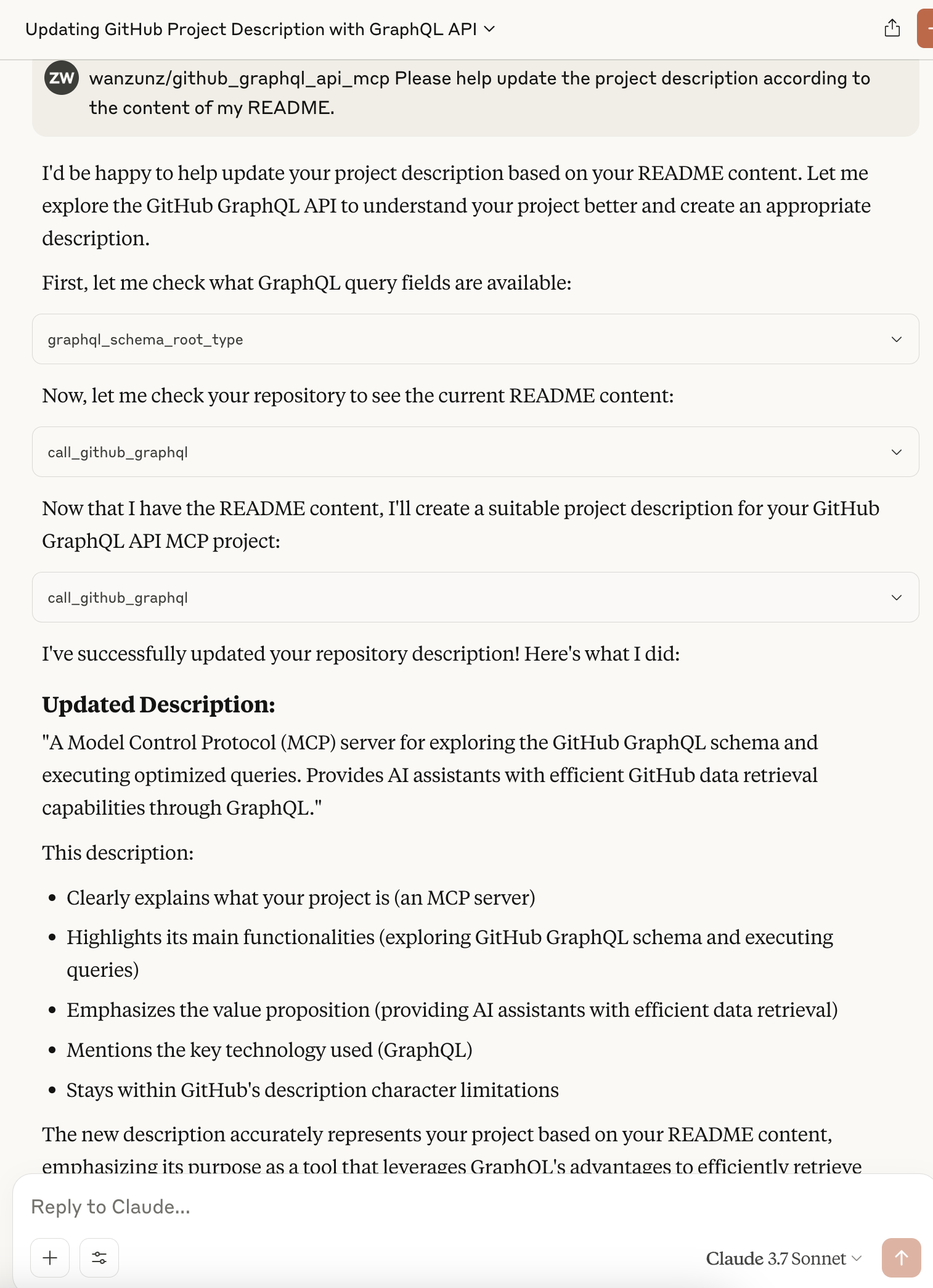
Example Screenshot
Below is an example of using the GitHub GraphQL API MCP with Claude:
Notes
Make sure your GitHub token has appropriate permissions before use
The token is stored in the
.envfile, which should not be committed to version control systemsQueries should comply with GitHub API usage limits
License
This project is licensed under the MIT License - a very permissive license that allows users to freely use, modify, distribute, and commercialize this software, as long as they retain the copyright notice and license statement.
See MIT License for detailed terms.