
MCP Salesforce Lite
Provides secure access to Salesforce data and operations through OAuth 2.0, enabling SOQL query execution, CRUD operations on records (Accounts, Contacts, Opportunities, etc.), and object metadata retrieval with built-in security and rate limiting.
Click on "Install Server".
Wait a few minutes for the server to deploy. Once ready, it will show a "Started" state.
In the chat, type
@followed by the MCP server name and your instructions, e.g., "@MCP Salesforce Liteshow me the last 10 opportunities created this month"
That's it! The server will respond to your query, and you can continue using it as needed.
Here is a step-by-step guide with screenshots.
mcp-salesforce-lite
Simple and lightweight Salesforce MCP server for connecting AI assistants to Salesforce data. Ideal for prototyping and small projects.




📦 Install from PyPI: pip install mcp-salesforce-lite
🔗 PyPI Package: https://pypi.org/project/mcp-salesforce-lite/
📚 GitHub Repository: https://github.com/luvl/mcp-salesforce-lite
Demo
See the MCP Salesforce Lite server in action with Claude Desktop:
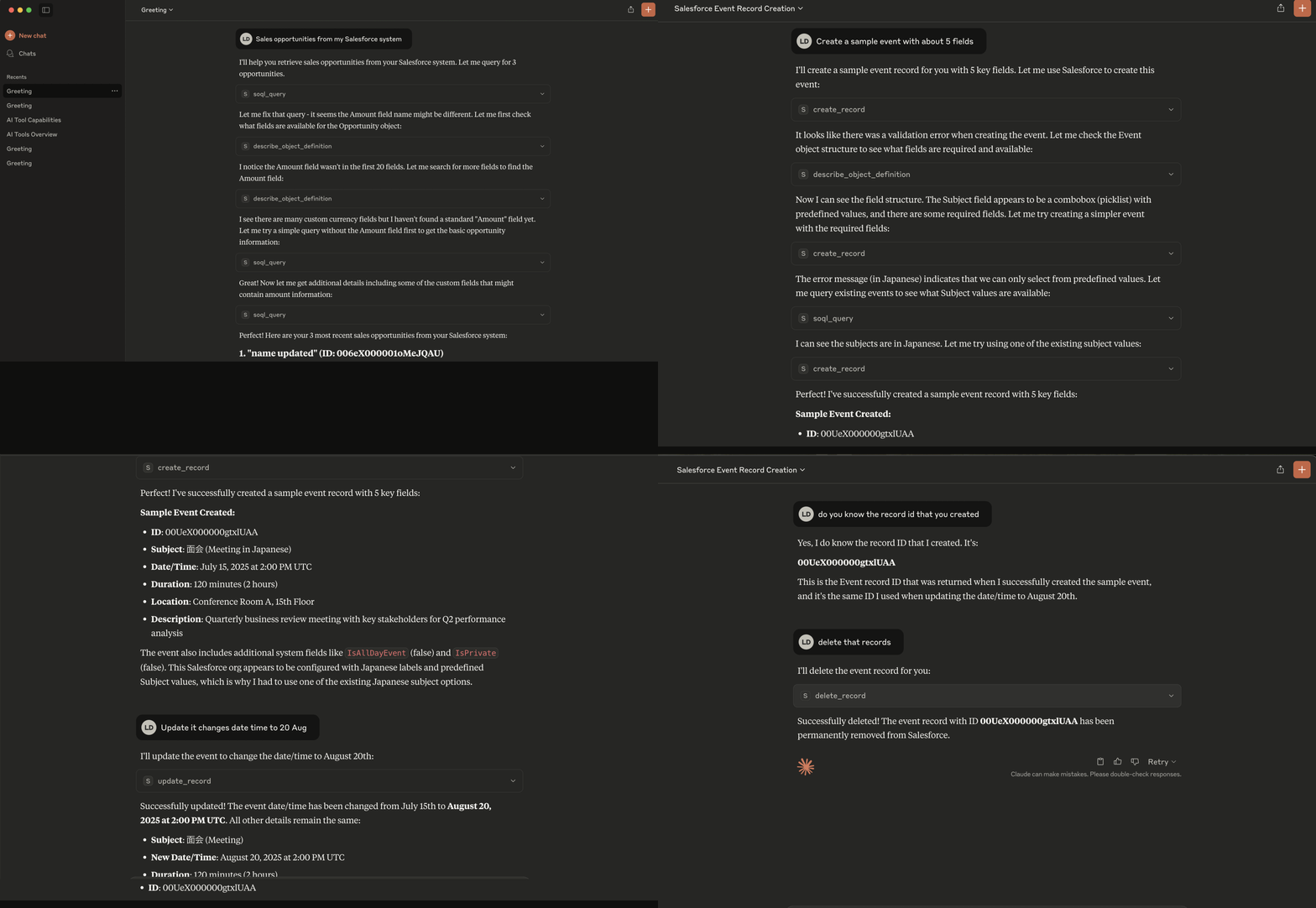
The demo shows Claude Desktop using the MCP server to interact with Salesforce data - querying objects, retrieving records, and performing CRUD operations seamlessly.
Related MCP server: Salesforce Basic MCP Server
Overview
This MCP (Model Context Protocol) server provides AI assistants like Claude with secure access to Salesforce data and operations. It implements the MCP standard to enable seamless integration between AI applications and Salesforce CRM.
Features
🔐 Secure Salesforce authentication via OAuth 2.0
📊 Access to Salesforce objects (Accounts, Contacts, Opportunities, etc.)
🔍 SOQL query execution
📝 CRUD operations on Salesforce records
🛡️ Built-in security and rate limiting
🚀 Easy setup and configuration
Quick Usage
# Install the package
pip install mcp-salesforce-lite

# Use with Claude Desktop (recommended)
uvx --from mcp-salesforce-lite mcp-salesforce-lite

# Or run directly
mcp-salesforce-lite
Works with: Claude Desktop, any MCP-compatible AI assistant
Quick Start with Claude Desktop
Production Usage (Recommended)
The easiest way to use this MCP server is to install it directly from PyPI and configure it with Claude Desktop.
Step 1: Configure Claude Desktop
Add the following configuration to your Claude Desktop settings file:
Configuration File Location:
macOS/Linux:
~/Library/Application Support/Claude/claude_desktop_config.jsonWindows:
%APPDATA%\Claude\claude_desktop_config.json
Configuration:
{
  "mcpServers": {
    "salesforce-lite": {
      "command": "uvx",
      "args": [
        "--from",
        "mcp-salesforce-lite",
        "mcp-salesforce-lite"
      ],
      "env": {
        "SALESFORCE_ACCESS_TOKEN": "your_access_token",
        "SALESFORCE_INSTANCE_URL": "your_instance_url"
      }
    }
  }
}
Step 2: Set Up Salesforce Credentials
Replace the environment variables in the configuration:
SALESFORCE_ACCESS_TOKEN: Your Salesforce access tokenSALESFORCE_INSTANCE_URL: Your Salesforce instance URL (e.g.,https://yourcompany.my.salesforce.com)
Step 3: Restart Claude Desktop
After saving the configuration, restart Claude Desktop. You should see a hammer icon indicating that tools are available.
Step 4: Test the Integration
Try asking Claude:
"List available Salesforce objects"
"Describe the Account object"
"Execute a SOQL query to get recent leads"
Prerequisites
Python 3.10 or higher
Salesforce Developer/Production org
Connected App configured in Salesforce
Development Setup
If you want to modify or contribute to this MCP server, follow these development setup instructions.
Installation
Option 1: Using uv (Recommended for development)
# Install uv if you haven't already
brew install uv  # macOS
# or
curl -LsSf https://astral.sh/uv/install.sh | sh  # Linux/macOS

# Clone and install the server
git clone https://github.com/luvl/mcp-salesforce-lite.git
cd mcp-salesforce-lite
uv sync
Option 2: Using Poetry
git clone https://github.com/luvl/mcp-salesforce-lite.git
cd mcp-salesforce-lite
poetry install
Salesforce Development Setup
Create a .env file in the project root:
SALESFORCE_ACCESS_TOKEN=your_access_token
SALESFORCE_INSTANCE_URL=your_instance_url
Usage
Development Mode
First, make sure you have your Salesforce credentials configured in your .env file.
Method 1: Direct Python Execution
# Run the server directly
python src/mcp_salesforce_lite/server.py
Method 2: Using Poetry
# Run with Poetry
poetry run python src/mcp_salesforce_lite/server.py
Method 3: Using UV (Recommended)
# Run with UV
uv run python src/mcp_salesforce_lite/server.py
Testing with MCP Inspector
If you have the MCP CLI installed, you can test your server:
# Test with MCP Inspector
mcp inspector

# Or run in development mode
mcp dev src/mcp_salesforce_lite/server.py
How to Release the Server as a Pip Package
The server can be packaged and distributed via PyPI using the included pyproject.toml configuration.
Available Tools
The server provides the following tools that AI assistants can use:
Query Tools
soql_query: Execute SOQL queries (schema must be defined to carefully ask for confirmation of UPDATE and DELETE operations)search_records: Search records across multiple objects with limit and paginationget_record: Retrieve a specific record by ID with limit and pagination
CRUD Operations
create_record: Create new records (make sure to describe_object first, and find the reference fields of the objects)update_record: Update existing recordsdelete_record: Delete records
Metadata Tools
describe_object_definition: Get object metadata and field information with paginationlist_avail_objects: List available Salesforce objects with limit and pagination
Development Claude Desktop Integration
If you're developing or running the server from source, you can use these alternative configurations:
💡 Tip: Example configuration files are provided in the examples/ directory:
examples/claude_config_direct.json- Direct Python executionexamples/claude_config_poetry.json- Poetry executionexamples/claude_config_uv.json- UV execution (recommended)
Option 1: Direct Python Execution
{
  "mcpServers": {
    "salesforce-lite": {
      "command": "python",
      "args": ["/ABSOLUTE/PATH/TO/mcp-salesforce-lite/src/mcp_salesforce_lite/server.py"],
      "env": {
        "SALESFORCE_ACCESS_TOKEN": "your_access_token",
        "SALESFORCE_INSTANCE_URL": "your_instance_url"
      }
    }
  }
}
Option 2: Poetry Execution
{
  "mcpServers": {
    "salesforce-lite": {
      "command": "poetry",
      "args": [
        "--directory",
        "/ABSOLUTE/PATH/TO/mcp-salesforce-lite",
        "run",
        "python",
        "src/mcp_salesforce_lite/server.py"
      ],
      "env": {
        "SALESFORCE_ACCESS_TOKEN": "your_access_token",
        "SALESFORCE_INSTANCE_URL": "your_instance_url"
      }
    }
  }
}
Option 3: UV Execution (Recommended for Development)
{
  "mcpServers": {
    "salesforce-lite": {
      "command": "uv",
      "args": [
        "--directory",
        "/ABSOLUTE/PATH/TO/mcp-salesforce-lite",
        "run",
        "python",
        "src/mcp_salesforce_lite/server.py"
      ],
      "env": {
        "SALESFORCE_ACCESS_TOKEN": "your_access_token",
        "SALESFORCE_INSTANCE_URL": "your_instance_url"
      }
    }
  }
}
Project Structure
mcp-salesforce-lite/
├── src/
│   └── mcp_salesforce_lite/
│       ├── __init__.py
│       ├── server.py          # Main MCP server
│       ├── client.py          # Salesforce client wrapper
│       ├── config.py          # Configuration management
│       └── tools/
│           ├── __init__.py
│           ├── query.py       # SOQL query tools
│           ├── crud.py        # Create, Read, Update, Delete tools
│           └── metadata.py    # Object metadata tools
├── examples/
│   ├── basic_usage.py
│   └── claude_config.json
├── assets/
│   └── sf-demo.gif           # Demo GIF showing usage
├── .env.example
├── pyproject.toml
├── poetry.lock
└── uv.lock
Release
Prerequisites
Register for PyPI Production: Go to https://pypi.org/account/register/
Enable 2FA: Set up two-factor authentication in your account settings
Create API Token: Go to https://pypi.org/manage/account/token/ and create a token
Update .pypirc: Replace
pypi-YOUR_PRODUCTION_TOKEN_FROM_PYPI_ORG_HEREwith your actual token
Publishing Process
Test on TestPyPI first:
# Build the package
uv build
# or: poetry build

# Upload to TestPyPI
twine upload --repository testpypi --config-file .pypirc dist/*

# Test install from TestPyPI
pip install --index-url https://test.pypi.org/simple/ --extra-index-url https://pypi.org/simple/ mcp-salesforce-lite
Publish to Production PyPI:
# Upload to production PyPI
twine upload --repository pypi --config-file .pypirc dist/*

# Test install from production PyPI
pip install mcp-salesforce-lite
Version Management
To publish a new version:
Update the version in
pyproject.tomlRebuild:
uv buildorpoetry buildUpload:
twine upload --repository pypi --config-file .pypirc dist/*
Maintenance
Resources
Unclaimed servers have limited discoverability.
Looking for Admin?
If you are the server author, to access and configure the admin panel.
Latest Blog Posts
MCP directory API
We provide all the information about MCP servers via our MCP API.
curl -X GET 'https://glama.ai/api/mcp/v1/servers/luvl/mcp-salesforce-lite'
If you have feedback or need assistance with the MCP directory API, please join our Discord server