
Click on "Install Server".
Wait a few minutes for the server to deploy. Once ready, it will show a "Started" state.
In the chat, type
@followed by the MCP server name and your instructions, e.g., "@Kaspa MCPCheck my KAS balance and show my wallet address"
That's it! The server will respond to your query, and you can continue using it as needed.
Here is a step-by-step guide with screenshots.
Kaspa MCP
MCP server for sending KAS on the Kaspa blockDAG.
About Kaspa
Kaspa is a fast, scalable Layer-1 cryptocurrency built on proof-of-work (PoW) and powered by the GHOSTDAG protocol — a novel consensus mechanism that extends Nakamoto's original design. Unlike traditional blockchains that discard competing blocks, GHOSTDAG allows parallel blocks to coexist and orders them within a Directed Acyclic Graph (blockDAG), enabling high throughput while preserving decentralization and security.
Key Features:
10 blocks per second with sub-second finality (Crescendo upgrade, May 2025)
Proof of Work using kHeavyHash algorithm
Fair launch - no premine, no ICO, no token allocations
Decentralized - runs on standard hardware
Installation
npm install
npm run build
Configuration
Set these environment variables:
Variable | Required | Description |
| Yes* | BIP39 mnemonic phrase (24 words) |
| Yes* | Hex-encoded private key (alternative to mnemonic) |
| No | Network: |
| No | BIP44 account index when using mnemonic. Defaults to |
*Either KASPA_MNEMONIC or KASPA_PRIVATE_KEY must be set.
Usage with Claude Desktop
Add to your Claude Desktop config (~/Library/Application Support/Claude/claude_desktop_config.json):
{
  "mcpServers": {
    "kaspa": {
      "command": "npx",
      "args": ["kaspa-mcp"],
      "env": {
        "KASPA_MNEMONIC": "your twenty four word mnemonic phrase here ...",
        "KASPA_NETWORK": "mainnet"
      }
    }
  }
}
Tools
generate_mnemonic
Generate a new BIP39 mnemonic phrase and derive the corresponding Kaspa wallet address.
Parameters:
wordCount(optional): Number of words - 12 or 24 (default: 12)network(optional): Network for address derivation -mainnet,testnet-10, ortestnet-11(default: mainnet)
Returns:
{
  mnemonic: string,    // The generated BIP39 mnemonic phrase
  address: string,     // Derived Kaspa address (account 0)
  network: string,     // Network used
  warning: string      // Security reminder
}
Important: The mnemonic is generated using cryptographically secure randomness. Save it securely - it cannot be recovered if lost.
get_my_address
Get the Kaspa address derived from your configured private key or mnemonic.
Returns: { address: string }
get_balance
Get balance for a Kaspa address.
Parameters:
address(optional): Address to check. Defaults to your wallet address.
Returns: { address: string, balance: string, utxoCount: number }
get_fee_estimate
Get current fee estimates from the network.
Returns: { priorityFee: string, normalFee: string, lowFee: string }
send_kaspa
Send KAS tokens to a recipient.
Parameters:
to: Recipient Kaspa address (must match wallet network)amount: Amount in KAS as string (e.g., "10.5", max 8 decimal places)priorityFee(optional): Priority fee in sompi
Returns: { txId: string, fee: string }
Validations:
Address format and network prefix validation
Amount must be a valid positive decimal number
Maximum 8 decimal places (1 sompi = 0.00000001 KAS)
Insufficient balance check before broadcast
get_transaction
Get transaction details including inputs and outputs.
Parameters:
txId: Transaction ID
Returns:
{
  txId: string,
  accepted: boolean,
  blockHash?: string,
  blockTime?: number,
  inputs: Array<{ transactionId: string, index: number }>,
  outputs: Array<{ index: number, amount: string, address: string }>
}
Example
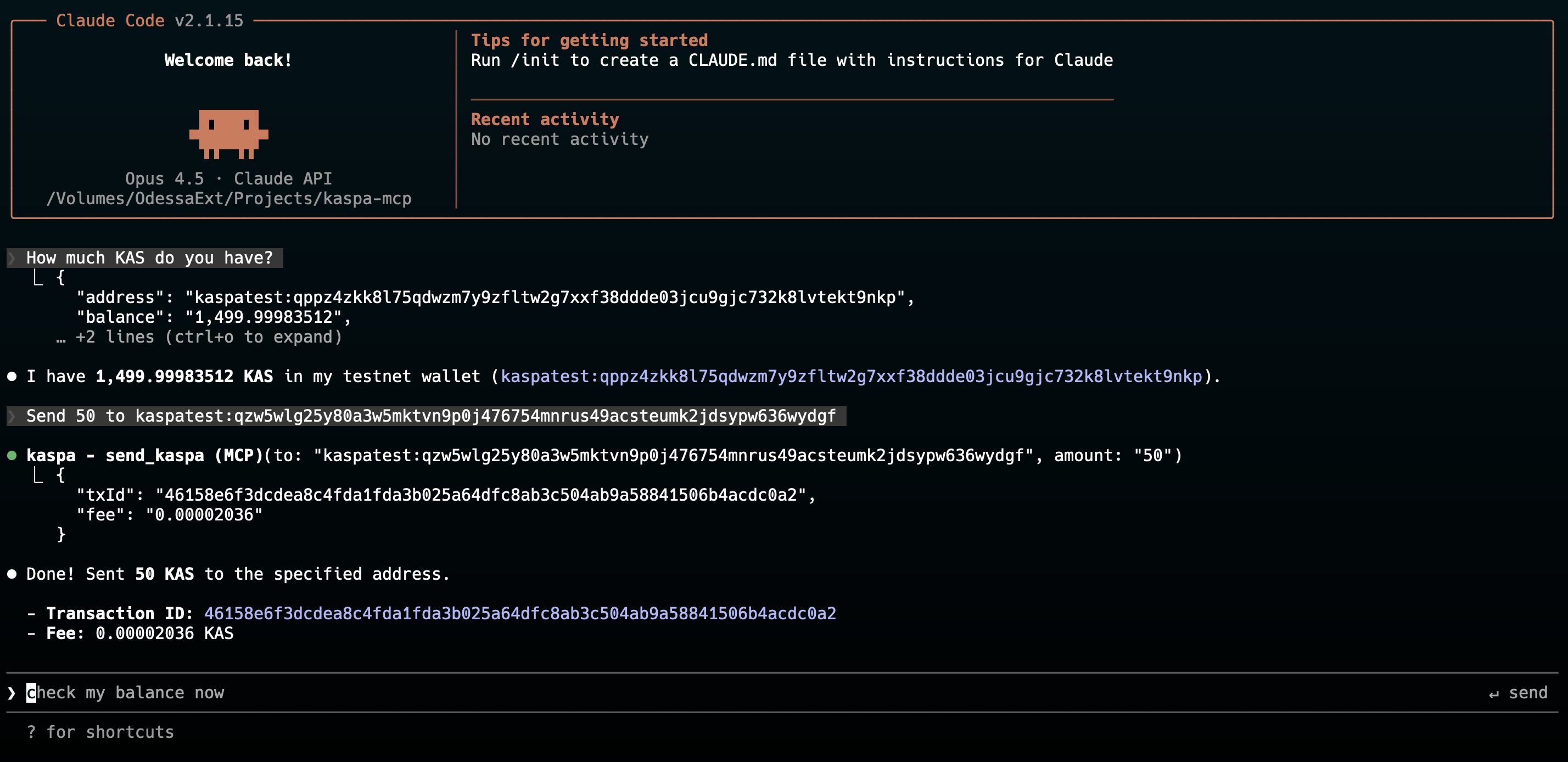
Test Prompts
Try these prompts to verify your MCP is working:
"Generate a new Kaspa wallet for me""What is my Kaspa address?""How much KAS do I have?""What are the current network fees?""Send 5 KAS to kaspa:qz..."The MCP will:
Validate the recipient address matches your network
Check your balance is sufficient
Build the transaction with KIP-9 compliant fees
Sign with your private key
Broadcast to the network via public nodes
Return the transaction ID
Technical Details
Uses kaspa-wasm for cryptographic operations
Connects to public nodes via Resolver for automatic node discovery
Implements BIP44 derivation path
m/44'/111111'/account'for mnemonic walletsTransaction building uses Generator for KIP-9 compliant UTXO management
Security
Private keys and mnemonics are only used locally for signing
Keys are never sent to any external service
Error messages are sanitized to prevent secret leakage
All transactions require explicit user action via MCP tools
Testing
npm testThe test suite includes deterministic test vectors based on the Kaspium wallet for cross-implementation verification. Test vectors are stored in src/kaspa/test-vectors.json and include:
Standard BIP39 test mnemonics (12 and 24 words)
Known private key → address derivations
Invalid input validation
These vectors ensure that key derivation is consistent across Kaspa wallet implementations using the BIP44 path m/44'/111111'/account'/0/0.
Note: Coin type 111111 is Kaspa's de-facto standard, used by rusty-kaspa (official node), Kaspium, and kaspa-wasm. While not formally registered in SLIP-0044, it is the established ecosystem convention.
Networks
Network | Address Prefix | API Endpoint |
|
| api.kaspa.org |
|
| api-tn10.kaspa.org |
|
| api-tn11.kaspa.org |
License
ISC
Resources
Unclaimed servers have limited discoverability.
Looking for Admin?
If you are the server author, to access and configure the admin panel.