
Click on "Install Server".
Wait a few minutes for the server to deploy. Once ready, it will show a "Started" state.
In the chat, type
@followed by the MCP server name and your instructions, e.g., "@Bubble MCPlist the 5 most recent orders from my database"
That's it! The server will respond to your query, and you can continue using it as needed.
Here is a step-by-step guide with screenshots.
Bubble MCP
A Model Context Protocol (MCP) server that enables AI assistants and other MCP-compatible clients to interact with Bubble.io applications. This server provides a standardized interface for reading and manipulating data in any Bubble application.
🚀 Features
Universal Bubble Support: Works with any Bubble.io application
Auto-discovery: Automatically discovers your app's data types and structure
CRUD Operations: Create, Read, Update, and Delete operations for all data types
Workflow Execution: Execute API workflows defined in your Bubble app
Privacy Settings Aware: Respects Bubble's privacy rules and constraints
Read-only/Read-write Modes: Configurable access levels for safety
Type-safe: Provides detailed type information for all operations
🔌 MCP Compatibility
This server implements the Model Context Protocol (MCP), an open protocol that enables secure, standardized communication between AI assistants and external systems. While MCP was developed by Anthropic, it's designed to be vendor-agnostic.
Currently Compatible Clients:
Claude Desktop - Full support
Other MCP clients - Should work with any client that implements the MCP specification
Future Compatibility:
As MCP is an open protocol, we expect more AI assistants and tools to add support over time. This server will work with any client that properly implements the MCP standard.
📋 Prerequisites
Node.js (v16 or higher)
npm or yarn
A Bubble.io application with API access enabled
An MCP-compatible client (e.g., Claude Desktop)
🛠️ Installation
Local Development Setup
For Mac/Linux:
Clone the repository:
git clone https://github.com/nocoderoi/bubble_mcp.git cd bubble_mcpInstall dependencies:
npm installCopy the example environment file:
cp .env.example .envEdit
.envwith your Bubble app details:nano .env # or use your preferred text editorBuild the project:
npm run build
For Windows:
Clone the repository:
git clone https://github.com/nocoderoi/bubble_mcp.git cd bubble_mcpInstall dependencies:
npm installCopy the example environment file:
copy .env.example .envEdit
.envwith your Bubble app details:notepad .envOr use any text editor to add:
BUBBLE_BASE_URL=https://your-app.bubbleapps.io BUBBLE_API_TOKEN=your-bubble-api-token-here MCP_MODE=read-write # Options: read-only, read-writeBuild the project:
npm run build
🔧 Configuration
Getting Your Bubble API Token
Go to your Bubble app editor
Navigate to Settings → API
Enable "This app exposes a Data API"
Generate an API token
Copy the token to your
.envfile
Setting Up Your MCP Client
The exact configuration steps depend on your MCP client. Below are examples for Claude Desktop:
Claude Desktop Configuration
For Mac/Linux:
Copy the example configuration:
cp claude-desktop-config.example.json claude-desktop-config.jsonEdit
claude-desktop-config.jsonwith your absolute path:pwd # Get your current directory path nano claude-desktop-config.jsonUpdate the configuration (example for Mac/Linux):
{ "mcpServers": { "bubble": { "command": "node", "args": [ "/Users/yourname/projects/bubble_mcp/dist/mcp-server.js" ], "env": { "BUBBLE_BASE_URL": "https://your-app.bubbleapps.io", "BUBBLE_API_TOKEN": "your-bubble-api-token-here", "MCP_MODE": "read-write" } } } }Copy to Claude Desktop config location:
cp claude-desktop-config.json ~/Library/Application\ Support/Claude/claude_desktop_config.json
For Windows:
Copy the example configuration:
copy claude-desktop-config.example.json claude-desktop-config.jsonGet your current directory path:
cdEdit
claude-desktop-config.jsonwith the full Windows path:{ "mcpServers": { "bubble": { "command": "node", "args": [ "C:\\Users\\yourname\\projects\\bubble_mcp\\dist\\mcp-server.js" ], "env": { "BUBBLE_BASE_URL": "https://your-app.bubbleapps.io", "BUBBLE_API_TOKEN": "your-bubble-api-token-here", "MCP_MODE": "read-write" } } } }Note: Use double backslashes (
\\) in the path!Copy to Claude Desktop config location:
copy claude-desktop-config.json %APPDATA%\Claude\claude_desktop_config.jsonRestart Claude Desktop
Other MCP Clients
For other MCP-compatible clients, refer to their documentation for configuration instructions. The key configuration elements you'll need are:
Command:
nodeArguments: Path to
dist/mcp-server.jsEnvironment variables:
BUBBLE_BASE_URL,BUBBLE_API_TOKEN, andMCP_MODE
🎯 Usage
Once configured, you can interact with your Bubble app through your MCP client:
Available Commands
List Data Types: "Show me all data types in my Bubble app"
Fetch Records: "Get all users from my database"
Create Records: "Create a new user with name 'John Doe'"
Update Records: "Update user with ID xxx to set email to 'new@email.com'"
Delete Records: "Delete the product with ID xxx"
Execute Workflows: "Run the 'send_welcome_email' workflow for user xxx"
🎥 Video Example
Watch a video demonstration of how to use the Bubble MCP integration with Claude Desktop:
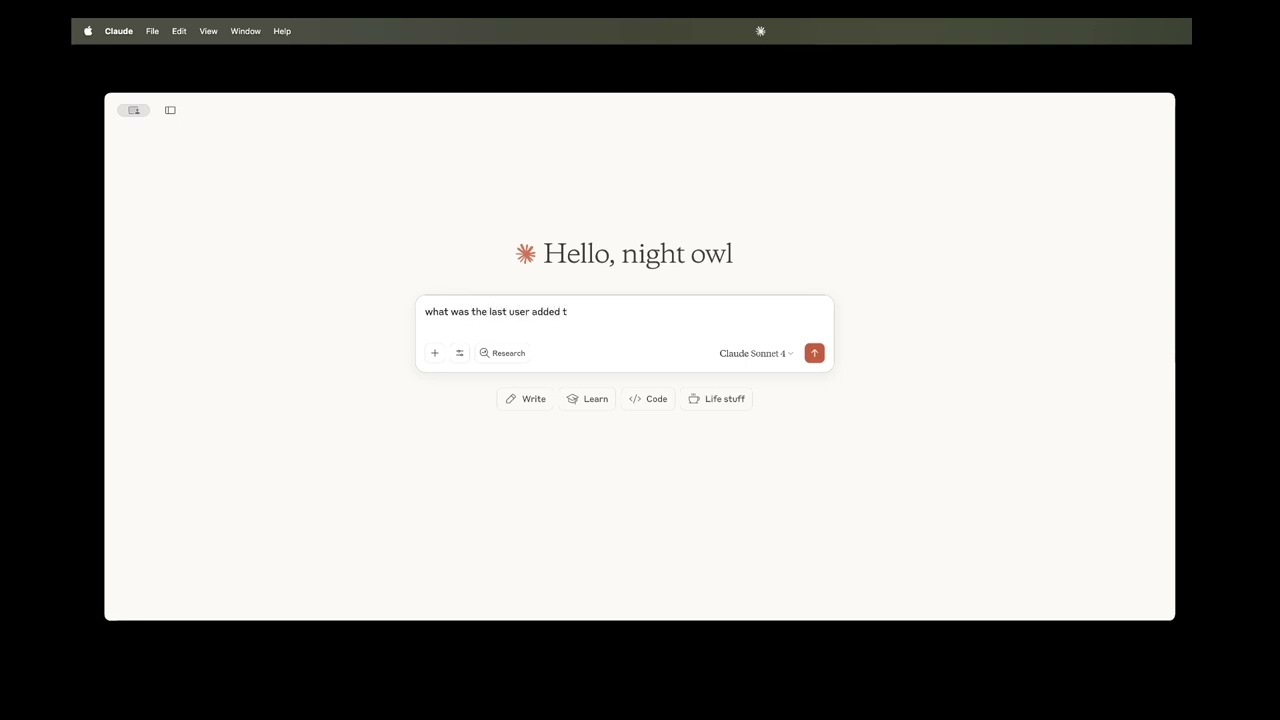
Example Interactions
🔒 Security Considerations
Understanding MCP Modes
The Bubble MCP server supports two operational modes that control what actions the MCP client can perform:
🔍 Read-Only Mode (Recommended)
What it does: Only allows viewing and fetching data from your Bubble app
Available operations:
List data types
Fetch records
View app structure
Blocked operations: Create, Update, Delete, and Workflow execution
When to use:
When exploring your data
For reporting and analysis
When learning about your app structure
As your default setting for safety
✏️ Read-Write Mode
What it does: Allows full CRUD operations and workflow execution
Available operations: All read operations PLUS:
Create new records
Update existing records
Delete records
Execute API workflows
When to use:
Only when you specifically need to modify data
For automation tasks
During active development
🛡️ Best Practices for Safety
Start with Read-Only: Always begin with
MCP_MODE=read-onlyin your configuration"env": { "MCP_MODE": "read-only" // Safe default }Temporary Write Access: Only switch to
read-writewhen you need to perform modifications"env": { "MCP_MODE": "read-write" // Use with caution }Separate Configurations: Consider having two MCP server configurations:
bubble-readonly: Your default for everyday usebubble-write: Only for when modifications are needed
API Token Permissions:
Create separate API tokens with different permission levels
Use restricted tokens for read-only access
Keep write-enabled tokens extra secure
⚠️ Mode Differences at a Glance
Feature | Read-Only | Read-Write |
List data types | ✅ | ✅ |
Fetch records | ✅ | ✅ |
Create records | ❌ | ✅ |
Update records | ❌ | ✅ |
Delete records | ❌ | ✅ |
Execute workflows | ❌ | ✅ |
Risk of data loss | None | Possible |
Recommended for beginners | ✅ | ❌ |
🔐 Additional Security Tips
API Tokens: Never commit your API tokens to version control
Environment Variables: Always use environment variables or secure configuration for sensitive data
Privacy Rules: The server respects Bubble's privacy rules - ensure your API token has appropriate permissions
Audit Trail: In read-write mode, keep track of changes made through the MCP server
Backup: Always backup your Bubble data before using read-write mode for bulk operations
🤝 Contributing
We welcome contributions from the community! Here's how you can help:
Fork the repository
Create a feature branch (
git checkout -b feature/amazing-feature)Commit your changes (
git commit -m 'Add amazing feature')Push to the branch (
git push origin feature/amazing-feature)Open a Pull Request
Development Guidelines
Write clear, commented code
Add tests for new features
Update documentation as needed
Follow the existing code style
Test with different Bubble app configurations
🐛 Troubleshooting
Common Issues
"Cannot find data type": Ensure your Bubble app has the Data API enabled
"Authentication failed": Check your API token is correct and has appropriate permissions
"Privacy rule violation": Your API token may not have access to certain data types
MCP client not connecting: Ensure the path in config is absolute and the server is built
Starting the Server
To start the MCP server, use one of the following commands depending on your environment:
For Direct Node Execution:
For Development Mode (with hot-reloading):
Debug Mode
Set DEBUG=true in your environment to enable verbose logging:
Mac/Linux:
Windows (Command Prompt):
Windows (PowerShell):
📝 License
This project is licensed under the MIT License - see the LICENSE file for details.
Made with ❤️ by the community