---
createdAt: 2025-01-02
updatedAt: 2025-06-29
title: react-i18next vs react-intl vs Intlayer
description: Integrate react-i18next with next-intl and Intlayer for the internationalization (i18n) of a React app
keywords:
- next-intl
- react-i18next
- Intlayer
- Internationalization
- Blog
- Next.js
- JavaScript
- React
slugs:
- blog
- react-i18next-vs-react-intl-vs-intlayer
---
# react-Intl VS react-i18next VS intlayer | React Internationalization (i18n)
This guide compares three established i18n options for **React**: **react-intl** (FormatJS), **react-i18next** (i18next), and **Intlayer**.
We focus on **plain React** applications (e.g., Vite, CRA, SPA). If you’re using Next.js, see our dedicated Next.js comparison.
We evaluate:
- Architecture & content organization
- TypeScript & safety
- Missing translation handling
- Rich content & formatting capabilities
- Performance & loading behavior
- Developer experience (DX), tooling & maintenance
- SEO/routing (framework-dependent)
<TOC/>
> **tl;dr**: All three can localize a React app. If you want **component-scoped content**, **strict TypeScript types**, **build-time missing-key checks**, **tree-shaken dictionaries**, and built-in editorial tooling (Visual Editor/CMS + optional AI translation), **Intlayer** is the most complete choice for modular React codebases.
---
## High-level positioning
- **react-intl** - ICU-first, standards-aligned formatting (dates/numbers/plurals) with a mature API. Catalogs are typically centralized; key safety and build-time validation are largely on you.
- **react-i18next** - Extremely popular and flexible; namespaces, detectors, and many plugins (ICU, backends). Powerful, but configuration can sprawl as projects scale.
- **Intlayer** - Component-centric content model for React, **strict TS typing**, **build-time checks**, **tree-shaking**, plus **Visual Editor/CMS** and **AI-assisted translations**. Works with React Router, Vite, CRA, etc.
---
## Feature matrix (React focus)
| Feature | `react-intlayer` (Intlayer) | `react-i18next` (i18next) | `react-intl` (FormatJS) |
| --------------------------------------------- | ----------------------------------------------------------------------------------------------------------------------------------- | -------------------------------------------------------------------------------------------------------- | ------------------------------------------------------------------------------------------- |
| **Translations Near Components** | ✅ Yes, content collocated with each component | ❌ No | ❌ No |
| **TypeScript Integration** | ✅ Advanced, auto-generated strict types | ⚠️ Basic; extra config for safety | ✅ Good, but less strict |
| **Missing Translation Detection** | ✅ TypeScript error hightlight and build-time error/warning | ⚠️ Mostly fallback strings at runtime | ⚠️ Fallback strings |
| **Rich Content (JSX/Markdown/components)** | ✅ Direct support | ⚠️ Limited / interpolation only | ⚠️ ICU syntax, not real JSX |
| **AI-powered Translation** | ✅ Yes, supports multiple AI providers. Usable using your own API keys. Considers the context of your application and content scope | ❌ No | ❌ No |
| **Visual Editor** | ✅ Yes, local Visual Editor + optional CMS; can externalize codebase content; embeddable | ❌ No / available via external localization platforms | ❌ No / available via external localization platforms |
| **Localized Routing** | ✅ Yes, supports localized paths out of the box (works with Next.js & Vite) | ⚠️ No built-in, requires plugins (e.g. `next-i18next`) or custom router config | ❌ No, only message formatting, routing must be manual |
| **Dynamic Route Generation** | ✅ Yes | ⚠️ Plugin/ecosystem or manual setup | ❌ Not provided |
| **Pluralization** | ✅ Enumeration-based patterns | ✅ Configurable (plugins like i18next-icu) | ✅ (ICU) |
| **Formatting (dates, numbers, currencies)** | ✅ Optimized formatters (Intl under the hood) | ⚠️ Via plugins or custom Intl usage | ✅ ICU formatters |
| **Content Format** | ✅ .tsx, .ts, .js, .json, .md, .txt, (.yaml WIP) | ⚠️ .json | ✅ .json, .js |
| **ICU support** | ⚠️ WIP | ⚠️ Via plugin (i18next-icu) | ✅ Yes |
| **SEO Helpers (hreflang, sitemap)** | ✅ Built-in tools: helpers for sitemap, robots.txt, metadata | ⚠️ Community plugins/manual | ❌ Not core |
| **Ecosystem / Community** | ⚠️ Smaller but growing fast and reactive | ✅ Largest and mature | ✅ Large |
| **Server-side Rendering & Server Components** | ✅ Yes, streamlined for SSR / React Server Components | ⚠️ Supported at page level but need to pass t-functions on component tree for children server components | ❌ Not supported, need to pass t-functions on component tree for children server components |
| **Tree-shaking (load only used content)** | ✅ Yes, per-component at build time via Babel/SWC plugins | ⚠️ Usually loads all (can be improved with namespaces/code-splitting) | ⚠️ Usually loads all |
| **Lazy loading** | ✅ Yes, per-locale / per-dictionary | ✅ Yes (e.g., backends/namespaces on demand) | ✅ Yes (split locale bundles) |
| **Purge unused content** | ✅ Yes, per-dictionary at build time | ❌ No, only via manual namespace segmentation | ❌ No, all declared messages are bundled |
| **Management of Large Projects** | ✅ Encourages modular, suited for design-system | ⚠️ Needs good file discipline | ⚠️ Central catalogs can get large |
---
## Deep-dive comparison
### 1) Architecture & scalability
- **react-intl / react-i18next**: Most setups maintain **centralized locale folders** per language, sometimes split by **namespaces** (i18next). Works well early on but becomes a shared surface area as apps grow.
- **Intlayer**: Promotes **per-component (or per-feature) dictionaries** **co-located** with the UI they serve. This keeps ownership clear, eases duplication/migration of components, and reduces cross-team key churn. Unused content is easier to identify and remove.
**Why it matters:** Modular content mirrors modular UI. Large React codebases stay cleaner when translations live with the components they belong to.
---
### 2) TypeScript & safety
- **react-intl**: Solid typings, but **no automatic key typing**; you enforce safety patterns yourself.
- **react-i18next**: Strong typings for hooks; **strict key typing** typically requires extra configuration or generators.
- **Intlayer**: **Auto-generates strict types** from your content. IDE autocomplete and **compile-time errors** catch typos and missing keys before runtime.
**Why it matters:** Shifting failures **left** (to build/CI) reduces production issues and speeds developer feedback loops.
---
### 3) Missing translation handling
- **react-intl / react-i18next**: Default to **runtime fallbacks** (key echo or default locale). You can add linting/plugins, but it’s not guaranteed at build.
- **Intlayer**: **Build-time detection** with warnings or errors when required locales/keys are missing.
**Why it matters:** CI failing on missing strings prevents “mystery English” leaking into non-English UIs.
---
### 4) Rich content & formatting
- **react-intl**: Excellent **ICU** support for plurals, selects, dates/numbers, and message composition. JSX can be used, but the mental model stays message-centric.
- **react-i18next**: Flexible interpolation and **`<Trans>`** for embedding elements/components; ICU available via plugin.
- **Intlayer**: Content files can include **rich nodes** (JSX/Markdown/components) and **metadata**. Formatting uses Intl under the hood; plural patterns are ergonomic.
**Why it matters:** Complex UI texts (links, bold pieces, inline components) are easier when the library embraces React nodes cleanly.
---
### 5) Performance & loading behavior
- **react-intl / react-i18next**: You typically manage **catalog splitting** and **lazy loading** manually (namespaces/dynamic imports). Effective but requires discipline.
- **Intlayer**: **Tree-shakes** unused dictionaries and supports **per-dictionary/per-locale lazy loading** out-of-the-box.
**Why it matters:** Smaller bundles and fewer unused strings improve startup and navigation performance.
---
### 6) DX, tooling & maintenance
- **react-intl / react-i18next**: Broad community ecosystem; for editorial workflows you usually adopt external localization platforms.
- **Intlayer**: Ships a **free Visual Editor** and **optional CMS** (keep content in Git or externalize it). Also offers a **VSCode extension** for content authoring and **AI-assisted translation** using your own provider keys.
**Why it matters:** Built-in tooling shortens the loop between developers and content authors - less glue code, fewer vendor dependencies.
---
## When to choose which?
- **Choose react-intl** if you want **ICU-first** message formatting with a straightforward, standards-aligned API and your team is comfortable maintaining catalogs and safety checks manually.
- **Choose react-i18next** if you need the **breadth of i18next’s ecosystem** (detectors, backends, ICU plugin, integrations) and accept more configuration to gain flexibility.
- **Choose Intlayer** if you value **component-scoped content**, **strict TypeScript**, **build-time guarantees**, **tree-shaking**, and **batteries-included** editorial tooling - especially for **large, modular** React apps, design-systems, etc.
---
## Interoperability with `react-intl` and `react-i18next`
`intlayer` can also help to manage your `react-intl` and `react-i18next` namespaces.
Using `intlayer`, you can declare your content in the format of your favorite i18n library, and intlayer will generate your namespaces in the location of your choice (example: `/messages/{{locale}}/{{namespace}}.json`).
Refer to [`dictionaryOutput` and `i18nextResourcesDir` options](https://intlayer.org/doc/concept/configuration#content-configuration) for more details.
---
## GitHub STARs
GitHub stars are a strong indicator of a project's popularity, community trust, and long-term relevance. While not a direct measure of technical quality, they reflect how many developers find the project useful, follow its progress, and are likely to adopt it. For estimating the value of a project, stars help compare traction across alternatives and provide insights into ecosystem growth.
## [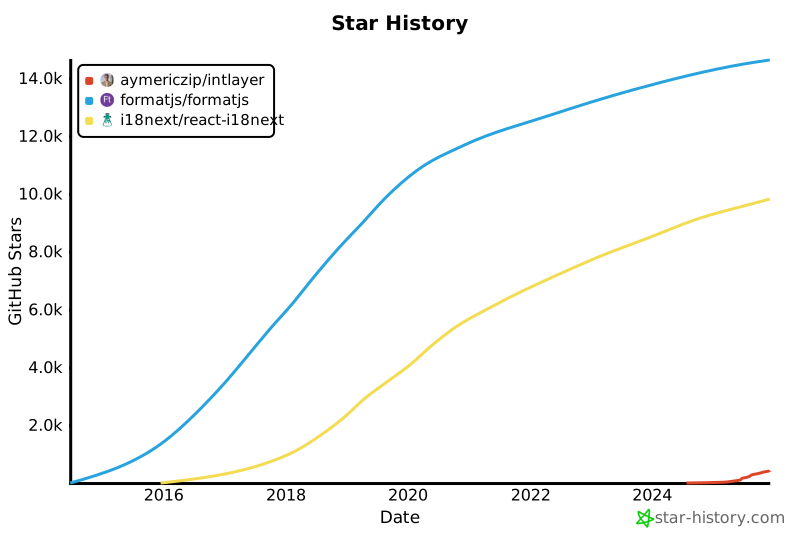](https://www.star-history.com/#formatjs/formatjs&i18next/react-i18next&aymericzip/intlayer)
## Conclusion
All three libraries localize React effectively. The differentiator is how much **infrastructure** you must build to reach a **safe, scalable** setup:
- With **Intlayer**, **modular content**, **strict TS typing**, **build-time safety**, **tree-shaken bundles**, and **editorial tooling** are defaults - not chores.
- If your team prizes **maintainability and speed** in multi-locale, component-driven React apps, Intlayer offers the **most complete** developer and content workflow today.
Refer to ['Why Intlayer?' doc](https://intlayer.org/doc/why) for more details.
