
Supports containerized deployments for both HTTP and stdio transports, enabling portable and isolated running environments.
Uses dotenv for environment variable management, allowing configuration of database credentials and server settings through .env files.
Built on Node.js, supporting both HTTP and stdio transports for interacting with PostgreSQL databases in different environments.
Supports containerized deployments using Podman as an alternative to Docker for running the MCP server.
Provides access to PostgreSQL databases, allowing users to list tables, retrieve schema information, and execute read-only SQL queries against PostgreSQL databases.
Click on "Install Server".
Wait a few minutes for the server to deploy. Once ready, it will show a "Started" state.
In the chat, type
@followed by the MCP server name and your instructions, e.g., "@PostgreSQL MCP Servershow me the top 10 customers by total purchases"
That's it! The server will respond to your query, and you can continue using it as needed.
Here is a step-by-step guide with screenshots.
MCP PostgreSQL Server (Stateful and Dual Transport)
A Model Context Protocol (MCP) server that provides both HTTP and Stdio transports for interacting with PostgreSQL databases. This server exposes database resources and tools through both transport methods, allowing for flexible integration in different environments.
Features
Dual Transport Support: Both HTTP (StreamableHTTPServerTransport) and Stdio (StdioServerTransport)
Database Resources: List tables and retrieve schema information
Query Tool: Execute read-only SQL queries
Stateful Sessions: HTTP transport supports session management
Docker Support: Containerized deployments for both transports
Production Ready: Graceful shutdown, error handling, and logging
Quick Start
Environment Setup
The database credentials must be passed as:
Either environment variables
# PostgreSQL Database Connection String
export POSTGRES_URL=your_connection_string

# PostgreSQL Database Configuration if POSTGRES_URL is not provided
export POSTGRES_USERNAME=your_username
export POSTGRES_PASSWORD=your_password
export POSTGRES_HOST=localhost
export POSTGRES_PORT=5432 # this is the default
export POSTGRES_DATABASE=your_database

# HTTP Server Configuration
# Following are the default values
export PORT=3000
export HOST=0.0.0.0

# CORS Configuration (comma-separated list of allowed origins)
# Following are the default values
export CORS_ORIGIN=http://localhost:8080,http://localhost:3000

# Environment
# Following are the default values
export NODE_ENV=development
Or in the working directory (directory where
npxcommand will be run): create a.envfile (the package usesdotenvpackage)
# .env.example
# PostgreSQL Database Configuration
POSTGRES_USERNAME=your_username
POSTGRES_PASSWORD=your_password
POSTGRES_HOST=localhost
POSTGRES_DATABASE=your_database

# HTTP Server Configuration
PORT=3000
HOST=0.0.0.0

# CORS Configuration (comma-separated list of allowed origins)
CORS_ORIGIN=http://localhost:8080,http://localhost:3000

# Environment
NODE_ENV=development
Run using npx
Download node.js and npm from here
Run the package. By default, it will run streamable http on port 3000:
npx @ahmedmustahid/postgres-mcp-server
# or npx @ahmedmustahid/postgres-mcp-server --port 3000 --verbose
For stdio transport:
npx @ahmedmustahid/postgres-mcp-server stdio
# npx @ahmedmustahid/postgres-mcp-server stdio --verbose
Environment Setup
Copy environment template
cp .env.example .envEdit your database credentials
nano .envPodman(or Docker) Usage
Install podman from here
Install
uvfrom hereInstall podman compose package:
uv add podman-compose(oruv syncto sync packages inpyproject.toml)
#get the environment variables
set -a
source .env
set +a
podman machine start
make podman-up
Test using Claude Desktop
First, install node.js and npm, build the project following the above instructions.
Edit your claude_desktop_config.json
{
  "mcpServers": {
    "postgres-mcp-server": {
      "command": "npx",
      "args": [
        "@ahmedmustahid/postgres-mcp-server",
        "stdio"
      ],
      "env": {
        "POSTGRES_USERNAME": "your-username",
        "POSTGRES_PASSWORD": "your-password",
        "POSTGRES_HOST": "hostname",
        "POSTGRES_DATABASE": "database-name"
      }
    }
  }
}
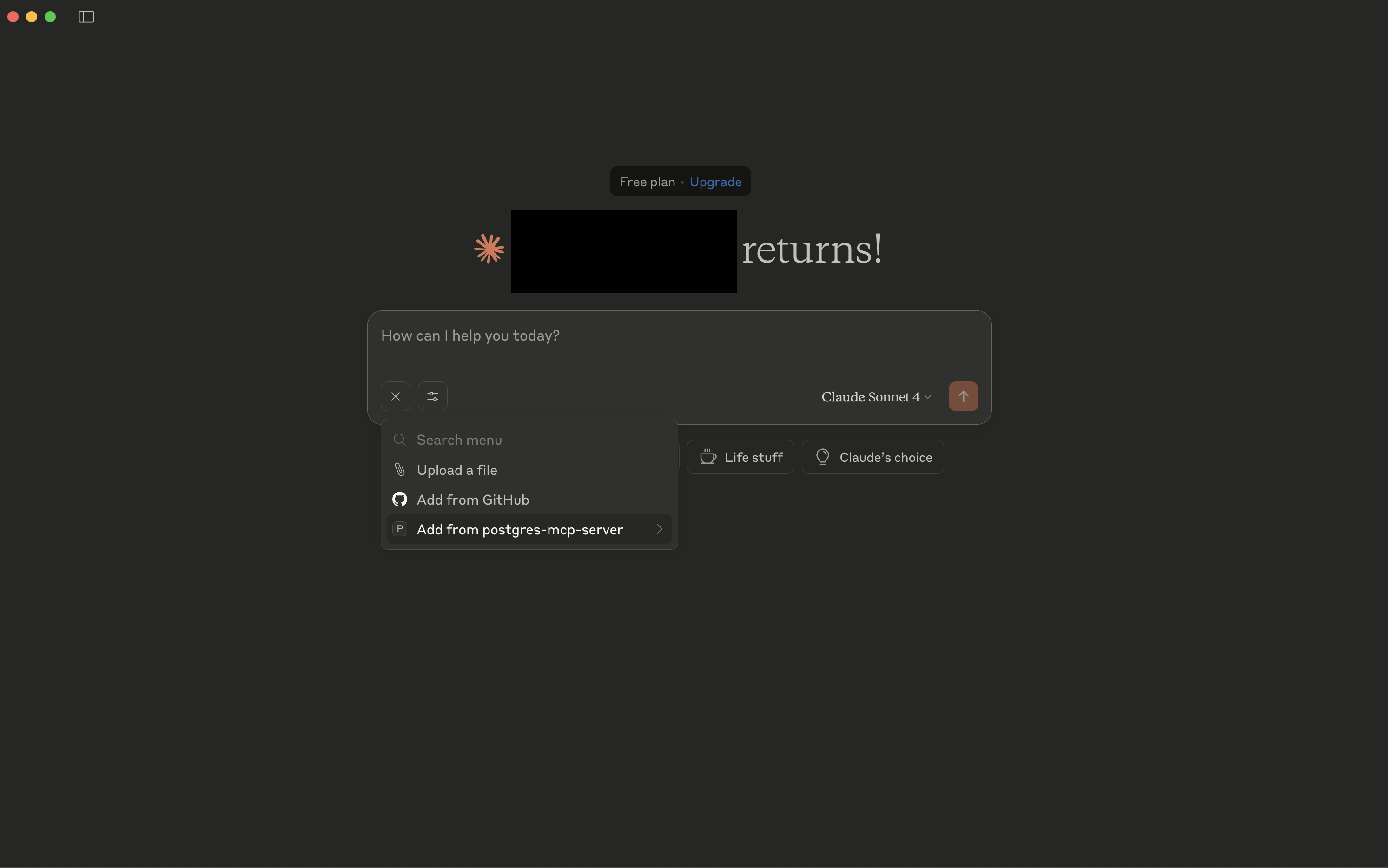
Check if MCP Server has been enabled
Verify from Claude Desktop Window
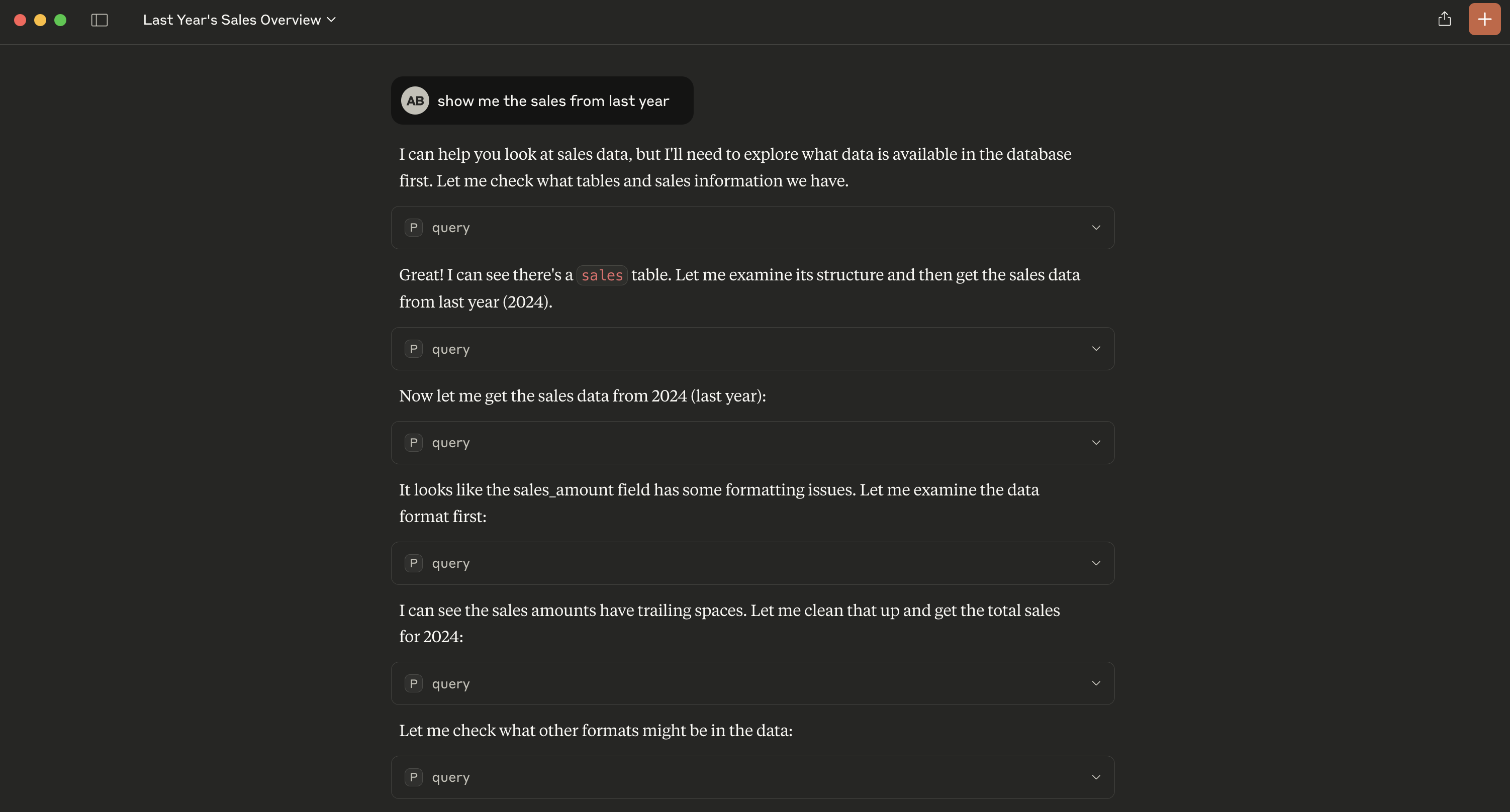
Using MCP Server from Claude Desktop
Prompt: Show sales table from last year.
Test using MCP Inspector
First, install node.js and npm, build the project following the above instructions. Install MCP Inspector: instructions: here
Check Stdio MCP Server
npx @modelcontextprotocol/inspector npx @ahmedmustahid/postgres-mcp-server stdio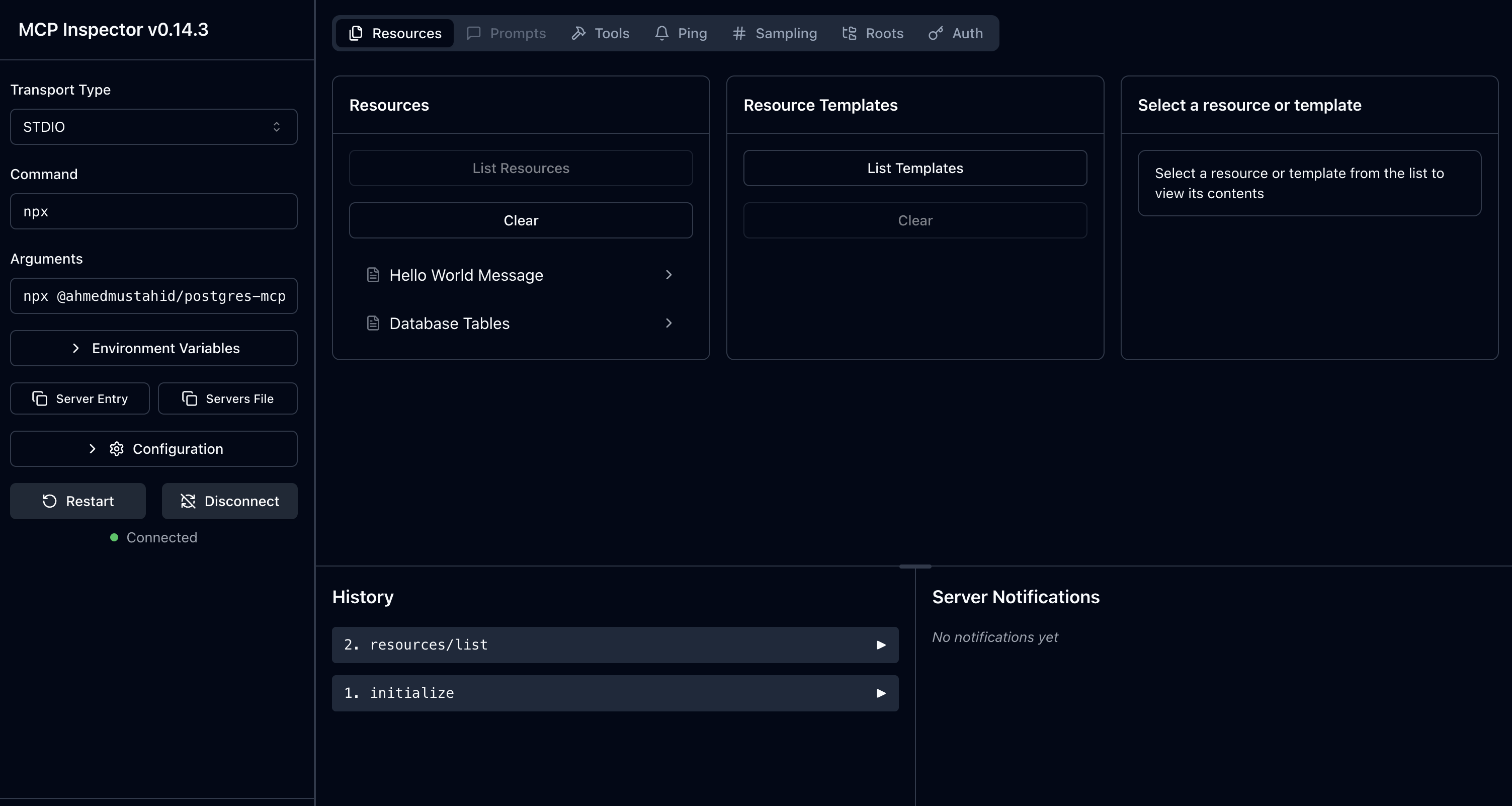
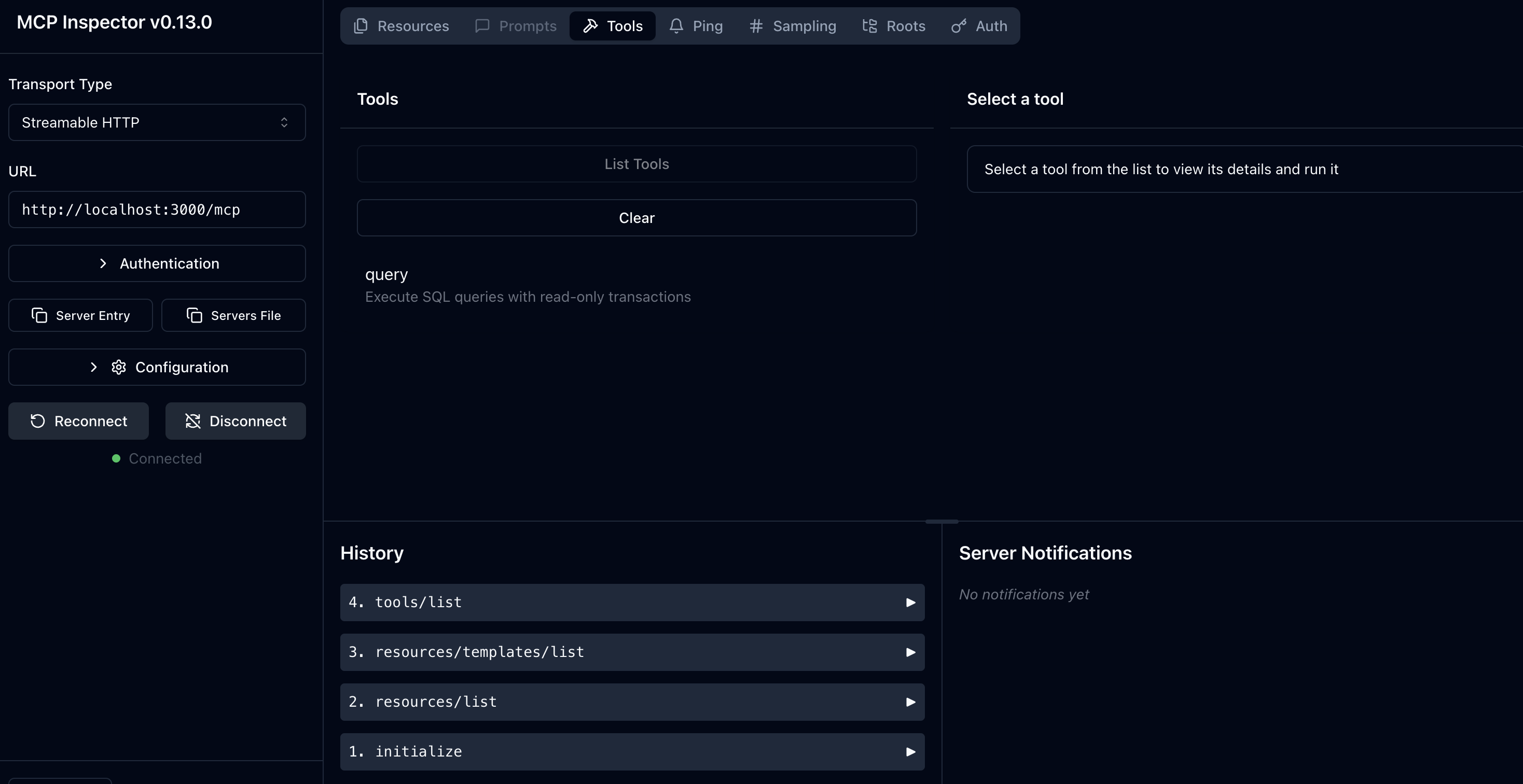
Check Streamable HTTP MCP Server
First, run the server (shell where environment has been configured):
npx @ahmedmustahid/postgres-mcp-serverRun the mcp inspector from another terminal
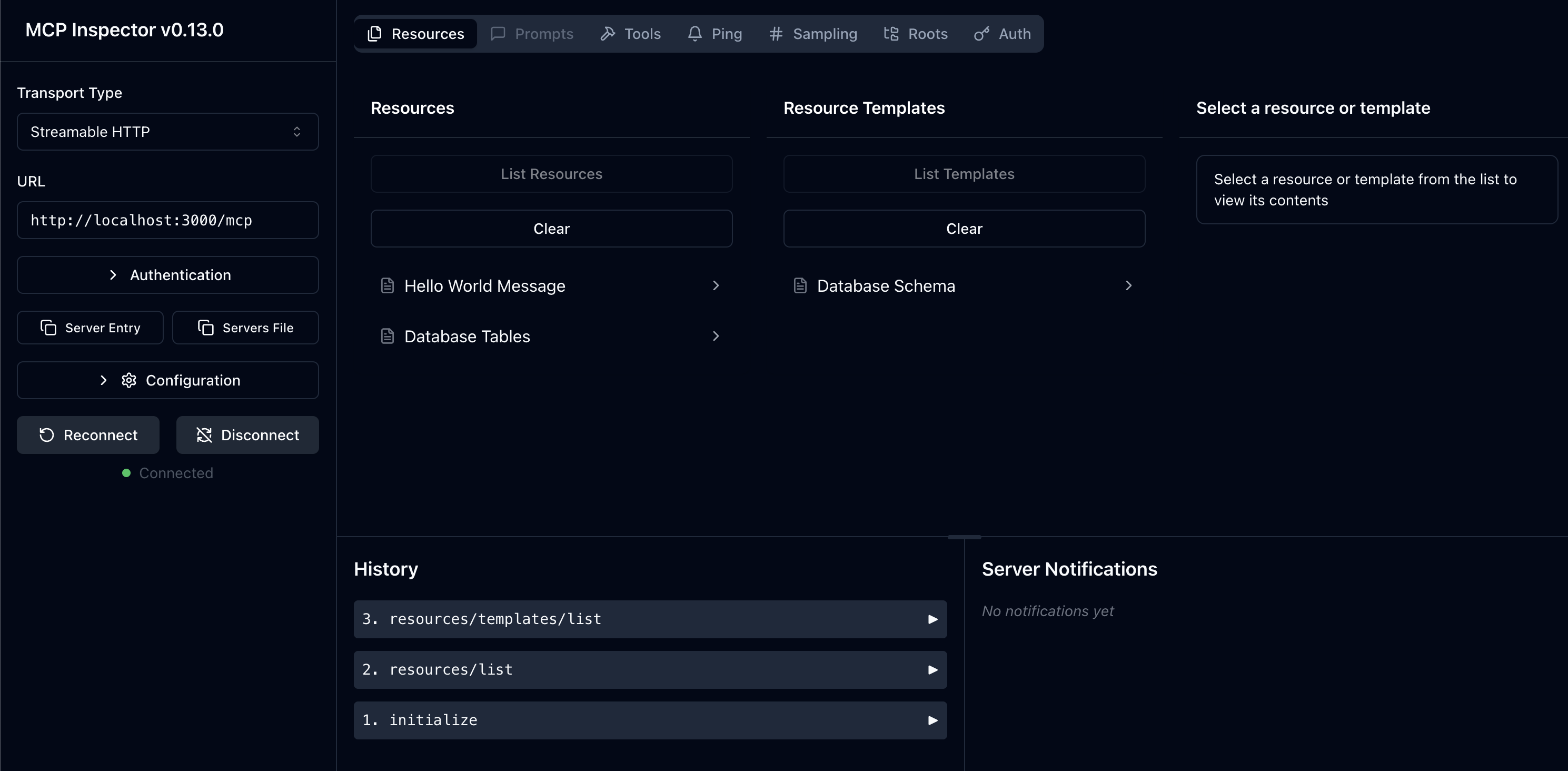
npx @modelcontextprotocol/inspectorAfter selecting Streamable HTTP from drop down menu, insert http://localhost:3000/mcp(default) into URL.
MCP tools:
MCP Resource:
Configuration
Environment Variables
You have to specify these inside the .env file.
Variable | Description | Default | Required |
| PostgreSQL username | - | Yes |
| PostgreSQL password | - | Yes |
| PostgreSQL host | - | Yes |
| PostgreSQL database name | - | Yes |
| HTTP server port | 3000 | No |
| HTTP server host | 0.0.0.0 | No |
| Allowed CORS origins (comma-separated) | localhost:8080,localhost:3000 | No |
| Environment mode | development | No |
Resources
Hello World (hello://world)
A simple greeting message for testing.
Database Tables (database://tables)
Lists all tables in the public schema with their schema URIs.
Database Schema (database://tables/{tableName}/schema)
Returns column information for a specific table.
Tools
query
Execute read-only SQL queries against the database.
Parameters:
sql(string): The SQL query to execute
Transport Differences
Feature | HTTP Transport | Stdio Transport |
Session Management | ✅ Stateful sessions | ❌ Stateless |
Concurrent Connections | ✅ Multiple clients | ❌ Single process |
Web Integration | ✅ REST API compatible | ❌ CLI only |
Interactive Use | ✅ Via HTTP clients | ✅ Direct stdio |
Docker Deployment | ✅ Web service | ✅ CLI container |
Health Checks
The HTTP server includes a basic health check endpoint accessible at the /health endpoint with a GET request (returns 405 Method Not Allowed, confirming the server is responsive).
Troubleshooting
Common Issues
Database Connection Errors
# Check your database credentials in .env
# Ensure PostgreSQL is running and accessible
Port Already in Use
# Change PORT in .env or stop conflicting services
lsof -i :3000
Docker Build Issues
# Clean Docker cache
npm run docker:clean
docker system prune -a
Session Management (HTTP)
# Sessions are stored in memory and will reset on server restart
# For production, consider implementing persistent session storage
Development
Adding New Resources
Create a new file in
src/resources/Implement the resource registration function
Add it to
src/server/server.ts
Adding New Tools
Create a new file in
src/tools/Implement the tool registration function
Add it to
src/server/server.ts
License
MIT
Contributing
Please read the contributing guidelines and submit pull requests to the main repository.