
Provides a sandboxed execution environment for JavaScript to filter large results, perform server-side aggregations, and transform data before it reaches the AI context.
Uses a secure Node.js virtual machine to power a Code Execution Mode that processes tool results and executes complex 'skills' patterns.
Exports performance metrics, including tool call latency, error rates, and cache performance, for real-time monitoring and observability.
Supports secure TypeScript code execution to batch multiple operations into a single tool call, reducing round-trips and token consumption.
Click on "Install Server".
Wait a few minutes for the server to deploy. Once ready, it will show a "Started" state.
In the chat, type
@followed by the MCP server name and your instructions, e.g., "@MCP Gatewayfetch the last 100 error logs from my database and summarize the main issues"
That's it! The server will respond to your query, and you can continue using it as needed.
Here is a step-by-step guide with screenshots.
MCP Gateway
A universal Model Context Protocol (MCP) Gateway that aggregates multiple MCP servers and provides result optimization that native tool search doesn't offer. Works with all major MCP clients:
✅ Claude Desktop / Claude Code
✅ Cursor
✅ OpenAI Codex
✅ VS Code Copilot
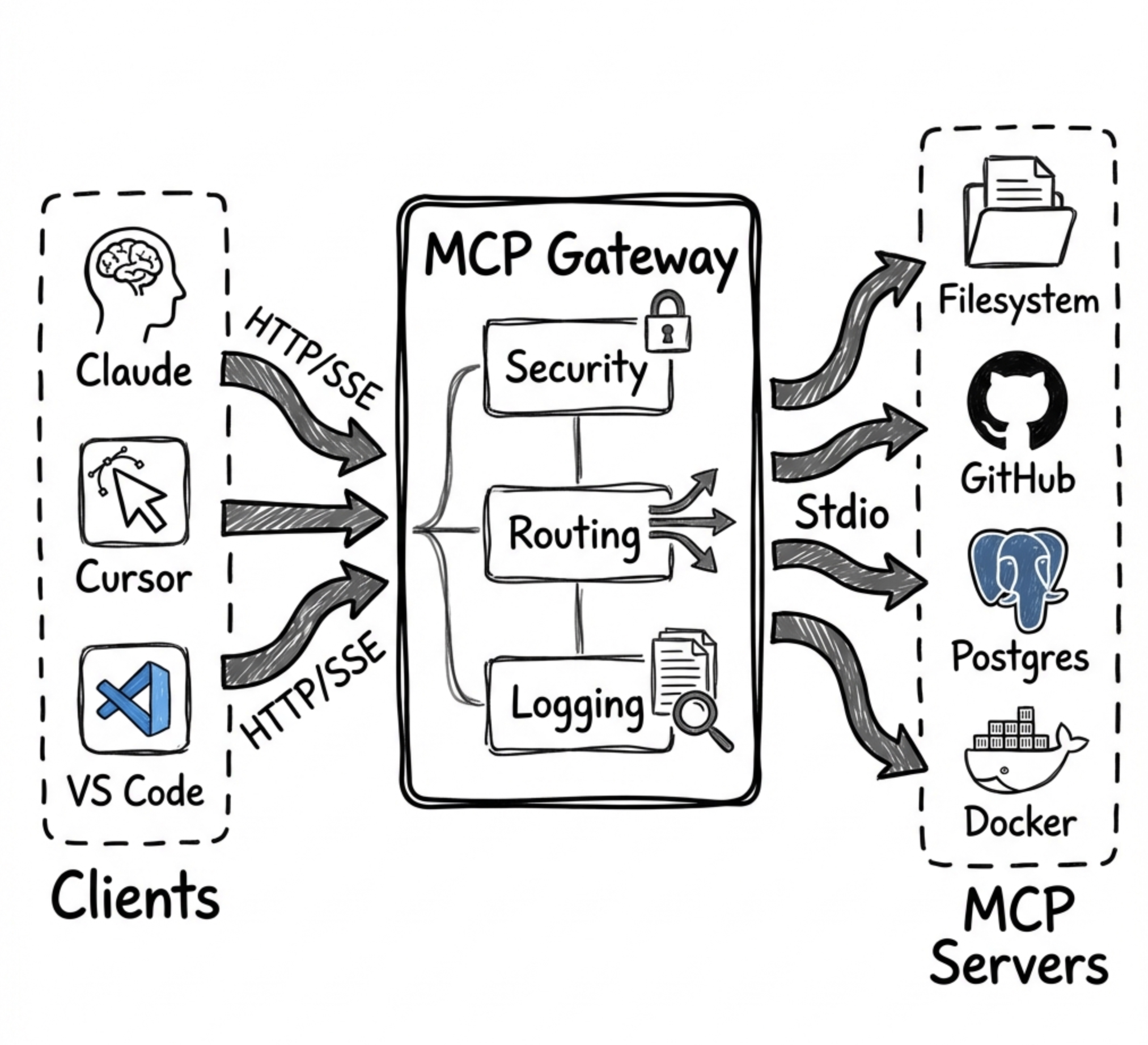
How MCP Gateway Complements Anthropic's Tool Search
January 2025: Anthropic released Tool Search Tool - a native server-side feature for discovering tools from large catalogs using
defer_loadingand regex/BM25 search.
MCP Gateway and Anthropic's Tool Search solve different problems:
Problem | Anthropic Tool Search | MCP Gateway |
Tool Discovery (finding the right tool from 100s) | ✅ Native | ✅ Progressive disclosure |
Result Filtering (trimming large results) | ❌ Not available | ✅ |
Auto-Summarization (extracting insights) | ❌ Not available | ✅ 60-90% token savings |
Delta Responses (only send changes) | ❌ Not available | ✅ 90%+ savings for polling |
Aggregations (count, sum, groupBy) | ❌ Not available | ✅ Server-side analytics |
Code Batching (multiple ops in one call) | ❌ Not available | ✅ 60-80% fewer round-trips |
Skills (reusable code patterns) | ❌ Not available | ✅ 95%+ token savings |
Bottom line: Anthropic's Tool Search helps you find the right tool. MCP Gateway helps you use tools efficiently by managing large results, batching operations, and providing reusable patterns.
You can use both together - let Anthropic handle tool discovery while routing tool calls through MCP Gateway for result optimization.
Why MCP Gateway?
Problem: AI agents face three critical challenges when working with MCP servers:
Tool Overload - Loading 300+ tool definitions consumes 77,000+ context tokens before any work begins
Result Bloat - Large query results (10K rows) can consume 50,000+ tokens per call
Repetitive Operations - Same workflows require re-explaining to the model every time
Note: Anthropic's Tool Search Tool now addresses #1 natively for direct API users. MCP Gateway remains essential for #2 and #3, and provides tool discovery for MCP clients that don't have native tool search.
Solution: MCP Gateway aggregates all your MCP servers and provides 15 layers of token optimization:
Layer | What It Does | Token Savings | Unique to Gateway? |
Progressive Disclosure | Load tool schemas on-demand | 85% | Shared* |
Smart Filtering | Auto-limit result sizes | 60-80% | ✅ |
Aggregations | Server-side analytics | 90%+ | ✅ |
Code Batching | Multiple ops in one call | 60-80% | ✅ |
Skills | Zero-shot task execution | 95%+ | ✅ |
Caching | Skip repeated queries | 100% | ✅ |
PII Tokenization | Redact sensitive data | Security | ✅ |
Response Optimization | Strip null/empty values | 20-40% | ✅ |
Session Context | Avoid resending data in context | Very High | ✅ |
Schema Deduplication | Reference identical schemas by hash | Up to 90% | ✅ |
Micro-Schema Mode | Ultra-compact type abbreviations | 60-70% | ✅ |
Delta Responses | Send only changes for repeated queries | 90%+ | ✅ |
Context Tracking | Monitor context usage, prevent overflow | Safety | ✅ |
Auto-Summarization | Extract insights from large results | 60-90% | ✅ |
Query Planning | Detect optimization opportunities | 30-50% | ✅ |
*Anthropic's Tool Search provides native tool discovery; MCP Gateway provides it for MCP clients without native support.
Result: A typical session drops from ~500,000 tokens to ~25,000 tokens (95% reduction).
305 Tools Through 19 Gateway Tools
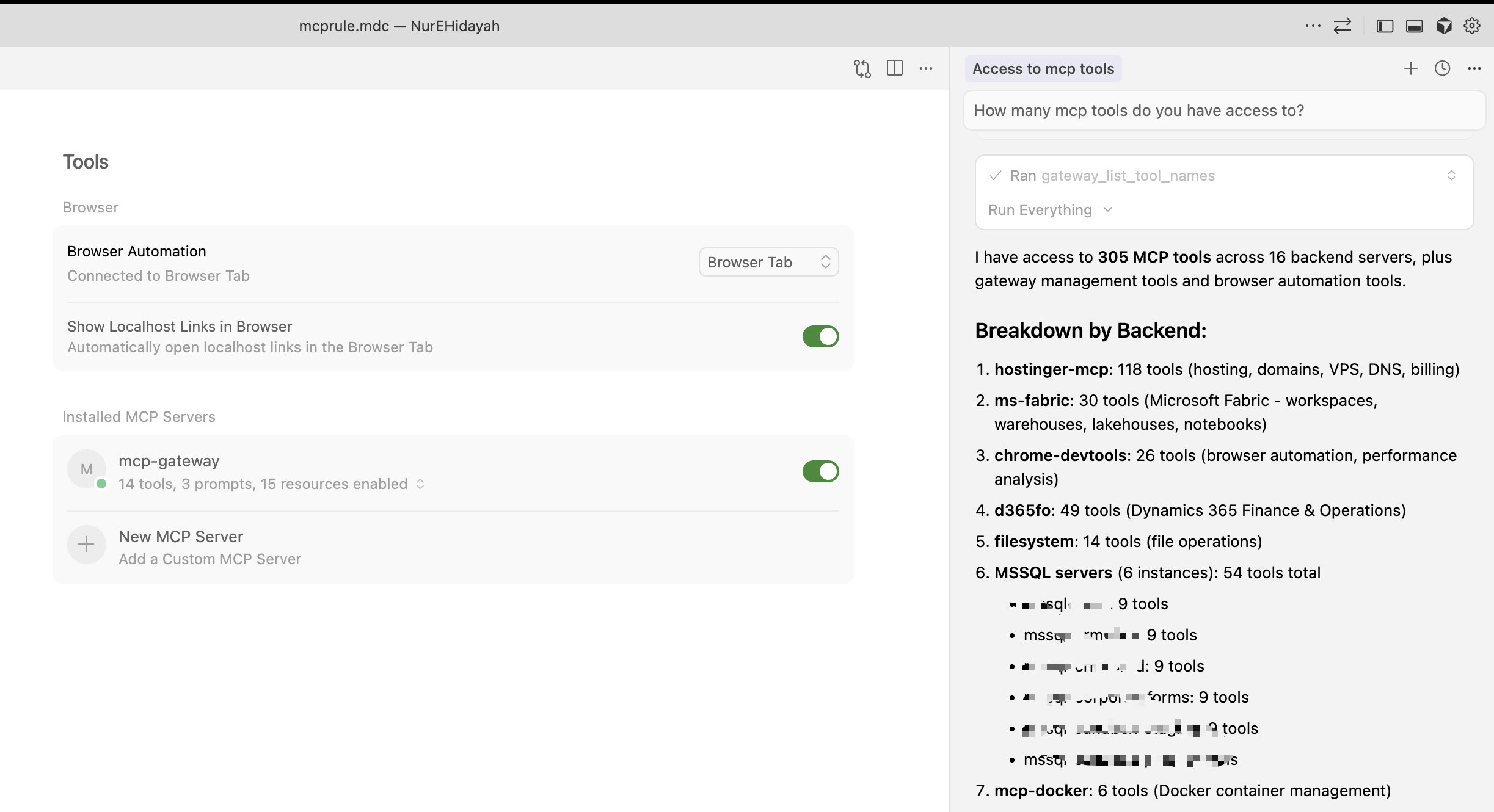
Cursor connected to MCP Gateway - 19 tools provide access to 305 backend tools across 16 servers
Minimal Context Usage
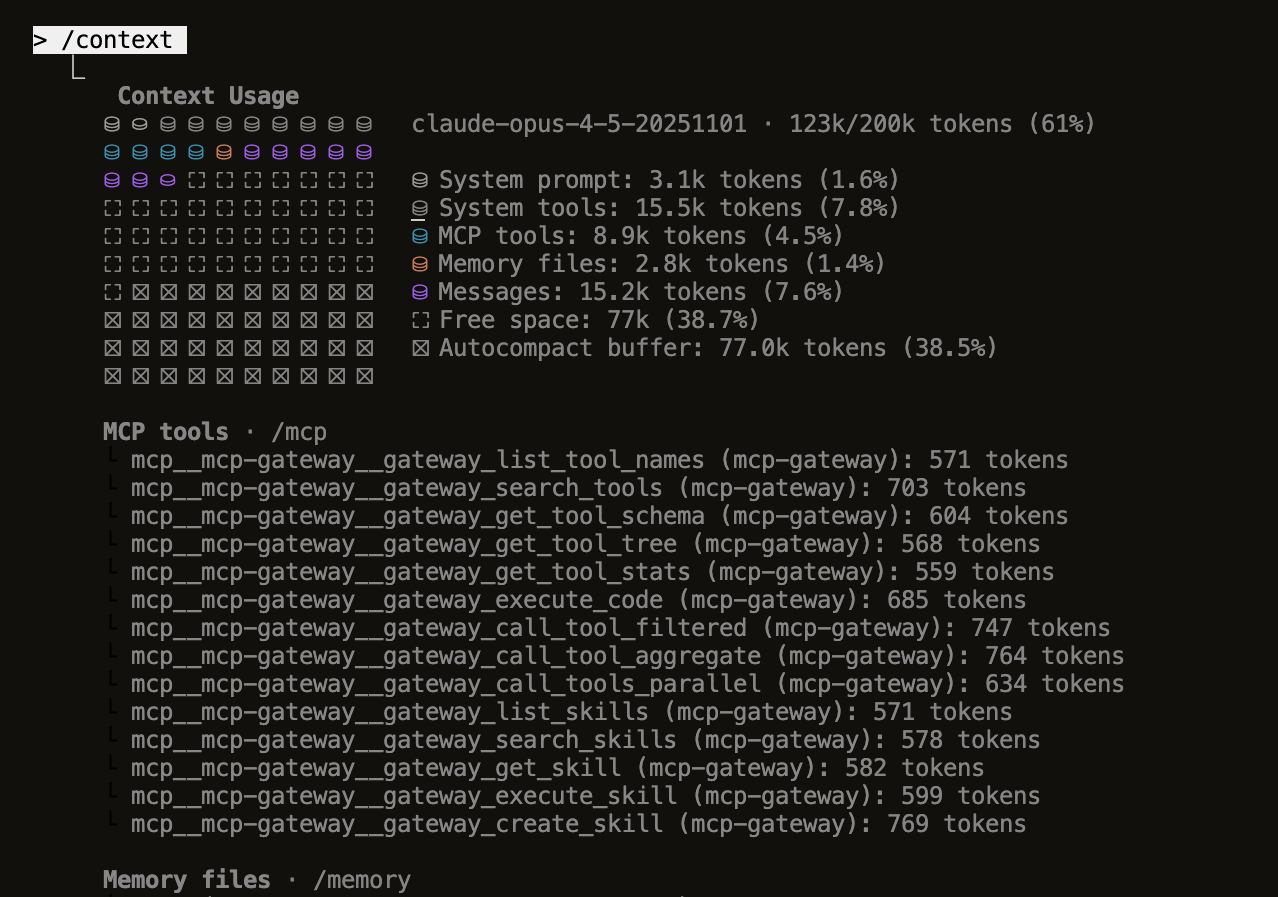
Claude Code
What's New (v1.0.0)
Gateway MCP Tools - All code execution features now exposed as MCP tools (
gateway_*) that any client can discover and use directlyHot-Reload Server Management - Add, edit, and delete MCP servers from the dashboard without restarting
UI State Persistence - Disabled tools and backends are remembered across server restarts
Enhanced Dashboard - Reconnect failed backends, view real-time status, improved error handling
Connection Testing - Test server connections before adding them to your configuration
Export/Import Config - Backup and share your server configurations easily
Parallel Tool Execution - Execute multiple tool calls simultaneously for better performance
Result Filtering & Aggregation - Reduce context bloat with
maxRows,fields,format, and aggregation options
Features
Core Gateway Features
🔀 Multi-Server Aggregation - Route multiple MCP servers through one gateway
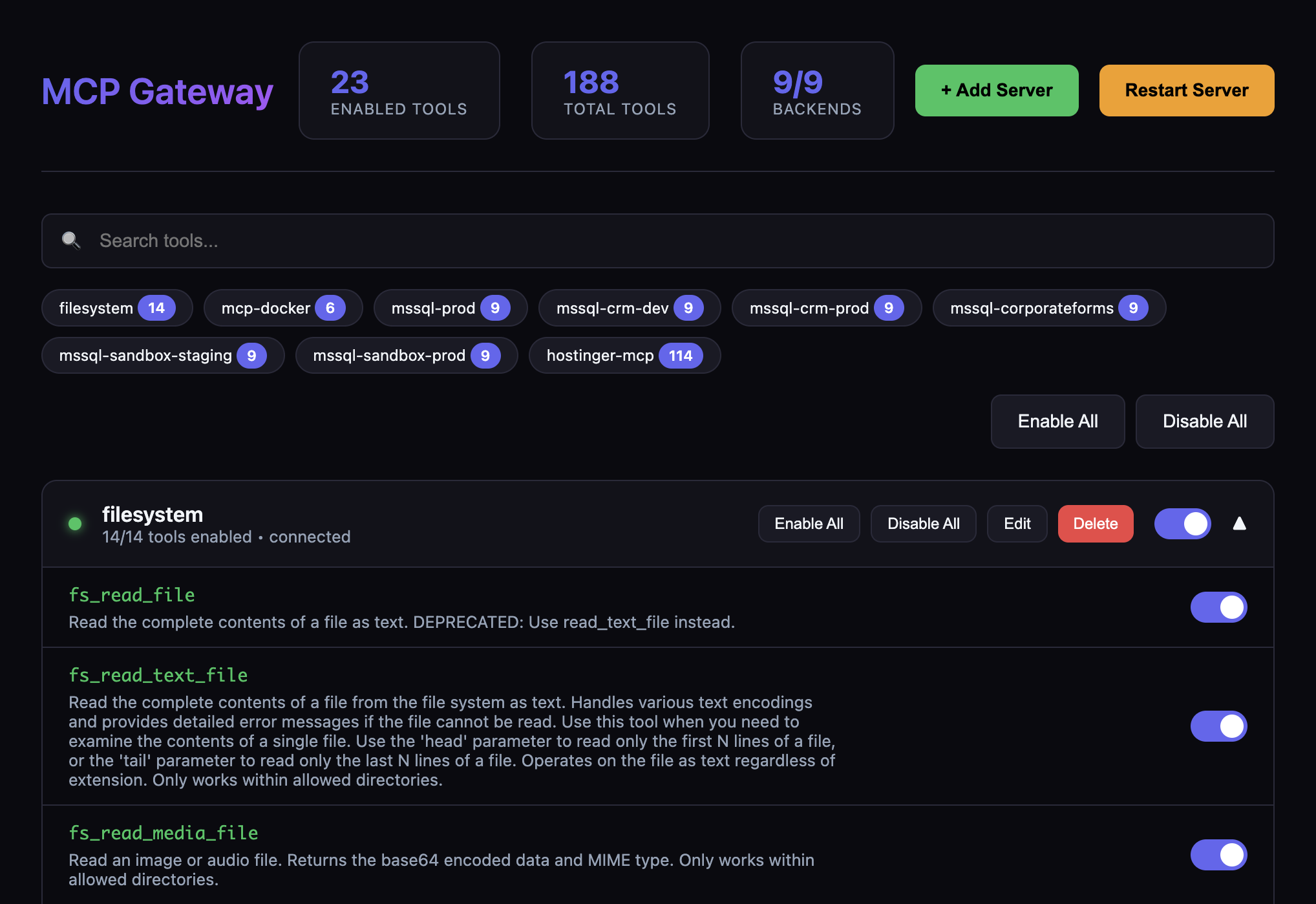
🎛️ Web Dashboard - Real-time UI to manage tools, backends, and server lifecycle
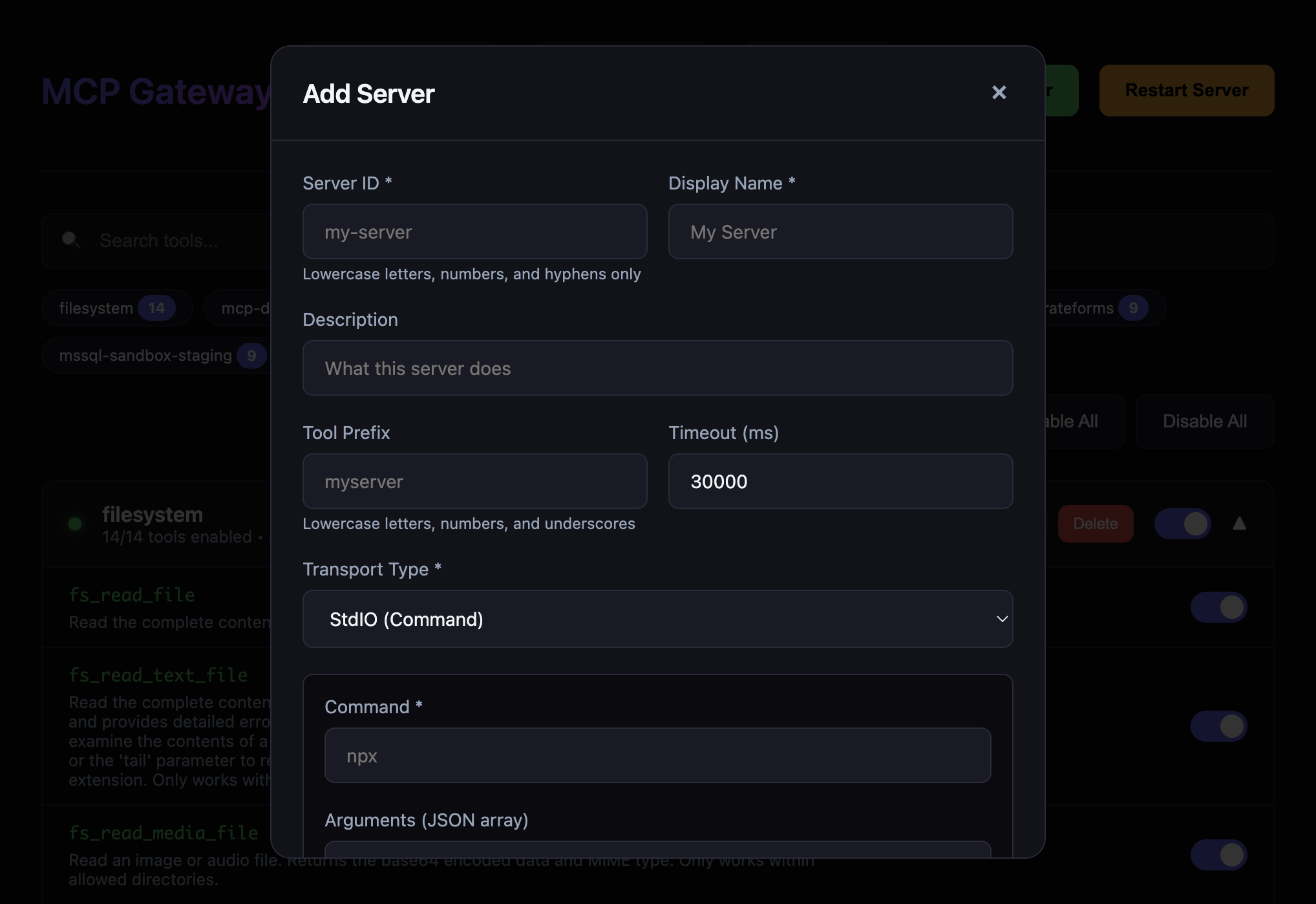
➕ Hot-Reload Server Management - Add, edit, delete MCP servers from dashboard without restart
🌐 HTTP Streamable Transport - Primary transport, works with all clients
📡 SSE Transport - Backward compatibility for older clients
🔐 Authentication - API Key and OAuth/JWT support
⚡ Rate Limiting - Protect your backend servers
🐳 Docker Ready - Easy deployment with Docker/Compose
📊 Health Checks - Monitor backend status with detailed diagnostics
🔄 Auto-Restart - Server restarts automatically on crash or via dashboard
💾 UI State Persistence - Remembers disabled tools/backends across restarts
Code Execution Mode (Token-Efficient AI)
Inspired by Anthropic's Code Execution with MCP - achieve up to 98.7% token reduction:
🔍 Progressive Tool Disclosure - Search and lazy-load tools to reduce token usage (85% reduction)
💻 Sandboxed Code Execution - Execute TypeScript/JavaScript in secure Node.js VM
📉 Context-Efficient Results - Filter, aggregate, and transform tool results (60-80% reduction)
🔒 Privacy-Preserving Operations - PII tokenization for sensitive data
📁 Skills System - Save and reuse code patterns for zero-shot execution (eliminates prompt tokens)
🗄️ State Persistence - Workspace for agent state across sessions
🛠️ Gateway MCP Tools - All code execution features exposed as MCP tools for any client
🧹 Response Optimization - Automatically strip null/empty values from responses (20-40% reduction)
🧠 Session Context - Track sent data to avoid resending in multi-turn conversations
🔗 Schema Deduplication - Reference identical schemas by hash (up to 90% reduction)
📐 Micro-Schema Mode - Ultra-compact schemas with abbreviated types (60-70% reduction)
🔄 Delta Responses - Send only changes for repeated queries (90%+ reduction)
📊 Context Tracking - Monitor context window usage and get warnings before overflow
📝 Auto-Summarization - Extract key insights from large results (60-90% reduction)
🔍 Query Planning - Analyze code to detect optimization opportunities (30-50% improvement)
Monitoring & Observability
📈 Prometheus Metrics - Tool call latency, error rates, cache performance
📊 JSON Metrics API - Programmatic access to gateway statistics
💾 Result Caching - LRU cache with TTL for tool results
📝 Audit Logging - Track sensitive operations
Screenshots
Dashboard Overview
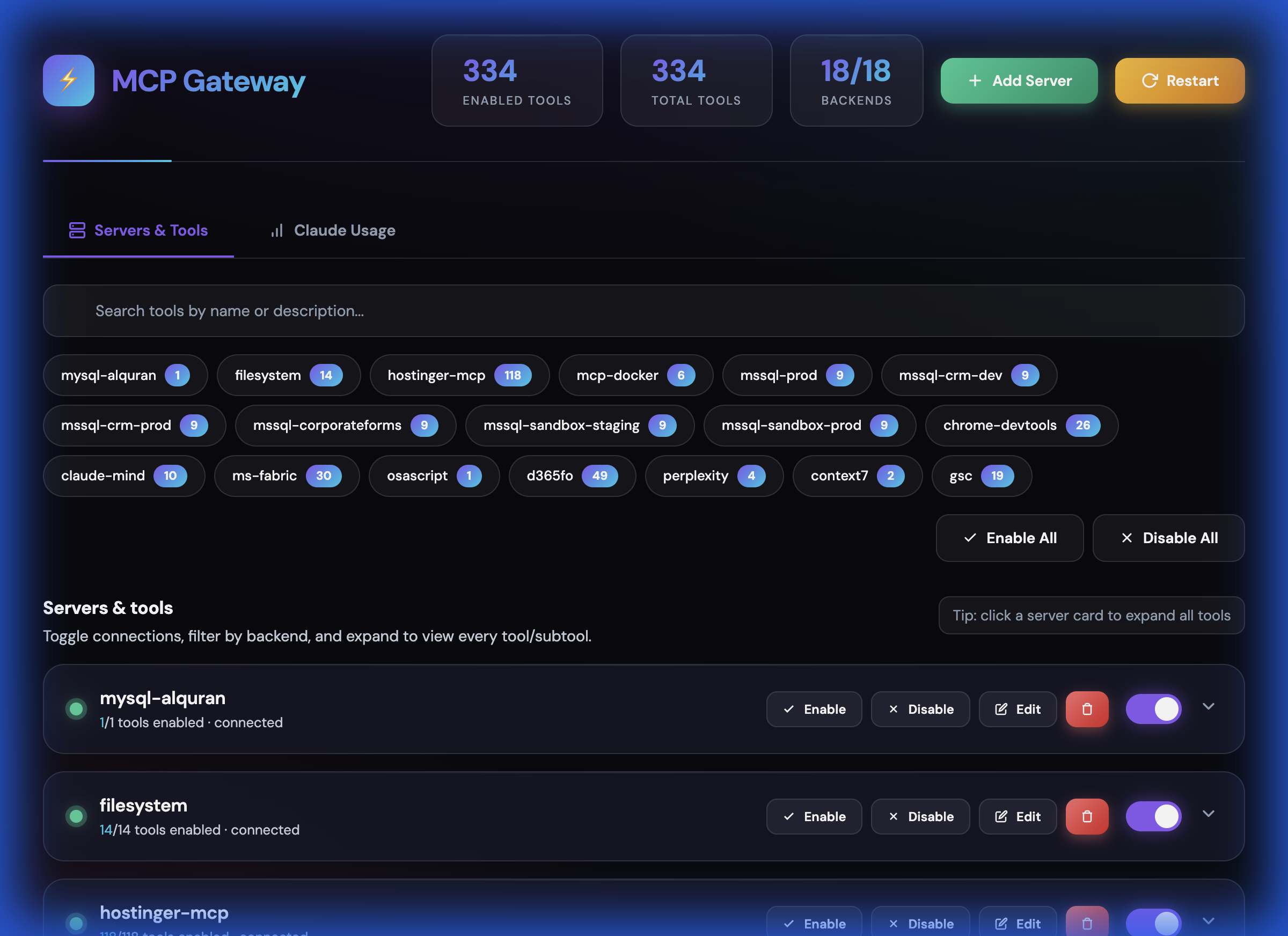
Tools Management
Add Server Dialog
Quick Start
1. Install Dependencies
npm install2. Configure Backend Servers
Copy the example config and edit it:
cp config/servers.example.json config/servers.jsonEdit config/servers.json to add your MCP servers:
{
  "servers": [
    {
      "id": "filesystem",
      "name": "Filesystem",
      "enabled": true,
      "transport": {
        "type": "stdio",
        "command": "npx",
        "args": ["-y", "@modelcontextprotocol/server-filesystem", "/path/to/dir"]
      },
      "toolPrefix": "fs"
    }
  ]
}
3. Start the Gateway
# Development
npm run dev

# Production
npm run build
npm start
The gateway will start on http://localhost:3010 by default.
Security modes
For local experimentation you can run without auth:
AUTH_MODE=none
However, sensitive endpoints (/dashboard, /dashboard/api/*, /api/code/*, /metrics/json) are blocked by default when AUTH_MODE=none. To allow unauthenticated access (not recommended except for isolated local use), explicitly opt in:
ALLOW_INSECURE=1
For secure usage, prefer:
AUTH_MODE=api-keywithAPI_KEYS=key1,key2or
AUTH_MODE=oauthwith the appropriateOAUTH_*settings shown below.
Endpoints
Core Endpoints
Endpoint | Transport | Use Case |
| HTTP Streamable | Primary endpoint - works with all clients |
| Server-Sent Events | Backward compatibility |
| JSON | Health checks and status |
| Web UI | Manage tools, backends, and restart server |
| Prometheus | Prometheus-format metrics |
| JSON | JSON-format metrics |
Code Execution API
Endpoint | Method | Description |
| GET | Search tools with filters |
| GET | Get filesystem-like tool tree |
| GET | Get all tool names (minimal tokens) |
| GET | Lazy-load specific tool schema |
| GET | Tool statistics by backend |
| GET | Auto-generated TypeScript SDK |
| POST | Execute code in sandbox |
| POST | Call tool with result filtering |
| POST | Call tool with aggregation |
| POST | Execute multiple tools in parallel |
| GET/POST | List or create skills |
| GET | Search skills |
| GET/DELETE | Get or delete skill |
| POST | Execute a skill |
| GET/POST | Get or update session state |
| GET | Cache statistics |
| POST | Clear cache |
Dashboard API
Endpoint | Method | Description |
| GET | Get all tools with enabled status |
| GET | Get all backends with status |
| POST | Toggle tool enabled/disabled |
| POST | Toggle backend enabled/disabled |
| POST | Reconnect a failed backend |
| POST | Add new backend server |
| PUT | Update backend configuration |
| DELETE | Remove backend server |
| GET | Export server configuration |
| POST | Import server configuration |
| POST | Restart the gateway server |
Dashboard
Access the web dashboard at http://localhost:3010/dashboard to:
View all connected backends and their real-time status
Add new MCP servers with connection testing (STDIO, HTTP, SSE transports)
Edit existing servers (modify command, args, environment variables)
Delete servers with graceful disconnect
Enable/disable individual tools or entire backends
Search and filter tools across all backends
Export/import configuration for backup and sharing
Reconnect failed backends with one click
Restart the entire gateway server
View tool counts and backend health at a glance
The dashboard persists UI state (disabled tools/backends) across server restarts.
Client Configuration
Claude Desktop / Claude Code
Open Claude Desktop → Settings → Connectors
Click Add remote MCP server
Enter your gateway URL:
http://your-gateway-host:3010/mcpComplete authentication if required
Note: Claude requires adding remote servers through the UI, not config files.
Claude Desktop via STDIO Proxy
If Claude Desktop doesn't support HTTP/SSE transports directly, you can use the included STDIO proxy script:
{
  "mcpServers": {
    "mcp-gateway": {
      "command": "node",
      "args": ["/path/to/mcp-gateway/scripts/claude-stdio-proxy.mjs"],
      "env": {
        "MCP_GATEWAY_URL": "http://localhost:3010/mcp"
      }
    }
  }
}
The proxy (scripts/claude-stdio-proxy.mjs) reads JSON-RPC messages from stdin, forwards them to the gateway HTTP endpoint, and writes responses to stdout. It automatically manages session IDs.
Cursor
Open Cursor → Settings → Features → MCP
Click Add New MCP Server
Choose Type:
HTTPorSSEEnter your gateway URL:
For HTTP (recommended):
http://your-gateway-host:3010/mcpFor SSE:
http://your-gateway-host:3010/sseOr add to your Cursor settings JSON:
{
  "mcpServers": {
    "my-gateway": {
      "type": "http",
      "url": "http://your-gateway-host:3010/mcp"
    }
  }
}
OpenAI Codex
Option 1: CLI
codex mcp add my-gateway --transport http --url https://your-gateway-host:3010/mcpOption 2: Config File
Add to ~/.codex/config.toml:
[mcp_servers.my_gateway]
type = "http"
url = "https://your-gateway-host:3010/mcp"

# With API key authentication
# headers = { Authorization = "Bearer your-api-key-here" }
Important: Codex requires HTTPS for remote servers and only supports HTTP Streamable (not SSE).
VS Code Copilot
Open Command Palette (
Cmd/Ctrl + Shift + P)Run MCP: Add MCP Server
Choose Remote (URL)
Enter your gateway URL:
http://your-gateway-host:3010/mcpApprove the trust prompt
Or add to your VS Code settings.json:
{
  "mcp.servers": {
    "my-gateway": {
      "type": "http",
      "url": "http://your-gateway-host:3010/mcp"
    }
  }
}
Cross-IDE Configuration (.agents/)
MCP Gateway uses a centralized .agents/ directory as the single source of truth for AI agent configuration across all IDEs:
.agents/
├── AGENTS.md              # Unified project rules (symlinked to all IDEs)
├── hooks/
│   └── skill-activation.mjs  # Auto-activates skills based on prompt keywords
├── skills/                # Single source of truth for all skills
│   ├── code-review/       # Executable: skill.json + index.ts + SKILL.md
│   ├── debugging/         # Protocol-only: SKILL.md only (loaded by AI agent)
│   ├── git-workflow/
│   └── ...
└── rules/                 # Additional rule fragments
    └── cipher-memory.md
How It Works
The .agents/AGENTS.md file is symlinked to each IDE's configuration location:
IDE | Symlink |
Cursor |
|
Windsurf |
|
Claude Code |
|
Codex |
|
This means:
One file to maintain - Edit
.agents/AGENTS.mdand all IDEs get the updateConsistent behavior - Same rules, skills, and protocols across all tools
Version controlled - Track all configuration in git
Skills Auto-Activation
Skills in .agents/skills/ can auto-activate when your AI agent detects relevant keywords in your prompt. Setup varies by IDE — see Setting Up Skill Auto-Activation in the Skills System section for full instructions.
Quick overview of built-in triggers:
Trigger Keywords | Skill Loaded |
"review code", "security audit", "find bugs" |
|
"debug", "fix bug", "not working", "error" |
|
"commit", "push", "create PR", "merge" |
|
"build UI", "dashboard", "React", "frontend" |
|
"deploy", "docker", "production", "hosting" |
|
"SQL optimization", "slow query" |
|
Setting Up for Your Fork
If you fork this repository:
The symlinks are already configured in the repo
Edit
.agents/AGENTS.mdto customize rules for your projectAdd/modify skills in
.agents/skills/
Backend Server Configuration
The gateway can connect to MCP servers using different transports:
STDIO (Local Process)
{
  "id": "filesystem",
  "name": "Filesystem Server",
  "enabled": true,
  "transport": {
    "type": "stdio",
    "command": "npx",
    "args": ["-y", "@modelcontextprotocol/server-filesystem", "/path/to/dir"],
    "env": {
      "SOME_VAR": "${ENV_VAR_NAME}"
    }
  },
  "toolPrefix": "fs",
  "timeout": 30000
}
HTTP (Remote Server)
{
  "id": "remote-server",
  "name": "Remote MCP Server",
  "enabled": true,
  "transport": {
    "type": "http",
    "url": "https://remote-mcp-server.com/mcp",
    "headers": {
      "Authorization": "Bearer ${REMOTE_API_KEY}"
    }
  },
  "toolPrefix": "remote",
  "timeout": 60000
}
Tool Prefixing
Use toolPrefix to namespace tools from different servers:
Server with
toolPrefix: "fs"exposesread_fileasfs_read_filePrevents naming collisions between servers
Makes it clear which server handles each tool
Authentication
API Key Authentication
Set environment variables:
AUTH_MODE=api-key
API_KEYS=key1,key2,key3
Clients send the key in the Authorization header:
Authorization: Bearer your-api-keyOAuth Authentication
AUTH_MODE=oauth
OAUTH_ISSUER=https://your-oauth-provider.com
OAUTH_AUDIENCE=mcp-gateway
OAUTH_JWKS_URI=https://your-oauth-provider.com/.well-known/jwks.json
Docker Deployment
Build and Run
# Build the image
docker build -t mcp-gateway .

# Run with environment variables
docker run -d \
  -p 3010:3010 \
  -v $(pwd)/config/servers.json:/app/config/servers.json:ro \
  -e AUTH_MODE=api-key \
  -e API_KEYS=your-secret-key \
  mcp-gateway
Docker Compose
# Start
docker-compose up -d

# View logs
docker-compose logs -f

# Stop
docker-compose down
Environment Variables
Core Configuration
Variable | Default | Description |
|
| Server port |
|
| Server host |
|
| Log level (debug, info, warn, error) |
|
| Gateway name in MCP responses |
|
| Lite mode - reduces exposed gateway tools for lower token usage (recommended) |
|
| Authentication mode (none, api-key, oauth) |
| - | Comma-separated API keys |
| - | OAuth token issuer |
| - | OAuth audience |
| - | OAuth JWKS endpoint |
|
| Allowed CORS origins ( |
|
| If |
|
| If |
|
| Rate limit window (ms) |
|
| Max requests per window |
Optional Features
MCP Gateway includes optional features that are disabled by default for minimal, public-friendly deployments. Enable them by setting the corresponding environment variable to 1.
Variable | Default | Description |
|
| Enable Skills system - reusable code patterns and skill execution |
|
| Enable Cipher Memory - cross-IDE persistent memory with Qdrant vector store |
|
| Enable Antigravity Usage - IDE quota tracking for Antigravity IDE |
|
| Enable Claude Usage - API token consumption tracking |
When a feature is disabled:
The corresponding dashboard tab is hidden
API endpoints return
404 Feature disabledwith instructions to enableNo errors occur from missing dependencies (Qdrant, Cipher service, etc.)
For personal/development use, enable the features you need in your .env:
# Enable all optional features
ENABLE_SKILLS=1
ENABLE_CIPHER=1
ENABLE_ANTIGRAVITY=1
ENABLE_CLAUDE_USAGE=1

# Disable lite mode to see all gateway tools
GATEWAY_LITE_MODE=0
Feature-Specific Configuration
These variables are only needed when the corresponding feature is enabled:
Variable | Feature | Default | Description |
| Cipher |
| Cipher Memory service URL |
| Cipher | - | Qdrant vector store URL |
| Cipher | - | Qdrant API key |
| Cipher |
| Qdrant collection name |
| Cipher |
| Qdrant request timeout |
Optional Features Guide
This section provides detailed instructions for enabling and using each optional feature.
Skills System (ENABLE_SKILLS=1)
The Skills system allows you to save and reuse code patterns for zero-shot execution. Skills are the most powerful token-saving feature in MCP Gateway, reducing token usage by 95%+ for recurring tasks.
What Skills Do
Save successful code patterns as reusable templates
Execute complex workflows with a single tool call (~20 tokens)
Eliminate prompt engineering for recurring tasks
Hot-reload when skill files change on disk
Enabling Skills
# In your .env file
ENABLE_SKILLS=1
Storage Location
All skills live in a single directory: .agents/skills/
Skills come in two flavors:
Executable skills (have skill.json + index.ts) — can be run via gateway_execute_skill:
code-review/
├── skill.json    # Metadata (name, description, inputs, tags)
├── index.ts      # Executable TypeScript code
├── SKILL.md      # Human-readable protocol/instructions
├── scripts/      # Optional helper scripts
└── references/   # Optional reference docs
Protocol-only skills (have SKILL.md only) — loaded by the AI agent, not executable via gateway:
debugging/
└── SKILL.md      # Protocol/instructions the AI follows
Protocol-only skills appear in gateway_list_skills but return a helpful error if you try to execute them, directing you to read the SKILL.md instead.
Creating Skills via MCP Tools
// Create a new skill
await gateway_create_skill({
  name: "daily-report",
  description: "Generate daily sales summary by region",
  code: `
    const sales = await mssql.executeQuery({
      query: \`SELECT region, SUM(amount) as total
              FROM orders WHERE date = '\${date}' GROUP BY region\`
    });
    console.log(JSON.stringify(sales));
  `,
  inputs: [
    { name: "date", type: "string", required: true, description: "Date in YYYY-MM-DD format" }
  ],
  tags: ["reporting", "sales", "daily"]
});
Executing Skills
// Execute with ~20 tokens instead of 500+ for raw code
await gateway_execute_skill({
  name: "daily-report",
  inputs: { date: "2024-01-15" }
});
Skills MCP Tools
Tool | Description |
| List all available skills with metadata |
| Search skills by name, description, or tags |
| Get full skill details including code |
| Execute a skill with input parameters |
| Create a new reusable skill |
Skills REST API
Endpoint | Method | Description |
| GET | List all skills |
| POST | Create a new skill |
| GET | Search skills |
| GET | Get skill details |
| DELETE | Delete a skill |
| POST | Execute a skill |
| GET | Get skill templates |
| POST | Sync external skills to workspace |
Dashboard
When enabled, a Skills tab appears in the dashboard (/dashboard) showing:
All available skills with search/filter
Skill details and code preview
Execute skills directly from UI
Create new skills from templates
Adding Your Own Skills
You can add skills to your gateway in two ways:
1. Create executable skills (for automation via gateway_execute_skill):
mkdir -p .agents/skills/my-skillCreate three files:
skill.json — metadata:
{
  "name": "my-skill",
  "description": "What this skill does",
  "version": "1.0.0",
  "category": "productivity",
  "inputs": [
    { "name": "target", "type": "string", "required": true, "description": "Target to process" }
  ],
  "tags": ["automation"]
}
index.ts — executable code:
const target = inputs?.target || 'default';
const result = await callTool('some_backend_tool', { query: target });
console.log(JSON.stringify(result));
SKILL.md — human-readable instructions (optional but recommended).
2. Create protocol-only skills (for AI agent workflows):
Just create a SKILL.md in a skill directory — no skill.json needed:
mkdir -p .agents/skills/my-protocol
cat > .agents/skills/my-protocol/SKILL.md << 'EOF'
# My Protocol

## When to Use
When the user asks to...

## Steps
1. First do X
2. Then do Y
3. Verify with Z
EOF
The gateway will list it as a protocol-only skill. AI agents read the SKILL.md directly instead of executing code.
Setting Up Skill Auto-Activation
Skills don't activate on their own — your AI agent needs to be told they exist. Choose your setup below:
Claude Code supports hooks that run on every prompt. The repo includes a hook at .agents/hooks/skill-activation.mjs that detects trigger keywords and injects skill recommendations into context.
Setup: Add this to your project's .claude/settings.local.json (create the file if it doesn't exist):
{
  "hooks": {
    "UserPromptSubmit": [
      {
        "hooks": [
          {
            "type": "command",
            "command": "node .agents/hooks/skill-activation.mjs"
          }
        ]
      }
    ]
  }
}
How it works:
You type a prompt like "review this code for security issues"
The hook matches "review code" →
code-reviewskillClaude receives: "Load
Claude reads the skill file and follows its protocol
Customize triggers: Edit the SKILLS array in .agents/hooks/skill-activation.mjs to add your own keyword → skill mappings.
Add this block to your .cursorrules file (or .cursor/rules/skills.mdc):
## Skills

This project has reusable AI skills at `.agents/skills/`. When the user's request
matches a skill, read its SKILL.md BEFORE responding.

| User says | Read this skill |
|-----------|----------------|
| "review code", "security audit", "find bugs" | `.agents/skills/code-review/SKILL.md` |
| "debug", "fix bug", "not working", "error" | `.agents/skills/debugging/SKILL.md` |
| "commit", "push", "create PR", "merge" | `.agents/skills/git-workflow/SKILL.md` |
| "build UI", "dashboard", "React", "frontend" | `.agents/skills/frontend-build/SKILL.md` |
| "deploy", "docker", "production", "hosting" | `.agents/skills/infra-deploy/SKILL.md` |
| "SQL optimization", "slow query" | `.agents/skills/sql-analyzer/SKILL.md` |

To see all available skills: `ls .agents/skills/`
Add the same block as Cursor to your .windsurfrules file.
Add this to whatever file your IDE reads for AI instructions (e.g., AGENTS.md, .github/copilot-instructions.md):
## Skills

This project has reusable AI skills at `.agents/skills/`. Each skill directory
contains a SKILL.md with instructions the AI should follow.

Before responding to a user request, check if any skill matches:
1. List skills: `ls .agents/skills/`
2. If a skill name matches the task, read `.agents/skills/{name}/SKILL.md`
3. Follow the skill's instructions in your response

Skills with a `skill.json` + `index.ts` can also be executed programmatically
via the MCP Gateway: `gateway_execute_skill({ name: "skill-name", inputs: {...} })`
If none of the above apply, paste this into your AI system prompt or project instructions:
You have access to a skills library at .agents/skills/. Each skill is a directory
containing a SKILL.md with step-by-step instructions for specific tasks.

IMPORTANT: Before starting any task, check if a matching skill exists:
- Code review → .agents/skills/code-review/SKILL.md
- Debugging → .agents/skills/debugging/SKILL.md
- Git workflow → .agents/skills/git-workflow/SKILL.md
- Frontend → .agents/skills/frontend-build/SKILL.md
- Deployment → .agents/skills/infra-deploy/SKILL.md
- SQL analysis → .agents/skills/sql-analyzer/SKILL.md

If a skill matches, read its SKILL.md and follow the protocol before responding.
For the full list: ls .agents/skills/
Cipher Memory (ENABLE_CIPHER=1)
Cipher Memory provides persistent AI memory across all IDEs. Decisions, learnings, patterns, and insights are stored in a vector database and recalled automatically in future sessions.
What Cipher Does
Cross-IDE memory - Memories persist across Claude, Cursor, Windsurf, VS Code, Codex
Project-scoped context - Filter memories by project path
Semantic search - Find relevant memories using natural language
Auto-consolidation - Session summaries stored automatically
Prerequisites
Cipher requires two external services:
Cipher Memory Service - The memory API (default:
http://localhost:8082)Qdrant Vector Store - For semantic memory storage
Enabling Cipher
# In your .env file
ENABLE_CIPHER=1

# Cipher service URL (if not running on default port)
CIPHER_API_URL=http://localhost:8082

# Qdrant configuration (required for memory stats)
QDRANT_URL=https://your-qdrant-instance.cloud
QDRANT_API_KEY=your-qdrant-api-key
QDRANT_COLLECTION=cipher_knowledge
QDRANT_TIMEOUT_MS=8000
Using Cipher via MCP
The Cipher service exposes the cipher_ask_cipher tool via MCP:
// Store a decision
cipher_ask_cipher({
  message: "STORE DECISION: Using PostgreSQL for the user service. Reasoning: Better JSON support.",
  projectPath: "/path/to/your/project"
});

// Recall context
cipher_ask_cipher({
  message: "Recall context for this project. What do you remember?",
  projectPath: "/path/to/your/project"
});

// Search memories
cipher_ask_cipher({
  message: "Search memory for: database decisions",
  projectPath: "/path/to/your/project"
});
Memory Types
Prefix | Use Case | Example |
| Architectural choices | "STORE DECISION: Using Redis for caching" |
| Bug fixes, discoveries | "STORE LEARNING: Fixed race condition in auth" |
| Completed features | "STORE MILESTONE: Completed user auth system" |
| Code patterns | "STORE PATTERN: Repository pattern for data access" |
| Ongoing issues | "STORE BLOCKER: CI failing on ARM builds" |
Dashboard API
Endpoint | Method | Description |
| GET | List memory sessions |
| GET | Get session history |
| POST | Send message to Cipher |
| GET | Search memories |
| GET | Get vector store statistics |
| GET | Get specific memory by ID |
Dashboard
When enabled, a Memory tab appears showing:
Total memories stored in Qdrant
Recent memories with timestamps
Memory categories breakdown (decisions, learnings, etc.)
Search interface for finding memories
Session history viewer
Claude Usage Tracking (ENABLE_CLAUDE_USAGE=1)
Track your Claude API token consumption and costs across all Claude Code sessions.
What It Does
Aggregate usage data from Claude Code JSONL logs
Track costs by model (Opus, Sonnet, Haiku)
Monitor cache efficiency (creation vs read tokens)
View daily/weekly/monthly trends
Live session monitoring
Prerequisites
This feature uses the ccusage CLI tool to parse Claude Code conversation logs from ~/.claude/projects/.
# The tool is auto-installed via npx when needed
npx ccusage@latest --json
Enabling Claude Usage
# In your .env file
ENABLE_CLAUDE_USAGE=1
No additional configuration required - the service automatically finds Claude Code logs.
Dashboard API
Endpoint | Method | Description |
| GET | Get usage summary (cached 5 min) |
| GET | Get usage for date range |
| GET | Get live session usage |
| POST | Force refresh cached data |
Response Format
{
  "totalCost": 45.67,
  "totalInputTokens": 15000000,
  "totalOutputTokens": 2500000,
  "totalCacheCreationTokens": 500000,
  "totalCacheReadTokens": 12000000,
  "cacheHitRatio": 96.0,
  "daysActive": 30,
  "avgCostPerDay": 1.52,
  "modelDistribution": [
    { "model": "Claude Sonnet", "cost": 40.00, "percentage": 87.5 },
    { "model": "Claude Opus", "cost": 5.67, "percentage": 12.5 }
  ],
  "topDays": [...],
  "daily": [...]
}
Dashboard
When enabled, a Usage tab appears showing:
Total cost and token breakdown
Cost by model pie chart
Cache hit ratio (higher = more efficient)
Daily usage trend graph
Top usage days
Live current session monitoring
Antigravity Usage Tracking (ENABLE_ANTIGRAVITY=1)
Track quota and usage for Antigravity IDE (formerly Windsurf/Codeium) accounts.
What It Does
Real-time quota monitoring for all model tiers
Multi-account support (Antigravity + Techgravity accounts)
Conversation statistics from local data
Brain/task tracking for agentic workflows
Auto-detection of running Language Server processes
How It Works
The service:
Detects running
language_server_macosprocessesExtracts CSRF tokens and ports from process arguments
Queries the local gRPC-Web endpoint for quota data
Falls back to file-based stats if API unavailable
Prerequisites
Antigravity IDE installed and running
Account directories exist in
~/.gemini/antigravity/or~/.gemini/techgravity/
Enabling Antigravity Usage
# In your .env file
ENABLE_ANTIGRAVITY=1
No additional configuration required.
Dashboard API
Endpoint | Method | Description |
| GET | Check if Antigravity accounts exist |
| GET | Get full usage summary |
| POST | Force refresh cached data |
Response Format
{
  "status": {
    "isRunning": true,
    "processId": 12345,
    "port": 64446,
    "accounts": [
      {
        "accountId": "antigravity",
        "accountName": "Antigravity",
        "accountEmail": "user@example.com",
        "planName": "Pro",
        "monthlyPromptCredits": 500,
        "availablePromptCredits": 450,
        "models": [
          {
            "modelId": "gemini-3-pro-high",
            "label": "Gemini 3 Pro (High)",
            "remainingPercentage": 85,
            "isExhausted": false,
            "timeUntilReset": "4h 30m"
          },
          {
            "modelId": "claude-sonnet-4.5",
            "label": "Claude Sonnet 4.5",
            "remainingPercentage": 60,
            "isExhausted": false
          }
        ]
      }
    ]
  },
  "conversationStats": {
    "primary": {
      "totalConversations": 150,
      "totalSizeBytes": 25000000,
      "formattedSize": "23.8 MB",
      "recentConversations": 25
    }
  },
  "brainStats": {
    "primary": {
      "totalTasks": 12,
      "totalSizeBytes": 5000000
    }
  }
}
Dashboard
When enabled, an Antigravity tab appears showing:
Running status indicator (green = active)
Per-account quota bars for each model
Remaining percentage with color coding (green/yellow/red)
Time until quota reset
Conversation and task statistics
Multi-account support (Antigravity + Techgravity)
Enabling All Features
For personal/development use, enable everything:
# .env file

# Core settings
PORT=3010
LOG_LEVEL=info

# Enable all optional features
ENABLE_SKILLS=1
ENABLE_CIPHER=1
ENABLE_ANTIGRAVITY=1
ENABLE_CLAUDE_USAGE=1

# Show all gateway tools (not just lite mode subset)
GATEWAY_LITE_MODE=0

# Cipher/Qdrant settings (if using Cipher)
CIPHER_API_URL=http://localhost:8082
QDRANT_URL=https://your-qdrant.cloud
QDRANT_API_KEY=your-api-key
QDRANT_COLLECTION=cipher_knowledge
Then restart the gateway:
npm run build && npm startAll four tabs will now appear in the dashboard at http://localhost:3010/dashboard.
Health Check
curl http://localhost:3010/healthResponse:
{
  "status": "ok",
  "gateway": "mcp-gateway",
  "backends": {
    "connected": 2,
    "total": 3,
    "details": {
      "filesystem": {
        "status": "connected",
        "toolCount": 5,
        "resourceCount": 0,
        "promptCount": 0
      }
    }
  },
  "tools": 10,
  "resources": 0,
  "prompts": 0
}
Architecture
┌─────────────────────────────────────────────────────────────────┐
│                          MCP Clients                            │
│  (Claude Desktop, Cursor, Codex, VS Code)                       │
└─────────────────────────────────────────────────────────────────┘
                                │
                    HTTP Streamable / SSE
                                │
                                ▼
┌─────────────────────────────────────────────────────────────────┐
│                        MCP Gateway                              │
│  ┌─────────────┐  ┌──────────────┐  ┌────────────────────────┐  │
│  │   Auth      │  │ Rate Limit   │  │   Protocol Handler     │  │
│  │  Middleware │──│  Middleware  │──│  (Aggregates Tools)    │  │
│  └─────────────┘  └──────────────┘  └────────────────────────┘  │
│                                              │                   │
│                         ┌────────────────────┼────────────────┐  │
│                         │                    │                │  │
│                         ▼                    ▼                ▼  │
│              ┌──────────────────┐ ┌──────────────────┐ ┌──────┐ │
│              │  STDIO Backend   │ │  HTTP Backend    │ │ ...  │ │
│              │  (Local Process) │ │  (Remote Server) │ │      │ │
│              └──────────────────┘ └──────────────────┘ └──────┘ │
└─────────────────────────────────────────────────────────────────┘
                         │                    │
                         ▼                    ▼
              ┌──────────────────┐ ┌──────────────────┐
              │  Local MCP       │ │  Remote MCP      │
              │  Server          │ │  Server          │
              └──────────────────┘ └──────────────────┘
Code Execution Mode
The Code Execution Mode allows AI agents to write and execute code instead of making individual tool calls, achieving up to 98.7% token reduction for complex workflows.
Why Skills? (Efficiency & Token Usage)
Skills are the most powerful token-saving feature in MCP Gateway. Here's why:
The Token Problem
Without skills, every complex operation requires:
Input tokens: Describe the task in natural language (~200-500 tokens)
Reasoning tokens: Model thinks about how to implement it (~100-300 tokens)
Output tokens: Model generates code to execute (~200-1000 tokens)
Result tokens: Large query results enter context (~500-10,000+ tokens)
Total: 1,000-12,000+ tokens per operation
The Skills Solution
With skills, the same operation requires:
Input tokens:
gateway_execute_skill({ name: "daily-report" })(~20 tokens)Result tokens: Pre-filtered, summarized output (~50-200 tokens)
Total: 70-220 tokens per operation → 95%+ reduction
Key Benefits
Benefit | Description | Token Savings |
Zero-Shot Execution | No prompt explaining how to do the task | 500-2000 tokens/call |
Deterministic Results | Pre-tested code, no LLM hallucinations | Eliminates retries |
Batched Operations | Multiple tool calls in single skill | 60-80% fewer round-trips |
Pre-filtered Output | Results processed before returning | 80-95% on large datasets |
Cached Execution | Repeated skill calls hit cache | 100% on cache hits |
Real-World Example
Without Skills (Traditional approach):
User: "Get me the daily sales report grouped by region"
Model: [Thinks about SQL, table schema, grouping logic...]
Model: [Generates code block with query, filtering, aggregation...]
Tool: [Returns 10,000 rows of raw data]
Model: [Processes and summarizes...]

Total: ~8,000 tokens, 4 round-trips, 15 seconds
With Skills (Skill-based approach):
User: "Get me the daily sales report grouped by region"
Model: gateway_execute_skill({ name: "daily-sales-report", inputs: { date: "today" } })
Tool: [Returns pre-aggregated summary: 5 regions, totals, trends]

Total: ~150 tokens, 1 round-trip, 2 seconds
Gateway MCP Tools
All code execution features are exposed as MCP tools that any client can use directly. When connected to the gateway, clients automatically get these 19 tools instead of 300+ raw tool definitions:
Tool Discovery (Progressive Disclosure)
Tool | Purpose | Token Impact |
| Get all tool names with pagination | ~50 bytes/tool |
| Search by name, description, category, backend | Filters before loading |
| Lazy-load specific tool schema | Load only when needed |
| Batch load multiple schemas | 40% smaller with |
| Get semantic categories (database, filesystem, etc.) | Navigate 300+ tools easily |
| Get tools organized by backend | Visual hierarchy |
| Get statistics about tools | Counts by backend |
Execution & Filtering
Tool | Purpose | Token Impact |
| Execute TypeScript/JavaScript in sandbox | Batch multiple ops |
| Call any tool with result filtering | 60-80% smaller results |
| Call tool with aggregation | 90%+ smaller for analytics |
| Execute multiple tools in parallel | Fewer round-trips |
Skills (Highest Token Savings)
Tool | Purpose | Token Impact |
| List saved code patterns | Discover available skills |
| Search skills by name/tags | Find the right skill fast |
| Get skill details and code | Inspect before executing |
| Execute a saved skill | ~20 tokens per call |
| Save a new reusable skill | One-time investment |
Optimization & Monitoring
Tool | Purpose | Token Impact |
| View token savings statistics | Monitor efficiency |
| Call tool with delta response - only changes | 90%+ for repeated queries |
| Monitor context window usage and get warnings | Prevent overflow |
| Call tool with auto-summarization of results | 60-90% for large data |
| Analyze code for optimization opportunities | Improve efficiency |
Progressive Tool Disclosure
Instead of loading all tool definitions upfront (which can consume excessive tokens with 300+ tools), use progressive disclosure:
# Get just tool names (minimal tokens)
curl http://localhost:3010/api/code/tools/names

# Search for specific tools
curl "http://localhost:3010/api/code/tools/search?query=database&backend=mssql"

# Get filesystem-like tree view
curl http://localhost:3010/api/code/tools/tree

# Lazy-load specific tool schema when needed
curl http://localhost:3010/api/code/tools/mssql_execute_query/schema
Detail levels for search:
name_only- Just tool namesname_description- Names with descriptionsfull_schema- Complete JSON schema
Sandboxed Code Execution
Execute TypeScript/JavaScript code in a secure Node.js VM sandbox:
curl -X POST http://localhost:3010/api/code/execute \
  -H "Content-Type: application/json" \
  -d '{
    "code": "const data = await mssql.executeQuery({ query: \"SELECT * FROM users\" });\nconst active = data.filter(u => u.active);\nconsole.log(`Found ${active.length} active users`);",
    "timeout": 30000
  }'
The sandbox:
Auto-generates TypeScript SDK from your MCP tools
Supports async/await, loops, and conditionals
Returns only
console.logoutput (not raw data)Has configurable timeout protection
Context-Efficient Results
Reduce context bloat from large tool results:
# Call tool with filtering
curl -X POST http://localhost:3010/api/code/tools/mssql_get_table_data/call \
  -H "Content-Type: application/json" \
  -d '{
    "args": { "tableName": "users" },
    "options": {
      "maxRows": 10,
      "fields": ["id", "name", "email"],
      "format": "summary"
    }
  }'

# Call with aggregation
curl -X POST http://localhost:3010/api/code/tools/mssql_get_table_data/call/aggregate \
  -H "Content-Type: application/json" \
  -d '{
    "args": { "tableName": "orders" },
    "aggregation": {
      "operation": "groupBy",
      "field": "status",
      "countField": "count"
    }
  }'
Available aggregations: count, sum, avg, min, max, groupBy, distinct
Privacy-Preserving Operations
Automatically tokenize PII so sensitive data never enters model context:
curl -X POST http://localhost:3010/api/code/execute \
  -H "Content-Type: application/json" \
  -d '{
    "code": "const users = await mssql.executeQuery({ query: \"SELECT * FROM users\" });\nconsole.log(users);",
    "privacy": {
      "tokenize": true,
      "patterns": ["email", "phone", "ssn", "credit_card"]
    }
  }'
Output shows tokenized values:
[{ name: "John", email: "[EMAIL_1]", phone: "[PHONE_1]" }]Tokens are automatically untokenized when data flows to another tool.
Skills System
Save successful code patterns as reusable skills:
# Create a skill
curl -X POST http://localhost:3010/api/code/skills \
  -H "Content-Type: application/json" \
  -d '{
    "name": "export-active-users",
    "description": "Export active users to CSV",
    "code": "const users = await mssql.executeQuery({ query: \"SELECT * FROM users WHERE active = 1\" });\nreturn users;",
    "parameters": {
      "type": "object",
      "properties": {
        "limit": { "type": "number", "default": 100 }
      }
    }
  }'

# List all skills
curl http://localhost:3010/api/code/skills

# Execute a skill
curl -X POST http://localhost:3010/api/code/skills/export-active-users/execute \
  -H "Content-Type: application/json" \
  -d '{ "limit": 50 }'
Skills are stored in the skills/ directory and can be discovered via filesystem exploration.
Session State & Workspace
Persist state across agent sessions:
# Save session state
curl -X POST http://localhost:3010/api/code/workspace/session \
  -H "Content-Type: application/json" \
  -d '{
    "lastQuery": "SELECT * FROM users",
    "results": { "count": 150 }
  }'

# Retrieve session state
curl http://localhost:3010/api/code/workspace/session
State is stored in the workspace/ directory.
Monitoring & Metrics
Prometheus Metrics
curl http://localhost:3010/metricsReturns metrics including:
mcp_tool_calls_total- Total tool calls by backend and toolmcp_tool_call_duration_seconds- Tool call latency histogrammcp_tool_errors_total- Error count by backendmcp_cache_hits_total/mcp_cache_misses_total- Cache performancemcp_active_connections- Active client connections
JSON Metrics
curl http://localhost:3010/metrics/jsonCaching
Tool results are cached using an LRU cache with TTL:
# View cache statistics
curl http://localhost:3010/api/code/cache/stats

# Clear cache
curl -X POST http://localhost:3010/api/code/cache/clear
Token Efficiency Architecture
MCP Gateway implements a multi-layered approach to minimize token usage at every stage of AI agent interactions.
Layer 1: Progressive Tool Disclosure (85% Reduction)
Traditional MCP clients load all tool schemas upfront. With 300+ tools, this can consume 77,000+ tokens before any work begins.
Traditional: Load 305 tools → 77,000 tokens in context
Gateway:     Load 14 gateway tools → 8,900 tokens in context (89% less)
How it works:
// Step 1: Get just tool names (50 bytes each)
const names = await gateway_list_tool_names();
// Returns: ["db_query", "db_insert", "fs_read", ...]

// Step 2: Search with minimal detail
const tools = await gateway_search_tools({
  query: "database",
  detailLevel: "name_only"  // or "name_description"
});

// Step 3: Load full schema ONLY when calling
const schema = await gateway_get_tool_schema({
  toolName: "db_query",
  compact: true  // 40% smaller schemas
});
Layer 2: Smart Result Filtering (60-80% Reduction)
Large tool results can consume thousands of tokens. Smart filtering is enabled by default.
// Default behavior - auto-applies smart filtering
await gateway_call_tool_filtered({
  toolName: "database_query",
  args: { query: "SELECT * FROM users" }
});
// Returns: { rowCount: 10000, sample: [...first 20 rows...], truncated: true }

// Explicit filtering for more control
await gateway_call_tool_filtered({
  toolName: "database_query",
  args: { query: "SELECT * FROM users" },
  filter: {
    maxRows: 10,              // Limit rows
    maxTokens: 500,           // Budget-aware truncation
    fields: ["id", "name"],   // Select columns
    format: "summary"         // Count + sample
  }
});
Layer 3: Server-Side Aggregations
Instead of fetching raw data and processing client-side, compute aggregations in the gateway:
// Without aggregation: Fetch 10,000 orders → 50,000 tokens
// With aggregation: Get summary → 200 tokens

await gateway_call_tool_aggregate({
  toolName: "orders_table",
  args: { tableName: "orders" },
  aggregation: {
    operation: "groupBy",
    groupByField: "status"
  }
});
// Returns: { "completed": 5420, "pending": 3210, "cancelled": 1370 }
Available operations: count, sum, avg, min, max, groupBy, distinct
Layer 4: Code Execution Batching
Execute multiple operations in a single round-trip. Results are processed server-side; only console.log output returns.
// Without batching: 5 tool calls = 5 round-trips + 5 result payloads
// With batching: 1 code execution = 1 round-trip + 1 summarized output

await gateway_execute_code({
  code: `
    const users = await db.query("SELECT * FROM users WHERE active = 1");
    const orders = await db.query("SELECT * FROM orders WHERE user_id IN (...)");

    const summary = users.map(u => ({
      name: u.name,
      orderCount: orders.filter(o => o.user_id === u.id).length
    }));

    console.log(JSON.stringify(summary.slice(0, 10)));
  `
});
Layer 5: Skills (95%+ Reduction)
Skills eliminate prompt engineering entirely for recurring tasks:
// Create once
await gateway_create_skill({
  name: "user-activity-report",
  description: "Get user activity summary for a date range",
  code: `
    const users = await db.query(\`SELECT * FROM users WHERE last_active BETWEEN '\${startDate}' AND '\${endDate}'\`);
    const grouped = users.reduce((acc, u) => {
      acc[u.department] = (acc[u.department] || 0) + 1;
      return acc;
    }, {});
    console.log(JSON.stringify({ total: users.length, byDepartment: grouped }));
  `,
  inputs: [
    { name: "startDate", type: "string", required: true },
    { name: "endDate", type: "string", required: true }
  ]
});

// Execute forever (~20 tokens per call)
await gateway_execute_skill({
  name: "user-activity-report",
  inputs: { startDate: "2024-01-01", endDate: "2024-01-31" }
});
Layer 6: Result Caching
Identical queries hit the LRU cache instead of re-executing:
// First call: Executes tool, caches result
await gateway_call_tool_filtered({ toolName: "db_query", args: { query: "SELECT COUNT(*) FROM users" } });

// Second call: Returns cached result instantly (0 tool execution tokens)
await gateway_call_tool_filtered({ toolName: "db_query", args: { query: "SELECT COUNT(*) FROM users" } });
Layer 7: PII Tokenization
Sensitive data never enters model context while still flowing between tools:
// Raw data: { email: "john@example.com", ssn: "123-45-6789" }
// Model sees: { email: "[EMAIL_1]", ssn: "[SSN_1]" }
// Next tool receives: Original values (auto-detokenized)
Layer 8: Response Optimization (20-40% Reduction)
Automatically strip default/empty values from all responses:
// Before optimization (raw response):
{ name: "John", email: null, phone: "", orders: [], metadata: {} }

// After optimization (stripped):
{ name: "John" }
// Saves 20-40% tokens on typical API responses
Strips: null, undefined, empty strings "", empty arrays [], empty objects {}
Layer 9: Session Context Cache (Very High Reduction)
Tracks what schemas and data have been sent in the conversation to avoid resending:
// First call: Full schema sent (~500 tokens)
await gateway_get_tool_schema({ toolName: "db_query" });

// Second call in same session: Reference returned (~20 tokens)
await gateway_get_tool_schema({ toolName: "db_query" });
// Returns: "[See schema 'db_query' sent earlier in conversation]"

// View savings
await gateway_get_optimization_stats();
// Returns: { session: { duplicatesAvoided: 15, tokensSaved: 4500 }, ... }
Layer 10: Schema Deduplication (Up to 90% Reduction)
Many tools share identical schemas. Reference by hash instead of duplicating:
// 10 database tools with same query schema:
// Without dedup: 10 × 200 tokens = 2000 tokens
// With dedup: 200 tokens (schema) + 10 × 5 tokens (refs) = 250 tokens
// Savings: 87.5%

// The gateway automatically identifies duplicate schemas
await gateway_get_optimization_stats();
// Returns: { schemaDeduplication: { uniqueSchemas: 45, totalSchemas: 305, duplicateSchemas: 260 } }
Layer 11: Micro-Schema Mode (60-70% Reduction)
Ultra-compact schema representation using abbreviated types:
// Full schema (~200 tokens):
{ type: "object", properties: { query: { type: "string", description: "SQL query" }, limit: { type: "number" } }, required: ["query"] }

// Micro schema (~60 tokens):
{ p: { query: { t: "s", r: 1 }, limit: { t: "n" } } }

// Use micro mode for maximum savings
await gateway_search_tools({ query: "database", detailLevel: "micro_schema" });
await gateway_get_tool_schema({ toolName: "db_query", mode: "micro" });

// Type abbreviations: s=string, n=number, i=integer, b=boolean, a=array, o=object
// r=1 means required, e=enum values, d=default value
Layer 12: Delta Responses (90%+ Reduction)
For repeated queries or polling, send only changes since last call:
// First call - returns full data
await gateway_call_tool_delta({
  toolName: "database_query",
  args: { query: "SELECT * FROM active_users" },
  idField: "id"  // Optional: use ID for smarter diffing
});
// Returns: { isDelta: false, data: [...1000 users...], stateHash: "abc123" }

// Second call - returns only changes
await gateway_call_tool_delta({
  toolName: "database_query",
  args: { query: "SELECT * FROM active_users" },
  idField: "id"
});
// Returns: { isDelta: true, data: { type: "diff", added: [2 new], updated: {"5": {...}}, removed: ["3"] }, stats: { savedPercent: 95 } }

// Perfect for:
// - Dashboard refreshes
// - Monitoring queries
// - Real-time data feeds
// - Polling scenarios
Layer 13: Context Window Tracking (Safety)
Monitor context usage to prevent overflow and get optimization recommendations:
// Check current context status
await gateway_get_context_status();
// Returns: {
//   tokensUsed: 45000,
//   contextLimit: 128000,
//   percentUsed: 35,
//   warning: null,  // 'low', 'medium', 'high', 'critical'
//   recommendation: null,
//   breakdown: { schemas: 8000, results: 32000, code: 5000 },
//   recentCalls: [{ tool: "db_query", tokens: 1200, timestamp: ... }]
// }

// When context is high (>70%), you'll get warnings:
// warning: "medium"
// recommendation: "Consider using compact or micro schema modes. Use result filtering."

// When critical (>95%):
// warning: "critical"
// recommendation: "CRITICAL: Context nearly full. Complete current task or start new session."
Layer 14: Auto-Summarization (60-90% Reduction)
Automatically extract insights from large results:
// Instead of returning 10,000 rows...
await gateway_call_tool_summarized({
  toolName: "database_query",
  args: { query: "SELECT * FROM orders" },
  maxTokens: 300,
  focusFields: ["status", "amount"]
});

// Returns summarized insights:
// {
//   wasSummarized: true,
//   data: {
//     count: 10000,
//     fields: ["id", "status", "amount", "created_at"],
//     sample: [/* first 5 rows */],
//     stats: { amount: { min: 10, max: 5000, avg: 250 } },
//     distribution: { status: { completed: 7500, pending: 2000, cancelled: 500 } },
//     insights: [
//       "Total records: 10000",
//       "status distribution: completed: 7500, pending: 2000, cancelled: 500",
//       "amount: min=10, max=5000, avg=250"
//     ]
//   },
//   summary: { originalTokens: 45000, summaryTokens: 280, savedPercent: 99 }
// }
Layer 15: Query Planning (30-50% Improvement)
Analyze code before execution to detect optimization opportunities:
await gateway_analyze_code({
  code: `
    const users = await db.query("SELECT * FROM users");
    const orders = await db.query("SELECT * FROM orders");
    const products = await db.query("SELECT * FROM products");

    for (const user of users) {
      await db.query(\`SELECT * FROM logs WHERE user_id = \${user.id}\`);
    }
  `
});

// Returns optimization plan:
// {
//   toolCalls: [/* detected calls */],
//   suggestions: [
//     {
//       type: "parallel",
//       severity: "info",
//       message: "Sequential awaits on lines 2, 3, 4 could run in parallel with Promise.all()",
//       suggestedCode: "const [users, orders, products] = await Promise.all([...])",
//       estimatedSavings: "66% time reduction"
//     },
//     {
//       type: "batch",
//       severity: "warning",
//       message: "Potential N+1 query pattern detected (await inside loop)",
//       estimatedSavings: "80-95% reduction for large datasets"
//     },
//     {
//       type: "filter",
//       severity: "warning",
//       message: "SELECT * returns all columns. Consider selecting only needed fields.",
//       estimatedSavings: "30-70% token reduction"
//     }
//   ],
//   warnings: ["High number of tool calls (4). Consider using code batching."],
//   summary: "Found 4 tool calls. Optimization opportunities: 1 parallel, 1 batch, 1 filter."
// }
Combined Token Savings
Layer | Feature | Typical Savings |
1 | Progressive Disclosure | 85% on tool schemas |
2 | Smart Filtering | 60-80% on results |
3 | Aggregations | 90%+ on analytics |
4 | Code Batching | 60-80% fewer round-trips |
5 | Skills | 95%+ on recurring tasks |
6 | Caching | 100% on repeated queries |
7 | PII Tokenization | Prevents data leakage |
8 | Response Optimization | 20-40% on all responses |
9 | Session Context | Very high on multi-turn |
10 | Schema Deduplication | Up to 90% on similar tools |
11 | Micro-Schema Mode | 60-70% on schema definitions |
12 | Delta Responses | 90%+ on repeated/polling queries |
13 | Context Tracking | Prevents context overflow |
14 | Auto-Summarization | 60-90% on large datasets |
15 | Query Planning | 30-50% through optimization |
Real-world impact: A typical 10-minute agent session with 50 tool calls drops from ~500,000 tokens to ~25,000 tokens.
Tips for AI Agents
When using MCP Gateway with AI agents (Claude, GPT, etc.), follow these best practices for efficient token usage:
1. Start with Tool Discovery
// First, get just tool names (minimal tokens)
const names = await gateway_list_tool_names();

// Search for specific functionality
const dbTools = await gateway_search_tools({ query: "database", detailLevel: "name_description" });

// Only load full schema when you need to call a tool
const schema = await gateway_get_tool_schema({ toolName: "mssql_execute_query" });
2. Use Code Execution for Complex Workflows
// Instead of multiple tool calls, batch operations in code
await gateway_execute_code({
  code: `
    const users = await mssql.executeQuery({ query: "SELECT * FROM users WHERE active = 1" });
    const summary = users.reduce((acc, u) => {
      acc[u.department] = (acc[u.department] || 0) + 1;
      return acc;
    }, {});
    console.log(JSON.stringify(summary));
  `
});
3. Filter Large Results
// Reduce context bloat from large datasets
await gateway_call_tool_filtered({
  toolName: "mssql_get_table_data",
  args: { tableName: "orders" },
  filter: { maxRows: 10, fields: ["id", "status", "total"], format: "summary" }
});

// Smart filtering is ON by default (maxRows: 20, format: "summary")
// Just call without filter - tokens are minimized automatically
await gateway_call_tool_filtered({
  toolName: "mssql_get_table_data",
  args: { tableName: "orders" }
});

// Opt-out for raw results when you need full data
await gateway_call_tool_filtered({
  toolName: "mssql_get_table_data",
  args: { tableName: "orders" },
  smart: false
});
4. Use Aggregations
// Get summaries instead of raw data
await gateway_call_tool_aggregate({
  toolName: "mssql_get_table_data",
  args: { tableName: "orders" },
  aggregation: { operation: "groupBy", groupByField: "status" }
});
5. Save Reusable Patterns as Skills
// Create a skill for common operations
await gateway_create_skill({
  name: "daily-sales-report",
  description: "Generate daily sales summary",
  code: "const sales = await mssql.executeQuery({...}); console.log(sales);",
  tags: ["reporting", "sales"]
});

// Execute later with different inputs
await gateway_execute_skill({ name: "daily-sales-report", inputs: { date: "2024-01-15" } });
Invoking Cipher from Any IDE
Cipher exposes the cipher_ask_cipher tool via MCP. To ensure memories persist across IDEs and sessions, always include the .
Tool Schema
cipher_ask_cipher({
  message: string,      // Required: What to store or ask
  projectPath: string   // Recommended: Full project path for cross-IDE filtering
})
Quick Reference
Action | Message Format |
Recall context |
|
Store decision |
|
Store bug fix |
|
Store milestone |
|
Store pattern |
|
Store blocker |
|
Search memory |
|
Session end |
|
IDE Configuration Examples
Add these instructions to your IDE's rules file so the AI automatically uses Cipher.
Claude Code can use a SessionStart hook for automatic recall. For manual configuration:
# Cipher Memory Protocol

At session start, recall context:
cipher_ask_cipher({
  message: "Recall context for this project. What do you remember?",
  projectPath: "/path/to/your/project"
})

Auto-store important events (decisions, bug fixes, milestones, patterns, blockers)
using cipher_ask_cipher with the STORE prefix and always include projectPath.
# Cipher Memory Protocol - MANDATORY
## Session Start
At the start of EVERY conversation, call:
cipher_ask_cipher({
message: "Recall context for this project. What do you remember?",
projectPath: "/path/to/your/project"
})
## Auto-Store Events
| Event | Call |
|-------|------|
| Decision | cipher_ask_cipher({ message: "STORE DECISION: ...", projectPath: "..." }) |
| Bug fix | cipher_ask_cipher({ message: "STORE LEARNING: ...", projectPath: "..." }) |
| Feature | cipher_ask_cipher({ message: "STORE MILESTONE: ...", projectPath: "..." }) |
| Pattern | cipher_ask_cipher({ message: "STORE PATTERN: ...", projectPath: "..." }) |
## projectPath Rules
1. ALWAYS use FULL path: /path/to/your/project
2. NEVER use placeholders like {cwd} - use the actual path
3. Determine path from workspace folder or open files# Cipher Memory Protocol - MANDATORY
## Session Start
At the start of EVERY conversation, call:
cipher_ask_cipher({
message: "Recall context for this project. What do you remember?",
projectPath: "/path/to/your/project"
})
## Auto-Store Events
Store decisions, bug fixes, milestones, and patterns automatically using
cipher_ask_cipher with STORE prefix. Always include full projectPath.
## projectPath Rules
1. ALWAYS use FULL path - /path/to/your/project
2. NEVER use placeholders - determine actual path from context# Cipher Memory Protocol - MANDATORY
## Session Start
At the start of EVERY conversation, call:
cipher_ask_cipher({
message: "Recall context for this project. What do you remember?",
projectPath: "/path/to/your/project"
})
## Auto-Store Events
When you encounter decisions, bug fixes, completed features, or discovered patterns,
store them in Cipher using cipher_ask_cipher with the appropriate STORE prefix.
## projectPath is MANDATORY
- Use FULL path like /path/to/your/project
- Never use placeholders or just the project name# Cipher Memory Protocol - MANDATORY
## Session Start
At the start of EVERY conversation, call:
cipher_ask_cipher message="Recall context for this project. What do you remember?" projectPath="/path/to/your/project"
## Auto-Store Events
| Event | Example Call |
|-------|--------------|
| Decision | cipher_ask_cipher message="STORE DECISION: [desc]" projectPath="/path/to/your/project" |
| Bug fix | cipher_ask_cipher message="STORE LEARNING: Fixed [bug]" projectPath="/path/to/your/project" |
| Feature | cipher_ask_cipher message="STORE MILESTONE: Completed [feature]" projectPath="/path/to/your/project" |
## projectPath Rules
1. ALWAYS use FULL path - /path/to/your/project
2. NEVER use placeholders - look at open files to determine actual path---
alwaysApply: true
---
# Cipher Memory Protocol - MANDATORY
## CRITICAL: Determine Project Path FIRST
Before ANY cipher call, determine the FULL project path from:
1. Workspace folder open in the IDE
2. File paths in the conversation
## Session Start
cipher_ask_cipher({
message: "Recall context for this project. What do you remember?",
projectPath: "/path/to/your/project"
})
## Auto-Store Events
Store decisions, learnings, milestones, and patterns using STORE prefix.
Always include projectPath with the FULL path.
## projectPath Rules
1. ALWAYS use FULL path - /path/to/your/project
2. NEVER use {cwd} or {project} placeholders - they don't resolve!
3. Determine path from context - workspace name, file paths, or ask userWhy projectPath Matters
The projectPath parameter is critical for:
Cross-IDE Filtering: Memories are scoped to projects, so switching from Cursor to Claude Code maintains context.
Avoiding Pollution: Without projectPath, memories from different projects mix together.
Team Sync: Workspace memory features rely on consistent project paths.
Common Mistake: Using {cwd} or just the project name. These don't resolve correctly. Always use the full absolute path like /path/to/your/project.
macOS Auto-Start (LaunchAgent)
To run the gateway automatically on login:
Copy and customize the example plist file:
# Copy the example file
cp com.mcp-gateway.plist.example ~/Library/LaunchAgents/com.mcp-gateway.plist

# Edit the file to update paths for your installation
nano ~/Library/LaunchAgents/com.mcp-gateway.plist
Update these paths in the plist file:
/path/to/mcp-gateway→ Your actual installation path/usr/local/bin/node→ Your Node.js path (runwhich nodeto find it)
Load the LaunchAgent:
# Create logs directory
mkdir -p /path/to/mcp-gateway/logs

# Load (start) the service
launchctl load ~/Library/LaunchAgents/com.mcp-gateway.plist

# Unload (stop) the service
launchctl unload ~/Library/LaunchAgents/com.mcp-gateway.plist

# Restart the service
launchctl kickstart -k gui/$(id -u)/com.mcp-gateway
Windows Setup
Running the Gateway
# Install dependencies
npm install

# Development mode
npm run dev

# Production
npm run build
npm start
Windows Auto-Start (Task Scheduler)
To run the gateway automatically on Windows startup:
Open Task Scheduler (
taskschd.msc)Click Create Task (not Basic Task)
Configure:
General tab: Name it
MCP Gateway, check "Run whether user is logged on or not"Triggers tab: Add trigger → "At startup"
Actions tab: Add action:
Program:
node(or full path likeC:\Program Files\nodejs\node.exe)Arguments:
dist/index.jsStart in:
C:\path\to\mcp-gateway
Settings tab: Check "Allow task to be run on demand"
Alternatively, use the start.example.sh pattern adapted for PowerShell:
# start-gateway.ps1
$env:NODE_ENV = "production"
$env:PORT = "3010"

Set-Location "C:\path\to\mcp-gateway"

while ($true) {
    Write-Host "Starting MCP Gateway..."
    node dist/index.js
    Write-Host "Gateway stopped. Restarting in 5 seconds..."
    Start-Sleep -Seconds 5
}
Windows Service (NSSM)
For a proper Windows service, use NSSM:
# Install NSSM, then:
nssm install MCPGateway "C:\Program Files\nodejs\node.exe" "C:\path\to\mcp-gateway\dist\index.js"
nssm set MCPGateway AppDirectory "C:\path\to\mcp-gateway"
nssm set MCPGateway AppEnvironmentExtra "NODE_ENV=production" "PORT=3010"
nssm start MCPGateway
Development
# Install dependencies
npm install

# Run in development mode (with hot reload)
npm run dev

# Type check
npm run typecheck

# Lint
npm run lint

# Build for production
npm run build
License
MIT