
Enables execution of JavaScript code within literate programming notebooks with isolated execution environments and package management
Runs JavaScript/TypeScript code in notebook environments using Node.js runtime with package.json support
Provides caching capabilities through Redis cluster integration with connection pooling and LRU eviction for high-traffic API scenarios
Supports TypeScript code execution in interactive notebooks with full dependency management and output capture
Click on "Install Server".
Wait a few minutes for the server to deploy. Once ready, it will show a "Started" state.
In the chat, type
@followed by the MCP server name and your instructions, e.g., "@Thoughtboxuse the five-whys model to analyze why our deployment failed"
That's it! The server will respond to your query, and you can continue using it as needed.
Here is a step-by-step guide with screenshots.
Thoughtbox
A reasoning ledger for AI agents. Thoughtbox is an MCP server that provides structured reasoning tools, enabling agents to think step-by-step, branch into alternative explorations, revise earlier conclusions, and maintain a persistent record of their cognitive process.
Unlike ephemeral chain-of-thought prompting, Thoughtbox creates a durable reasoning chain — a ledger of thoughts that can be visualized, exported, and analyzed. Each thought is a node in a graph structure supporting forward thinking, backward planning, branching explorations, and mid-course revisions.
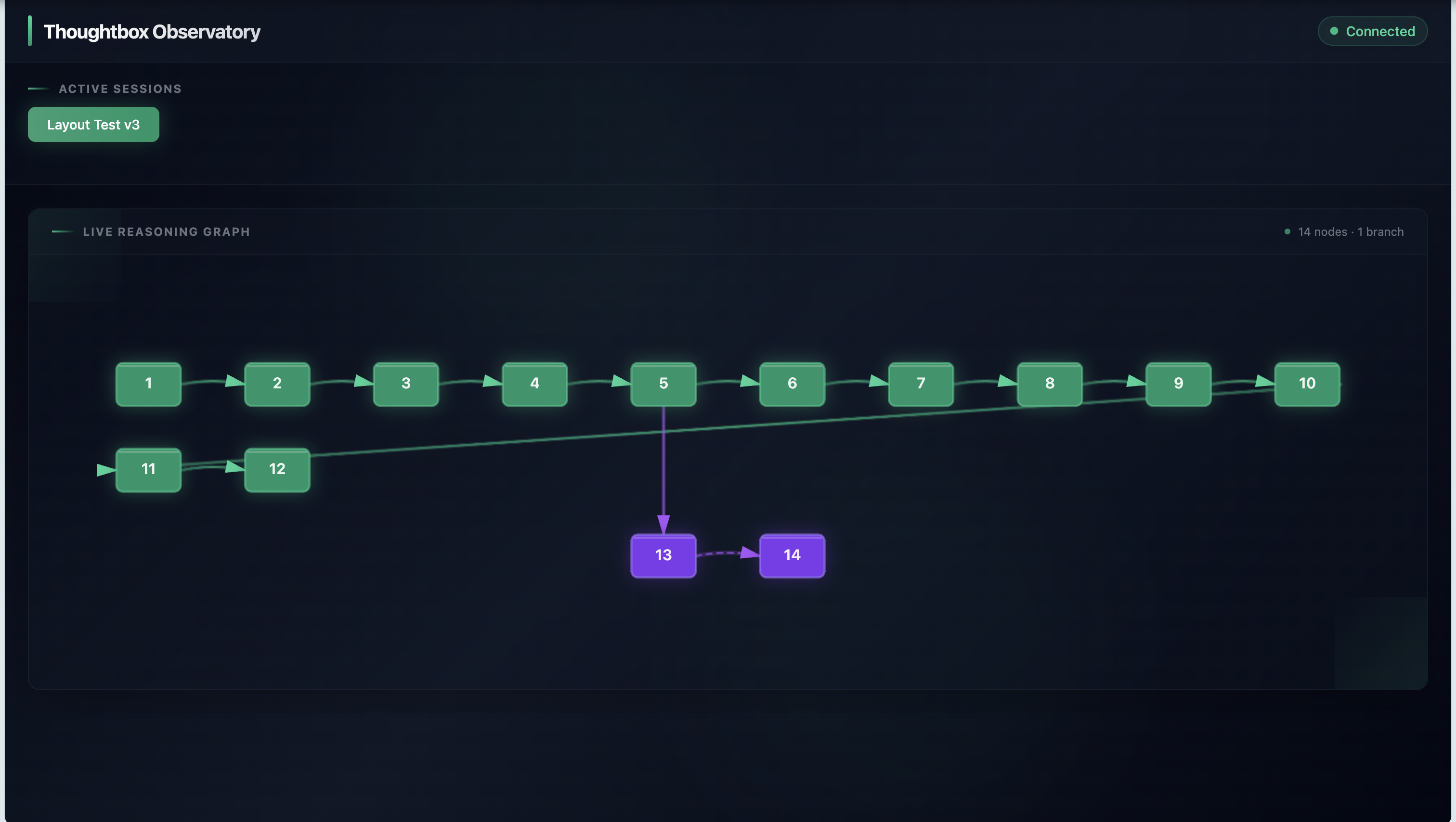 Observatory UI showing a reasoning session with 14 thoughts and a branch exploration (purple nodes 13-14) forking from thought 5.
Core Concepts
The Reasoning Ledger
Thoughtbox treats reasoning as data, not just process. Every thought is:
Numbered: Logical position in the reasoning chain (supports non-sequential addition)
Timestamped: When the thought was recorded
Linked: Connected to previous thoughts, branch origins, or revised thoughts
Persistent: Stored in sessions that survive across conversations
Exportable: Full reasoning chains can be exported as JSON or Markdown
This creates an auditable trail of how conclusions were reached — invaluable for debugging agent behavior, understanding decision-making, and improving reasoning strategies.
Thinking Patterns
Thoughtbox supports multiple reasoning strategies out of the box:
Pattern | Description | Use Case |
Forward Thinking | Sequential 1→2→3→N progression | Exploration, discovery, open-ended analysis |
Backward Thinking | Start at goal (N), work back to start (1) | Planning, system design, working from known goals |
Branching | Fork into parallel explorations (A, B, C...) | Comparing alternatives, A/B scenarios |
Revision | Update earlier thoughts with new information | Error correction, refined understanding |
Interleaved | Alternate reasoning with tool actions | Tool-oriented tasks, adaptive execution |
See the Patterns Cookbook for comprehensive examples.
Features
1. Thoughtbox Tool — Structured Reasoning
The core tool for step-by-step thinking with full graph capabilities.
// Simple forward thinking
{ thought: "First, let's identify the problem...", thoughtNumber: 1, totalThoughts: 5, nextThoughtNeeded: true }

// Branching to explore alternatives
{ thought: "Option A: Use PostgreSQL...", thoughtNumber: 3, branchFromThought: 2, branchId: "sql-path", ... }

// Revising an earlier conclusion
{ thought: "Actually, the root cause is...", thoughtNumber: 7, isRevision: true, revisesThought: 3, ... }
Parameters:
thought(string): The current thinking stepthoughtNumber(integer): Logical position in the chaintotalThoughts(integer): Estimated total (adjustable)nextThoughtNeeded(boolean): Continue thinking?branchFromThought(integer): Fork point for branchingbranchId(string): Branch identifierisRevision(boolean): Marks revision of earlier thoughtrevisesThought(integer): Which thought is being revised
2. Observatory — Real-Time Visualization
A built-in web UI for watching reasoning unfold in real-time.
Features:
Live Graph: Watch thoughts appear as they're added
Snake Layout: Compact left-to-right flow with row wrapping
Hierarchical Branches: Branches collapse into clickable stub nodes (A, B, C...)
Navigation: Click stubs to explore branches, back button to return
Detail Panel: Click any node to view full thought content
Multi-Session: Switch between active reasoning sessions
Access: The Observatory is available at http://localhost:1729 when the server is running.
3. Mental Models — Reasoning Frameworks
15 structured mental models that provide process scaffolds for different problem types.
Available Models:
rubber-duck— Explain to clarify thinkingfive-whys— Root cause analysispre-mortem— Anticipate failuressteelmanning— Strengthen opposing argumentsfermi-estimation— Order-of-magnitude reasoningtrade-off-matrix— Multi-criteria decisionsdecomposition— Break down complexityinversion— Solve by avoiding failureAnd 7 more...
Operations:
get_model— Retrieve a specific model's promptlist_models— List all models (filter by tag)list_tags— Available categories (debugging, planning, decision-making, etc.)
4. Notebook — Literate Programming
Interactive notebooks combining documentation with executable JavaScript/TypeScript.
Features:
Isolated execution environments per notebook
Full package.json support with dependency installation
Sequential Feynman template for deep learning workflows
Export to
.src.mdformat
Operations: create, add_cell, run_cell, export, list, load, update_cell
Installation
Quick Start
npx -y @kastalien-research/thoughtboxMCP Client Configuration
Claude Code
Add to your ~/.claude/settings.json or project .claude/settings.json:
{
  "mcpServers": {
    "thoughtbox": {
      "command": "npx",
      "args": ["-y", "@kastalien-research/thoughtbox"]
    }
  }
}
Cline / VS Code
Add to your MCP settings or .vscode/mcp.json:
{
  "servers": {
    "thoughtbox": {
      "command": "npx",
      "args": ["-y", "@kastalien-research/thoughtbox"]
    }
  }
}
Usage Examples
Forward Thinking — Problem Analysis
Thought 1: "Users report slow checkout. Let's analyze..."
Thought 2: "Data shows 45s average, target is 10s..."
Thought 3: "Root causes: 3 API calls, no caching..."
Thought 4: "Options: Redis cache, query optimization, parallel calls..."
Thought 5: "Recommendation: Implement Redis cache for product data"
Backward Thinking — System Design
Thought 8: [GOAL] "System handles 10k req/s with <100ms latency"
Thought 7: "Before that: monitoring and alerting operational"
Thought 6: "Before that: resilience patterns implemented"
Thought 5: "Before that: caching layer with invalidation"
...
Thought 1: [START] "Current state: 1k req/s, 500ms latency"
Branching — Comparing Alternatives
Thought 4: "Need to choose database architecture..."

Branch A (thought 5): branchId="sql-path"
  "PostgreSQL: ACID compliance, mature tooling, relational integrity"

Branch B (thought 5): branchId="nosql-path"
  "MongoDB: Flexible schema, horizontal scaling, document model"

Thought 6: [SYNTHESIS] "Use PostgreSQL for transactions, MongoDB for analytics"
Environment Variables
DISABLE_THOUGHT_LOGGING=true— Suppress thought logging to stderr
Development
# Install dependencies
npm install

# Build
npm run build

# Development with hot reload
npm run dev

# Run the server
npm start
Architecture
src/
├── index.ts              # MCP server entry point
├── persistence/          # Session and thought storage
│   └── storage.ts        # In-memory storage with linked thought chains
├── observatory/          # Real-time visualization
│   ├── ui/               # Self-contained HTML/CSS/JS
│   ├── ws-server.ts      # WebSocket server for live updates
│   └── emitter.ts        # Event emission for thought changes
├── mental-models/        # 15 reasoning frameworks
├── notebook/             # Literate programming engine
└── resources/            # Documentation and patterns cookbook
License
MIT License — free to use, modify, and distribute.
This server cannot be installed
Resources
Looking for Admin?
Admins can modify the Dockerfile, update the server description, and track usage metrics. If you are the server author, to access the admin panel.