A
licenseA
qualityD
maintenanceAn improved implementation of persistent memory using a local knowledge graph with a customizable --memory-path. This lets Claude remember information about the user across chats.
10
283 npm
890
MIT

The Knowledge Graph Memory Server enables persistent memory management using a local knowledge graph that allows Claude to remember information across conversations. It provides comprehensive CRUD operations for:
Entities: Create with names, types, and observations; update types and observations; delete entities (removes associated relations); retrieve specific entities by name; search across names, types, and observation content.
Relations: Establish directed connections between entities in active voice; update existing relations; delete specific relations.
Observations: Add factual information to existing entities; remove specific observations from entities.
Graph Operations: Read the entire knowledge graph structure; search nodes by query; open specific nodes with their relations.
Click on "Deploy Server".
Wait a few minutes for the server to deploy. Once ready, it will show a "Started" state.
In the chat, type @ followed by the MCP server name and your instructions, e.g., "@Knowledge Graph Memory Server remember that I prefer dark mode and work as a software engineer"
That's it! The server will respond to your query, and you can continue using it as needed.
Here is a step-by-step guide with screenshots.
An improved implementation of persistent memory using a local knowledge graph with a customizable memory path.
This lets Claude remember information about the user across chats.
This is a fork of the originalMemory Server and is intended to not use the ephemeral memory npx installation method.
mcp-knowledge-graph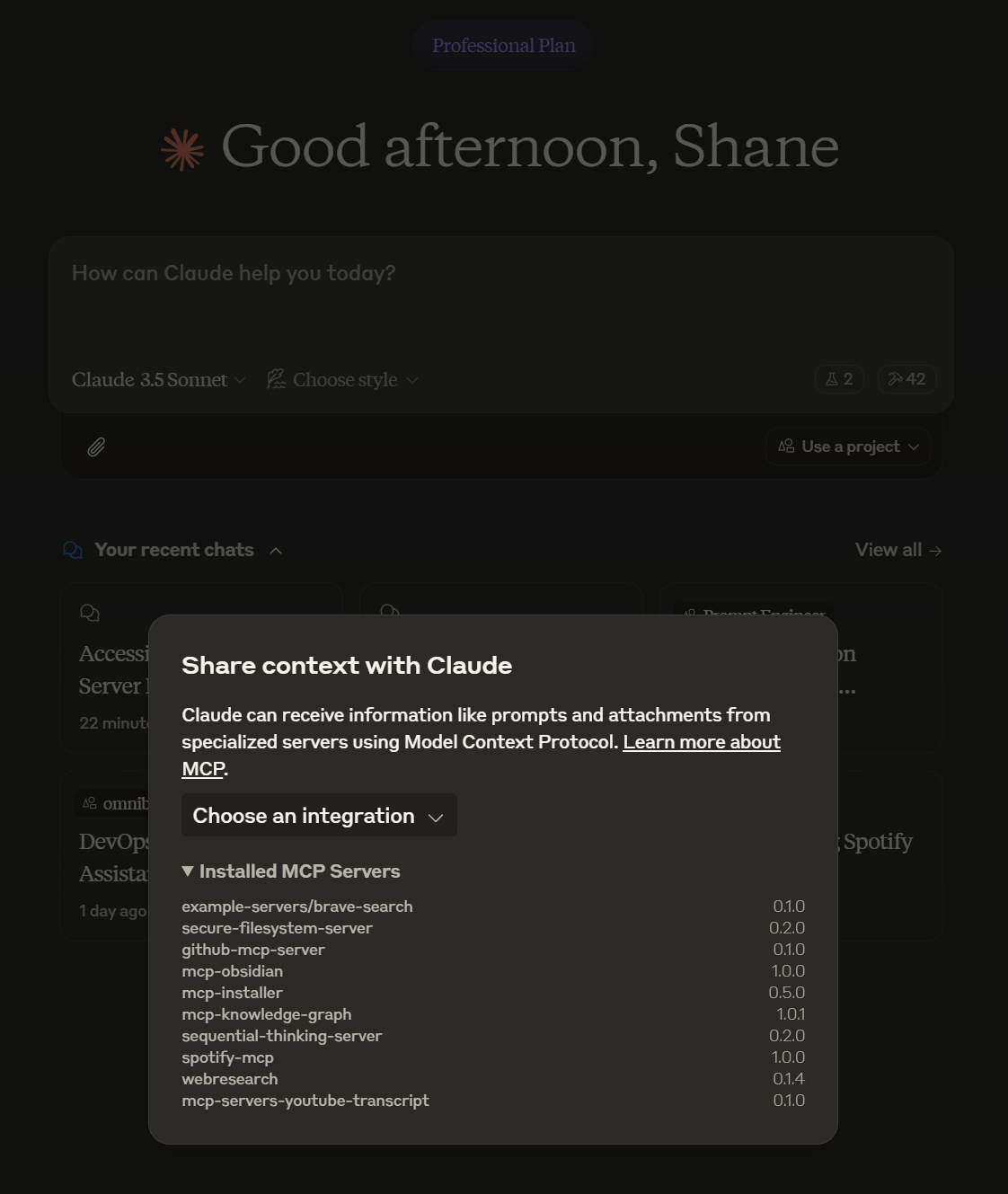

Related MCP server: Knowledge Graph Memory Server
Entities are the primary nodes in the knowledge graph. Each entity has:
A unique name (identifier)
An entity type (e.g., "person", "organization", "event")
A list of observations
Creation date and version tracking
The version tracking feature helps maintain a historical context of how knowledge evolves over time.
Example:
{
  "name": "John_Smith",
  "entityType": "person",
  "observations": ["Speaks fluent Spanish"]
}
Relations define directed connections between entities. They are always stored in active voice and describe how entities interact or relate to each other. Each relation includes:
Source and target entities
Relationship type
Creation date and version information
This versioning system helps track how relationships between entities evolve over time.
Example:
{
  "from": "John_Smith",
  "to": "Anthropic",
  "relationType": "works_at"
}
Observations are discrete pieces of information about an entity. They are:
Stored as strings
Attached to specific entities
Can be added or removed independently
Should be atomic (one fact per observation)
Example:
{
  "entityName": "John_Smith",
  "observations": [
    "Speaks fluent Spanish",
    "Graduated in 2019",
    "Prefers morning meetings"
  ]
}create_entities
Create multiple new entities in the knowledge graph
Input: entities (array of objects)
Each object contains:
name (string): Entity identifier
entityType (string): Type classification
observations (string[]): Associated observations
Ignores entities with existing names
create_relations
Create multiple new relations between entities
Input: relations (array of objects)
Each object contains:
from (string): Source entity name
to (string): Target entity name
relationType (string): Relationship type in active voice
Skips duplicate relations
add_observations
Add new observations to existing entities
Input: observations (array of objects)
Each object contains:
entityName (string): Target entity
contents (string[]): New observations to add
Returns added observations per entity
Fails if entity doesn't exist
delete_entities
Remove entities and their relations
Input: entityNames (string[])
Cascading deletion of associated relations
Silent operation if entity doesn't exist
delete_observations
Remove specific observations from entities
Input: deletions (array of objects)
Each object contains:
entityName (string): Target entity
observations (string[]): Observations to remove
Silent operation if observation doesn't exist
delete_relations
Remove specific relations from the graph
Input: relations (array of objects)
Each object contains:
from (string): Source entity name
to (string): Target entity name
relationType (string): Relationship type
Silent operation if relation doesn't exist
read_graph
Read the entire knowledge graph
No input required
Returns complete graph structure with all entities and relations
search_nodes
Search for nodes based on query
Input: query (string)
Searches across:
Entity names
Entity types
Observation content
Returns matching entities and their relations
open_nodes
Retrieve specific nodes by name
Input: names (string[])
Returns:
Requested entities
Relations between requested entities
Silently skips non-existent nodes
Add this to your mcp.json or claude_desktop_config.json:
{
    "mcpServers": {
      "memory": {
        "command": "npx",
        "args": [
          "-y",
          "@itseasy21/mcp-knowledge-graph"
        ],
        "env": {
          "MEMORY_FILE_PATH": "/path/to/your/projects.jsonl"
        }
      }
    }
}To install Knowledge Graph Memory Server for Claude Desktop automatically via Smithery:
npx -y @smithery/cli install @itseasy21/mcp-knowledge-graph --client claudeYou can specify a custom path for the memory file in two ways:
Using command-line arguments:
{
  "mcpServers": {
    "memory": {
      "command": "npx",
      "args": ["-y", "@itseasy21/mcp-knowledge-graph", "--memory-path", "/path/to/your/memory.jsonl"]
    }
  }
}
Using environment variables:
{
  "mcpServers": {
    "memory": {
      "command": "npx",
      "args": ["-y", "@itseasy21/mcp-knowledge-graph"],
      "env": {
        "MEMORY_FILE_PATH": "/path/to/your/memory.jsonl"
      }
    }
  }
}
If no path is specified, it will default to memory.jsonl in the server's installation directory.
The prompt for utilizing memory depends on the use case. Changing the prompt will help the model determine the frequency and types of memories created.
Here is an example prompt for chat personalization. You could use this prompt in the "Custom Instructions" field of a Claude.ai Project.
Follow these steps for each interaction:

1. User Identification:
   - You should assume that you are interacting with default_user
   - If you have not identified default_user, proactively try to do so.

2. Memory Retrieval:
   - Always begin your chat by saying only "Remembering..." and retrieve all relevant information from your knowledge graph
   - Always refer to your knowledge graph as your "memory"

3. Memory
   - While conversing with the user, be attentive to any new information that falls into these categories:
     a) Basic Identity (age, gender, location, job title, education level, etc.)
     b) Behaviors (interests, habits, etc.)
     c) Preferences (communication style, preferred language, etc.)
     d) Goals (goals, targets, aspirations, etc.)
     e) Relationships (personal and professional relationships up to 3 degrees of separation)

4. Memory Update:
   - If any new information was gathered during the interaction, update your memory as follows:
     a) Create entities for recurring organizations, people, and significant events
     b) Connect them to the current entities using relations
b) Store facts about them as observationsThis MCP server is licensed under the MIT License. This means you are free to use, modify, and distribute the software, subject to the terms and conditions of the MIT License. For more details, please see the LICENSE file in the project repository.
Add new observations to existing entities in the knowledge graph
| Name | Required | Description | Default |
|---|---|---|---|
| observations | Yes |
Does the description disclose side effects, auth requirements, rate limits, or destructive behavior?
With no annotations provided, the description must disclose behavioral traits on its own. It only states that it adds observations, without detailing whether observations are appended or replaced, what happens if the entity does not exist (e.g., error or auto-creation), or any other side effects. The tool is clearly a write operation, but critical safety and behavior information is missing.
Agents need to know what a tool does to the world before calling it. Descriptions should go beyond structured annotations to explain consequences.
Is the description appropriately sized, front-loaded, and free of redundancy?
The description is a single, concise sentence that immediately conveys the tool's core function. There is no fluff or redundant phrasing, and the primary verb and object are front-loaded. It earns a high score for efficiency.
Shorter descriptions cost fewer tokens and are easier for agents to parse. Every sentence should earn its place.
Given the tool's complexity, does the description cover enough for an agent to succeed on first attempt?
Given that there are no annotations and no output schema, the description must provide comprehensive context on its own. However, it only gives a high-level statement and lacks necessary details about input requirements, validation, error handling, or effect on existing data. This leaves significant gaps in the agent's understanding of the tool's full behavior.
Complex tools with many parameters or behaviors need more documentation. Simple tools need less. This dimension scales expectations accordingly.
Does the description clarify parameter syntax, constraints, interactions, or defaults beyond what the schema provides?
The schema has zero coverage for the top-level parameter, and the description does not compensate by explaining the parameter structure. Although the nested schema properties describe entityName and contents, the description adds no semantic value beyond the schema, and the agent must rely solely on the schema to understand that observations is an array of objects with those fields. This is insufficient given the low schema coverage.
Input schemas describe structure but not intent. Descriptions should explain non-obvious parameter relationships and valid value ranges.
Does the description clearly state what the tool does and how it differs from similar tools?
The description uses a specific verb 'Add' and identifies the resource 'observations' and the target 'existing entities' within the knowledge graph. This clearly distinguishes it from sibling tools like create_entities (which creates entities) and delete_observations (which removes observations), making the tool's purpose unambiguous.
Agents choose between tools based on descriptions. A clear purpose with a specific verb and resource helps agents select the right tool.
Does the description explain when to use this tool, when not to, or what alternatives exist?
The description implies that this tool is used when adding observations to existing entities, but it does not explicitly state when to use it over alternatives or provide any comparison with sibling tools. There is no mention of constraints such as 'only for existing entities' or guidance about creating entities first. Thus, the usage context is implied rather than explicitly outlined.
Agents often have multiple tools that could apply. Explicit usage guidance like "use X instead of Y when Z" prevents misuse.
Create multiple new entities in the knowledge graph
| Name | Required | Description | Default |
|---|---|---|---|
| entities | Yes |
Does the description disclose side effects, auth requirements, rate limits, or destructive behavior?
With no annotations provided, the description carries the full burden of behavioral disclosure. It only states that it creates entities, but does not mention potential duplicate handling, overwrite behavior, validation rules, or whether the operation is atomic—information an agent would need for a mutating tool.
Agents need to know what a tool does to the world before calling it. Descriptions should go beyond structured annotations to explain consequences.
Is the description appropriately sized, front-loaded, and free of redundancy?
The description is a single, front-loaded sentence that communicates the core purpose with no filler. It is appropriately concise for a simple tool.
Shorter descriptions cost fewer tokens and are easier for agents to parse. Every sentence should earn its place.
Given the tool's complexity, does the description cover enough for an agent to succeed on first attempt?
Given the absence of annotations, an output schema, and limited schema coverage, the description should offer more context about usage, side effects, or return behavior. It does not, leaving significant gaps for an agent to make assumptions about how the tool behaves.
Complex tools with many parameters or behaviors need more documentation. Simple tools need less. This dimension scales expectations accordingly.
Does the description clarify parameter syntax, constraints, interactions, or defaults beyond what the schema provides?
The schema's top-level 'entities' parameter has no description (coverage 0%), and the tool description does not explain what constitutes an entity (name, type, observations). The description adds no value beyond the bare phrase 'multiple new entities,' failing to compensate for the schema gap.
Input schemas describe structure but not intent. Descriptions should explain non-obvious parameter relationships and valid value ranges.
Does the description clearly state what the tool does and how it differs from similar tools?
The description uses a specific verb ('Create') and a specific resource ('multiple new entities in the knowledge graph'), clearly distinguishing this from sibling tools like create_relations and add_observations. It is explicit and unambiguous.
Agents choose between tools based on descriptions. A clear purpose with a specific verb and resource helps agents select the right tool.
Does the description explain when to use this tool, when not to, or what alternatives exist?
The description provides no guidance on when to use this tool versus alternatives. It does not mention create_relations, add_observations, or any exclusions, leaving the agent to infer selection based solely on the name.
Agents often have multiple tools that could apply. Explicit usage guidance like "use X instead of Y when Z" prevents misuse.
Create multiple new relations between entities in the knowledge graph. Relations should be in active voice
| Name | Required | Description | Default |
|---|---|---|---|
| relations | Yes |
Does the description disclose side effects, auth requirements, rate limits, or destructive behavior?
With no annotations, the description carries the full burden of behavioral disclosure. It only states 'create' and offers an active-voice guideline, but does not mention idempotency, validation of from/to entities, behavior on duplicates, or error handling.
Agents need to know what a tool does to the world before calling it. Descriptions should go beyond structured annotations to explain consequences.
Is the description appropriately sized, front-loaded, and free of redundancy?
The description is a single sentence with a brief second clause. Every word earns its place and the main purpose is front-loaded.
Shorter descriptions cost fewer tokens and are easier for agents to parse. Every sentence should earn its place.
Given the tool's complexity, does the description cover enough for an agent to succeed on first attempt?
For a mutation tool with no annotations or output schema, the description is too sparse. It omits critical details such as whether from/to entities must already exist, how duplicates are handled, and whether creation is atomic for the batch.
Complex tools with many parameters or behaviors need more documentation. Simple tools need less. This dimension scales expectations accordingly.
Does the description clarify parameter syntax, constraints, interactions, or defaults beyond what the schema provides?
Schema description coverage is 0% at the top level, so the description needed to compensate. It adds the active-voice guideline but does not explain the structure of the relations array or the meaning of from/to/relationType, which the schema already partially covers.
Input schemas describe structure but not intent. Descriptions should explain non-obvious parameter relationships and valid value ranges.
Does the description clearly state what the tool does and how it differs from similar tools?
The description clearly states the action (create), the object (multiple new relations), and the context (knowledge graph). It distinguishes from siblings like delete_relations and create_entities.
Agents choose between tools based on descriptions. A clear purpose with a specific verb and resource helps agents select the right tool.
Does the description explain when to use this tool, when not to, or what alternatives exist?
The description implies this tool is for creating relations, but it does not explicitly state when to use it versus alternatives or mention any prerequisites. The active-voice guideline is a style note, not usage guidance.
Agents often have multiple tools that could apply. Explicit usage guidance like "use X instead of Y when Z" prevents misuse.
Delete multiple entities and their associated relations from the knowledge graph
| Name | Required | Description | Default |
|---|---|---|---|
| entityNames | Yes | An array of entity names to delete |
Does the description disclose side effects, auth requirements, rate limits, or destructive behavior?
No annotations are provided, so the description carries the full burden. It does disclose that associated relations are deleted as part of the operation, which is a useful behavioral detail. However, it does not mention irreversibility, permissions, or whether observations are affected, leaving gaps in transparency.
Agents need to know what a tool does to the world before calling it. Descriptions should go beyond structured annotations to explain consequences.
Is the description appropriately sized, front-loaded, and free of redundancy?
The description is a single concise sentence that front-loads the action and scope with no unnecessary words. Every word contributes to understanding the tool's purpose.
Shorter descriptions cost fewer tokens and are easier for agents to parse. Every sentence should earn its place.
Given the tool's complexity, does the description cover enough for an agent to succeed on first attempt?
For a simple one-parameter destructive tool with no output schema, the description conveys the core purpose but omits behavioral details such as error handling, atomicity, and return values. Given the lack of annotations, it is moderately complete but has room for improvement.
Complex tools with many parameters or behaviors need more documentation. Simple tools need less. This dimension scales expectations accordingly.
Does the description clarify parameter syntax, constraints, interactions, or defaults beyond what the schema provides?
The input schema has 100% coverage of the parameter 'entityNames' with a description, so the baseline is 3. The tool description does not add any additional parameter semantics beyond what the schema already provides.
Input schemas describe structure but not intent. Descriptions should explain non-obvious parameter relationships and valid value ranges.
Does the description clearly state what the tool does and how it differs from similar tools?
The description clearly states the tool deletes multiple entities and their associated relations, using a specific verb ('Delete') and resource ('entities' and 'relations'). It distinguishes itself from sibling tools like delete_relations, which only handle relations, and delete_observations, which handles observations.
Agents choose between tools based on descriptions. A clear purpose with a specific verb and resource helps agents select the right tool.
Does the description explain when to use this tool, when not to, or what alternatives exist?
The description provides no guidance on when to use this tool versus alternatives such as delete_relations or delete_observations. It does not state any exclusions, prerequisites, or scenarios where another tool would be more appropriate.
Agents often have multiple tools that could apply. Explicit usage guidance like "use X instead of Y when Z" prevents misuse.
Delete specific observations from entities in the knowledge graph
| Name | Required | Description | Default |
|---|---|---|---|
| deletions | Yes |
Does the description disclose side effects, auth requirements, rate limits, or destructive behavior?
No annotations are provided, so the description must disclose behavioral traits. It only states the action without mentioning permanence, side effects, required permissions, or return format. As a mutation tool, this is insufficient.
Agents need to know what a tool does to the world before calling it. Descriptions should go beyond structured annotations to explain consequences.
Is the description appropriately sized, front-loaded, and free of redundancy?
The description is a single sentence that directly conveys the core action, with no unnecessary words. It is well-structured and front-loaded.
Shorter descriptions cost fewer tokens and are easier for agents to parse. Every sentence should earn its place.
Given the tool's complexity, does the description cover enough for an agent to succeed on first attempt?
The tool has a non-trivial parameter schema and no output schema or annotations. The description is too minimal to fully inform usage, lacking details on how to specify deletions and what to expect in response.
Complex tools with many parameters or behaviors need more documentation. Simple tools need less. This dimension scales expectations accordingly.
Does the description clarify parameter syntax, constraints, interactions, or defaults beyond what the schema provides?
The description does not explain the 'deletions' parameter structure. Schema coverage is 0% for the top-level parameter, and the description adds no semantic meaning beyond the schema's nested field descriptions.
Input schemas describe structure but not intent. Descriptions should explain non-obvious parameter relationships and valid value ranges.
Does the description clearly state what the tool does and how it differs from similar tools?
The description clearly states the function: deleting specific observations from entities in a knowledge graph. It distinguishes itself from sibling tools like delete_entities and add_observations by specifying the granularity ('specific observations').
Agents choose between tools based on descriptions. A clear purpose with a specific verb and resource helps agents select the right tool.
Does the description explain when to use this tool, when not to, or what alternatives exist?
No guidance on when to use this tool versus alternatives such as delete_entities or when not to use it. The description lacks any context or conditions for usage.
Agents often have multiple tools that could apply. Explicit usage guidance like "use X instead of Y when Z" prevents misuse.
Delete multiple relations from the knowledge graph
| Name | Required | Description | Default |
|---|---|---|---|
| relations | Yes | An array of relations to delete |
Does the description disclose side effects, auth requirements, rate limits, or destructive behavior?
With no annotations, the description must convey behavioral traits, but it only says 'Delete' without mentioning consequences such as irreversibility, partial failure handling, or permissions. For a mutating operation, this is a significant gap.
Agents need to know what a tool does to the world before calling it. Descriptions should go beyond structured annotations to explain consequences.
Is the description appropriately sized, front-loaded, and free of redundancy?
The description is a single sentence that is direct and front-loaded. Every word earns its place, and there is no redundant information.
Shorter descriptions cost fewer tokens and are easier for agents to parse. Every sentence should earn its place.
Given the tool's complexity, does the description cover enough for an agent to succeed on first attempt?
The tool is simple with one well-specified parameter and no output schema, so the core purpose is covered. However, behavioral details like error handling, atomicity, or effects on related entities are absent, which leaves some ambiguity for an agent.
Complex tools with many parameters or behaviors need more documentation. Simple tools need less. This dimension scales expectations accordingly.
Does the description clarify parameter syntax, constraints, interactions, or defaults beyond what the schema provides?
The input schema fully describes the 'relations' parameter and its nested properties (from, to, relationType), so the description adds little beyond what is already structured. The phrase 'multiple' aligns with the array type but does not provide extra meaning.
Input schemas describe structure but not intent. Descriptions should explain non-obvious parameter relationships and valid value ranges.
Does the description clearly state what the tool does and how it differs from similar tools?
The description clearly states a specific action ('Delete') on a specific resource ('relations'), and the plural 'multiple relations' distinguishes this from sibling tools like delete_entities and delete_observations. It is concise and unambiguous.
Agents choose between tools based on descriptions. A clear purpose with a specific verb and resource helps agents select the right tool.
Does the description explain when to use this tool, when not to, or what alternatives exist?
The description implies usage for deleting one or more relations, but it does not explicitly state when to prefer this over alternatives, nor does it mention any exclusions or prerequisites. It provides only minimal contextual guidance.
Agents often have multiple tools that could apply. Explicit usage guidance like "use X instead of Y when Z" prevents misuse.
Open specific nodes in the knowledge graph by their names
| Name | Required | Description | Default |
|---|---|---|---|
| names | Yes | An array of entity names to retrieve |
Does the description disclose side effects, auth requirements, rate limits, or destructive behavior?
With no annotations, the description carries the full burden of disclosing behavior. It only says 'open', which implies read-only retrieval, but does not explicitly state that it is non-mutating, what it returns, or how missing names are handled. This leaves significant ambiguity.
Agents need to know what a tool does to the world before calling it. Descriptions should go beyond structured annotations to explain consequences.
Is the description appropriately sized, front-loaded, and free of redundancy?
The description is a single, efficiently worded sentence that directly states the action and resource. It contains no filler or redundant information.
Shorter descriptions cost fewer tokens and are easier for agents to parse. Every sentence should earn its place.
Given the tool's complexity, does the description cover enough for an agent to succeed on first attempt?
The tool has no output schema and the description does not clarify what 'open' returns (e.g., node attributes, observations, relations). For an agent to invoke the tool and interpret results correctly, this missing information is a notable gap.
Complex tools with many parameters or behaviors need more documentation. Simple tools need less. This dimension scales expectations accordingly.
Does the description clarify parameter syntax, constraints, interactions, or defaults beyond what the schema provides?
The input schema has 100% coverage, already describing 'names' as 'An array of entity names to retrieve'. The tool description merely restates 'by their names', adding no extra semantic detail beyond the schema, so the baseline of 3 applies.
Input schemas describe structure but not intent. Descriptions should explain non-obvious parameter relationships and valid value ranges.
Does the description clearly state what the tool does and how it differs from similar tools?
The description uses the specific verb 'Open' and identifies the resource 'nodes in the knowledge graph', scoped by 'names', making it clear this is a direct retrieval by exact names. It implicitly differentiates from search_nodes (searching) and read_graph (full graph), but does not explicitly name alternatives.
Agents choose between tools based on descriptions. A clear purpose with a specific verb and resource helps agents select the right tool.
Does the description explain when to use this tool, when not to, or what alternatives exist?
No guidance is given on when to use this tool versus siblings. The description does not state that it should be used when exact node names are known, nor does it exclude using search_nodes for lookup or read_graph for broader context.
Agents often have multiple tools that could apply. Explicit usage guidance like "use X instead of Y when Z" prevents misuse.
Read the entire knowledge graph
| Name | Required | Description | Default |
|---|---|---|---|
No parameters | |||
Does the description disclose side effects, auth requirements, rate limits, or destructive behavior?
With no annotations, the description must carry the full burden of behavioral disclosure, but it only states that the graph is read. It does not mention that the operation is read-only, whether it requires permissions, or that the response may be very large. The word 'read' implies non-destructive behavior, but no details are given.
Agents need to know what a tool does to the world before calling it. Descriptions should go beyond structured annotations to explain consequences.
Is the description appropriately sized, front-loaded, and free of redundancy?
The description is a single, concise sentence that directly states the tool's purpose with no redundancy. It is well-structured and every word contributes to the meaning.
Shorter descriptions cost fewer tokens and are easier for agents to parse. Every sentence should earn its place.
Given the tool's complexity, does the description cover enough for an agent to succeed on first attempt?
Given the lack of annotations and output schema, the description should explain what reading the graph returns or any caveats (e.g., large payloads). It does not, and it also fails to differentiate this tool from search_nodes for partial reads. The tool is simple, but the description is still incomplete for an agent to use it confidently.
Complex tools with many parameters or behaviors need more documentation. Simple tools need less. This dimension scales expectations accordingly.
Does the description clarify parameter syntax, constraints, interactions, or defaults beyond what the schema provides?
The tool has zero parameters and the schema is empty, so there is nothing to document. The baseline for zero parameters is 4, and the description correctly indicates that no inputs are needed, without adding unnecessary detail.
Input schemas describe structure but not intent. Descriptions should explain non-obvious parameter relationships and valid value ranges.
Does the description clearly state what the tool does and how it differs from similar tools?
The description uses a specific verb 'read' and identifies the resource 'the entire knowledge graph,' clearly distinguishing it from sibling tools that create or delete entities. However, it is brief and doesn't elaborate on the output format or how it differs from export_to_obsidian, so it falls short of a perfect score.
Agents choose between tools based on descriptions. A clear purpose with a specific verb and resource helps agents select the right tool.
Does the description explain when to use this tool, when not to, or what alternatives exist?
The description provides no explicit guidance on when to use this tool over alternatives like search_nodes or open_nodes. It is only implied that this is for reading the whole graph, with no mention of filtering or use cases.
Agents often have multiple tools that could apply. Explicit usage guidance like "use X instead of Y when Z" prevents misuse.
Search for nodes in the knowledge graph based on a query
| Name | Required | Description | Default |
|---|---|---|---|
| query | Yes | The search query to match against entity names, types, and observation content |
Does the description disclose side effects, auth requirements, rate limits, or destructive behavior?
With no annotations, the description carries the full burden. It describes the action as 'search' but does not disclose key behaviors such as case sensitivity, partial matching, result limits, ordering, or whether it searches across all entity fields or just specific ones.
Agents need to know what a tool does to the world before calling it. Descriptions should go beyond structured annotations to explain consequences.
Is the description appropriately sized, front-loaded, and free of redundancy?
The description is a single sentence with no wasted words, but it is vague and lacks structure. It could be improved by adding brief details or examples without increasing length significantly.
Shorter descriptions cost fewer tokens and are easier for agents to parse. Every sentence should earn its place.
Given the tool's complexity, does the description cover enough for an agent to succeed on first attempt?
For a simple one-parameter tool without an output schema, the description is minimally adequate. However, given the presence of sibling tools with overlapping functionality, more context (e.g., search scope, result format) would make it complete.
Complex tools with many parameters or behaviors need more documentation. Simple tools need less. This dimension scales expectations accordingly.
Does the description clarify parameter syntax, constraints, interactions, or defaults beyond what the schema provides?
The schema covers 100% of the parameter with a description that explains what the query matches against. The tool description restates 'based on a query' but adds no additional semantics beyond the schema, so baseline 3 applies.
Input schemas describe structure but not intent. Descriptions should explain non-obvious parameter relationships and valid value ranges.
Does the description clearly state what the tool does and how it differs from similar tools?
The description clearly states the tool searches for nodes in the knowledge graph based on a query, which is specific enough to distinguish from siblings like 'traverse_graph' or 'query_by_time'. However, it could be more precise (e.g., specifying it's a full-text search).
Agents choose between tools based on descriptions. A clear purpose with a specific verb and resource helps agents select the right tool.
Does the description explain when to use this tool, when not to, or what alternatives exist?
The description provides no guidance on when to use this tool versus alternatives (e.g., 'query_by_time', 'traverse_graph', 'read_graph'). No exclusions or context for selection are given.
Agents often have multiple tools that could apply. Explicit usage guidance like "use X instead of Y when Z" prevents misuse.
Update multiple existing entities in the knowledge graph
| Name | Required | Description | Default |
|---|---|---|---|
| entities | Yes |
Does the description disclose side effects, auth requirements, rate limits, or destructive behavior?
With no annotations provided, the description carries the full burden of behavioral disclosure. It mentions 'update' which implies mutation, but fails to detail critical aspects such as required permissions, whether updates are atomic or batch, error handling for invalid entities, or impact on existing data. This leaves significant gaps in understanding the tool's behavior.
Agents need to know what a tool does to the world before calling it. Descriptions should go beyond structured annotations to explain consequences.
Is the description appropriately sized, front-loaded, and free of redundancy?
The description is a single, efficient sentence with no wasted words, making it easy to parse. It front-loads the key action ('update') and resource, though it could benefit from more detail given the tool's complexity.
Shorter descriptions cost fewer tokens and are easier for agents to parse. Every sentence should earn its place.
Given the tool's complexity, does the description cover enough for an agent to succeed on first attempt?
Given the tool's mutation nature, lack of annotations, no output schema, and 0% schema description coverage, the description is incomplete. It doesn't address return values, error cases, or behavioral nuances, making it inadequate for safe and effective use by an AI agent in this context.
Complex tools with many parameters or behaviors need more documentation. Simple tools need less. This dimension scales expectations accordingly.
Does the description clarify parameter syntax, constraints, interactions, or defaults beyond what the schema provides?
The schema description coverage is 0%, so the description must compensate for undocumented parameters. It only mentions 'entities' broadly without explaining the structure (e.g., 'name', 'entityType', 'observations') or their roles in updates. This adds minimal value beyond the schema, failing to clarify parameter meanings effectively.
Input schemas describe structure but not intent. Descriptions should explain non-obvious parameter relationships and valid value ranges.
Does the description clearly state what the tool does and how it differs from similar tools?
The description clearly states the verb ('update') and resource ('multiple existing entities in the knowledge graph'), making the purpose understandable. However, it doesn't distinguish this tool from its sibling 'update_relations' or specify what aspects of entities are updated (e.g., types, observations), leaving room for improvement in sibling differentiation.
Agents choose between tools based on descriptions. A clear purpose with a specific verb and resource helps agents select the right tool.
Does the description explain when to use this tool, when not to, or what alternatives exist?
The description provides no guidance on when to use this tool versus alternatives like 'create_entities' for new entities or 'update_relations' for different graph components. It lacks context on prerequisites (e.g., entities must exist) or exclusions, offering minimal usage direction.
Agents often have multiple tools that could apply. Explicit usage guidance like "use X instead of Y when Z" prevents misuse.
Update multiple existing relations in the knowledge graph
| Name | Required | Description | Default |
|---|---|---|---|
| relations | Yes |
Does the description disclose side effects, auth requirements, rate limits, or destructive behavior?
With no annotations provided, the description carries the full burden of behavioral disclosure. It states 'Update multiple existing relations' which implies mutation, but doesn't cover critical aspects like required permissions, whether updates are atomic or batched, error handling, or what happens if relations don't exist. This is inadequate for a mutation tool with zero annotation coverage.
Agents need to know what a tool does to the world before calling it. Descriptions should go beyond structured annotations to explain consequences.
Is the description appropriately sized, front-loaded, and free of redundancy?
The description is a single, efficient sentence that directly states the tool's purpose without unnecessary words. It's appropriately sized and front-loaded, making it easy to parse quickly.
Shorter descriptions cost fewer tokens and are easier for agents to parse. Every sentence should earn its place.
Given the tool's complexity, does the description cover enough for an agent to succeed on first attempt?
Given the complexity of updating multiple relations in a knowledge graph, no annotations, no output schema, and poor parameter coverage, the description is insufficient. It lacks details on behavior, parameters, and outcomes, making it incomplete for safe and effective tool invocation by an agent.
Complex tools with many parameters or behaviors need more documentation. Simple tools need less. This dimension scales expectations accordingly.
Does the description clarify parameter syntax, constraints, interactions, or defaults beyond what the schema provides?
The description adds no parameter semantics beyond what's implied by the tool name. With 0% schema description coverage and 1 parameter ('relations'), the schema provides structure but no descriptions for nested properties. The description fails to explain what 'relations' contains or how updates are applied, leaving parameters largely undocumented.
Input schemas describe structure but not intent. Descriptions should explain non-obvious parameter relationships and valid value ranges.
Does the description clearly state what the tool does and how it differs from similar tools?
The description clearly states the action ('Update') and resource ('multiple existing relations in the knowledge graph'), making the purpose understandable. However, it doesn't explicitly differentiate from sibling tools like 'create_relations' or 'delete_relations' beyond the 'update' verb, which is why it doesn't reach a perfect score.
Agents choose between tools based on descriptions. A clear purpose with a specific verb and resource helps agents select the right tool.
Does the description explain when to use this tool, when not to, or what alternatives exist?
The description provides no guidance on when to use this tool versus alternatives. It doesn't mention prerequisites (e.g., relations must exist), exclusions, or compare it to siblings like 'create_relations' or 'delete_relations', leaving the agent with minimal context for selection.
Agents often have multiple tools that could apply. Explicit usage guidance like "use X instead of Y when Z" prevents misuse.
Recent tool additions, removals, and schema changes observed during successful MCP inspections.
add_observationscreate_entitiescreate_relationsdelete_entitiesdelete_observationsdelete_relationsopen_nodesread_graphsearch_nodesupdate_entitiesupdate_relationsScored across 11 tools
Each tool has a clearly distinct purpose targeting specific operations on entities, relations, observations, or the graph as a whole. There is no overlap or ambiguity between tools like create_entities vs. update_entities or delete_observations vs. delete_entities.
All tools follow a consistent verb_noun pattern with snake_case throughout, such as create_entities, update_relations, and delete_observations. The naming is predictable and uniform across all 11 tools.
With 11 tools, this server is well-scoped for managing a knowledge graph, covering CRUD operations for entities, relations, and observations, plus graph-wide functions. Each tool earns its place without being excessive or insufficient.
The tool set provides complete CRUD/lifecycle coverage for the knowledge graph domain, including create, read, update, and delete for entities, relations, and observations, plus search and graph reading. There are no obvious gaps or dead ends for agent workflows.
Persistent memory for Claude Code and Cursor. Stop re-explaining your project every session.
Personal wiki and memory layer for AI assistants. Persistent, structured memory across sessions.
Persistent knowledge graph for AI agents. Remember, recall, and forget facts.
Persistent memory for AI agents across Claude, ChatGPT and any MCP client.