
Uses Hugging Face sentence-transformers models for document embeddings and cross-encoder models for re-ranking search results, with support for any compatible model from the Hugging Face model hub.
Click on "Install Server".
Wait a few minutes for the server to deploy. Once ready, it will show a "Started" state.
In the chat, type
@followed by the MCP server name and your instructions, e.g., "@Local FAISS MCP Serversearch for information about how FAISS handles similarity search in my documents"
That's it! The server will respond to your query, and you can continue using it as needed.
Here is a step-by-step guide with screenshots.
Local FAISS MCP Server




A Model Context Protocol (MCP) server that provides local vector database functionality using FAISS for Retrieval-Augmented Generation (RAG) applications.
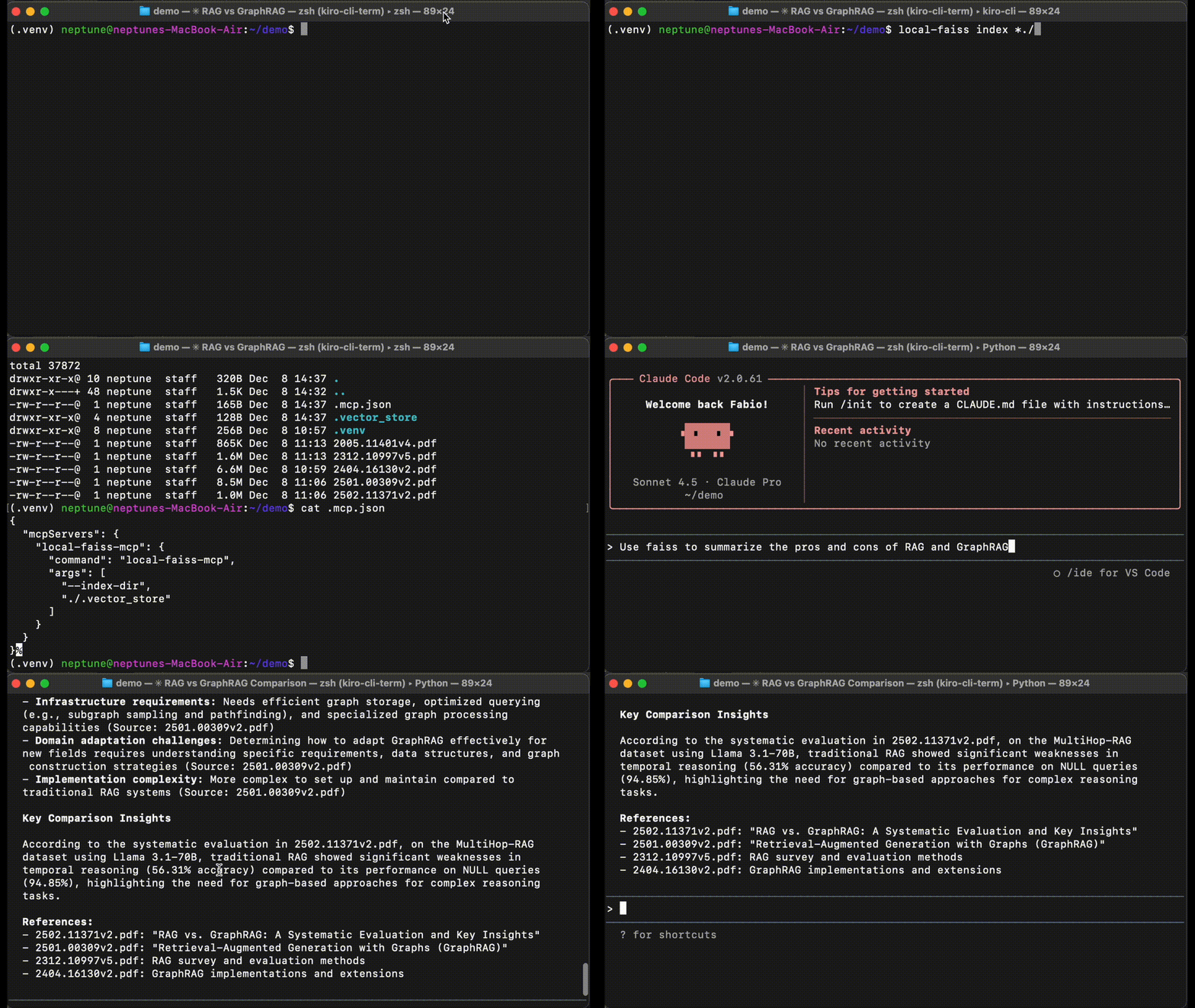
Features
Core Capabilities
Local Vector Storage: Uses FAISS for efficient similarity search without external dependencies
Document Ingestion: Automatically chunks and embeds documents for storage
Semantic Search: Query documents using natural language with sentence embeddings
Persistent Storage: Indexes and metadata are saved to disk
MCP Compatible: Works with any MCP-compatible AI agent or client
v0.2.0 Highlights
CLI Tool:
local-faisscommand for standalone indexing and searchDocument Formats: Native PDF/TXT/MD support, DOCX/HTML/EPUB with pandoc
Re-ranking: Two-stage retrieve and rerank for better results
Custom Embeddings: Choose any Hugging Face embedding model
MCP Prompts: Built-in prompts for answer extraction and summarization
Quickstart
Or use with Claude Code - configure MCP client (see Configuration) and try:
Claude will retrieve relevant document chunks from your vector store and use them to answer your question.
Installation
⚡️ Upgrading? Run pip install --upgrade local-faiss-mcp
From PyPI (Recommended)
Optional: Extended Format Support
For DOCX, HTML, EPUB, and 40+ additional formats, install pandoc:
Note: PDF, TXT, and MD work without pandoc.
From Source
Usage
Running the Server
After installation, you can run the server in three ways:
1. Using the installed command (easiest):
2. As a Python module:
3. For development/testing:
Command-line Arguments:
--index-dir: Directory to store FAISS index and metadata files (default: current directory)--embed: Hugging Face embedding model name (default:all-MiniLM-L6-v2)--rerank: Enable re-ranking with specified cross-encoder model (default:BAAI/bge-reranker-base)
Using a Custom Embedding Model:
Using Re-ranking for Better Results:
Re-ranking uses a cross-encoder model to reorder FAISS results for improved relevance. This two-stage "retrieve and rerank" approach is common in production search systems.
How Re-ranking Works:
FAISS retrieves top candidates (10x more than requested)
Cross-encoder scores each candidate against the query
Results are re-sorted by relevance score
Top-k most relevant results are returned
Popular re-ranking models:
BAAI/bge-reranker-base- Good balance (default)cross-encoder/ms-marco-MiniLM-L-6-v2- Fast and efficientcross-encoder/ms-marco-TinyBERT-L-2-v2- Very fast, smaller model
The server will:
Create the index directory if it doesn't exist
Load existing FAISS index from
{index-dir}/faiss.index(or create a new one)Load document metadata from
{index-dir}/metadata.json(or create new)Listen for MCP tool calls via stdin/stdout
Available Tools
The server provides two tools for document management:
1. ingest_document
Ingest a document into the vector store.
Parameters:
document(required): Text content OR file path to ingestsource(optional): Identifier for the document source (default: "unknown")
Auto-detection: If document looks like a file path, it will be automatically parsed.
Supported formats:
Native: TXT, MD, PDF
With pandoc: DOCX, ODT, HTML, RTF, EPUB, and 40+ formats
Examples:
2. query_rag_store
Query the vector store for relevant document chunks.
Parameters:
query(required): The search query texttop_k(optional): Number of results to return (default: 3)
Example:
Available Prompts
The server provides MCP prompts to help extract answers and summarize information from retrieved documents:
1. extract-answer
Extract the most relevant answer from retrieved document chunks with proper citations.
Arguments:
query(required): The original user query or questionchunks(required): Retrieved document chunks as JSON array with fields:text,source,distance
Use Case: After querying the RAG store, use this prompt to get a well-formatted answer that cites sources and explains relevance.
Example workflow in Claude:
Use
query_rag_storetool to retrieve relevant chunksUse
extract-answerprompt with the query and resultsGet a comprehensive answer with citations
2. summarize-documents
Create a focused summary from multiple document chunks.
Arguments:
topic(required): The topic or theme to summarizechunks(required): Document chunks to summarize as JSON arraymax_length(optional): Maximum summary length in words (default: 200)
Use Case: Synthesize information from multiple retrieved documents into a concise summary.
Example Usage:
In Claude Code, after retrieving documents with query_rag_store, you can use the prompts like:
The prompts will guide the LLM to provide structured, citation-backed answers based on your vector store data.
Command-Line Interface
The local-faiss CLI provides standalone document indexing and search capabilities.
Index Command
Index documents from the command line:
Configuration: The CLI automatically uses MCP configuration from:
./.mcp.json(local/project-specific)~/.claude/.mcp.json(Claude Code config)~/.mcp.json(fallback)
If no config exists, creates ./.mcp.json with default settings (./.vector_store).
Supported formats:
Native: TXT, MD, PDF (always available)
With pandoc: DOCX, ODT, HTML, RTF, EPUB, etc.
Install:
brew install pandoc(macOS) orapt install pandoc(Linux)
Search Command
Search the indexed documents:
Results show:
Source file path
FAISS distance score
Re-rank score (if enabled in MCP config)
Text preview (first 300 characters)
CLI Features
✅ Incremental indexing: Adds to existing index, doesn't overwrite
✅ Progress output: Shows indexing progress for each file
✅ Shared config: Uses same settings as MCP server
✅ Auto-detection: Supports glob patterns and recursive folders
✅ Format support: Handles PDF, TXT, MD natively; DOCX+ with pandoc
Configuration with MCP Clients
Claude Code
Add this server to your Claude Code MCP configuration (.mcp.json):
User-wide configuration (~/.claude/.mcp.json):
With custom index directory:
With custom embedding model:
With re-ranking enabled:
Full configuration with embedding and re-ranking:
Project-specific configuration (./.mcp.json in your project):
Alternative: Using Python module (if the command isn't in PATH):
Claude Desktop
Add this server to your Claude Desktop configuration:
Architecture
Embedding Model: Configurable via
--embedflag (default:all-MiniLM-L6-v2with 384 dimensions)Supports any Hugging Face sentence-transformers model
Automatically detects embedding dimensions
Model choice persisted with the index
Index Type: FAISS IndexFlatL2 for exact L2 distance search
Chunking: Documents are split into ~500 word chunks with 50 word overlap
Storage: Index saved as
faiss.index, metadata saved asmetadata.json
Choosing an Embedding Model
Different models offer different trade-offs:
Model | Dimensions | Speed | Quality | Use Case |
| 384 | Fast | Good | Default, balanced performance |
| 768 | Medium | Better | Higher quality embeddings |
| 384 | Fast | Good | Multilingual support |
| 384 | Medium | Better | Better quality at same size |
Important: Once you create an index with a specific model, you must use the same model for subsequent runs. The server will detect dimension mismatches and warn you.
Development
Standalone Test
Test the FAISS vector store functionality without MCP infrastructure:
This test:
Initializes the vector store
Ingests sample documents
Performs semantic search queries
Tests persistence and reload
Cleans up test files
Unit Tests
Run the complete test suite:
Run specific test files:
The test suite includes:
test_embedding_models.py: Comprehensive tests for custom embedding models, dimension detection, and compatibility
test_standalone.py: End-to-end integration test without MCP infrastructure
License
MIT