
The Domain MCP server enables AI assistants to manage Dynadot domains through natural language commands, eliminating the need for API knowledge or manual web interface navigation. It provides 10 tools covering 106 API actions across comprehensive domain management capabilities:
Domain Operations: List, search, register (single/bulk), renew, delete, restore, lock/unlock domains, check availability and TLD pricing, and push domains between Dynadot accounts
Domain Settings: Configure nameservers, WHOIS privacy levels, auto-renewal, URL forwarding (standard/stealth), parking pages, email forwarding, folder organization, and domain notes
DNS Management: Get/set DNS records (A, AAAA, CNAME, MX, TXT) for main domains and subdomains with TTL and priority settings, plus full DNSSEC configuration
Nameserver Management: Register custom nameservers (glue records), update IP addresses, list, and delete nameservers
Domain Transfers: Initiate/cancel transfers, check status, manage authorization codes, authorize outbound transfers, and handle push requests between accounts
Contact Management: Create, edit, delete, and list WHOIS contacts with support for regional settings (.CN audits, EU, Latvia, Lithuania)
Folder Management: Organize domains into folders with bulk settings for WHOIS, DNS, nameservers, forwarding, parking, and renewal options
Account Management: View account balance and details, configure default settings for new domain registrations (WHOIS, nameservers, DNS, forwarding, renewal options)
Aftermarket Operations: Manage backorders, list/bid on auctions, buy expired domains, manage marketplace listings, and confirm Afternic/Sedo transactions
Order Management: View order history, check order/processing status, list available coupons, and manage reseller WHOIS verification
Click on "Install Server".
Wait a few minutes for the server to deploy. Once ready, it will show a "Started" state.
In the chat, type
@followed by the MCP server name and your instructions, e.g., "@Domain MCPcheck if example.com is available and show me similar domains"
That's it! The server will respond to your query, and you can continue using it as needed.
Here is a step-by-step guide with screenshots.
Domain MCP - Domain Management for AI Assistants





A Domain MCP server that brings natural language domain management to Claude, Cursor, and other AI assistants. Manage Dynadot domains, DNS, contacts, and transfers through conversational commands powered by the Model Context Protocol (MCP).
🚀 AI-powered domain operations - Just ask: "List my domains", "Register example.com", or "Set up DNS"
Table of Contents
Features
🤖 Natural Language Domain Management: Use AI assistants like Claude and Cursor to manage domains conversationally - no API knowledge needed
📦 Complete Domain MCP Server: 106 Dynadot API actions across 10 composite MCP tools for domains, DNS, transfers, and more
⚡ Production-Ready AI Integration: Built for Claude Code, Cursor, Claude Desktop, and any MCP-compatible client
🔒 Type-Safe & Reliable: TypeScript, Zod validation, comprehensive test suite with 100% tool coverage
✅ MCP Protocol Compliant: Full Model Context Protocol specification compliance with real CRUD operation tests
Examples in Action
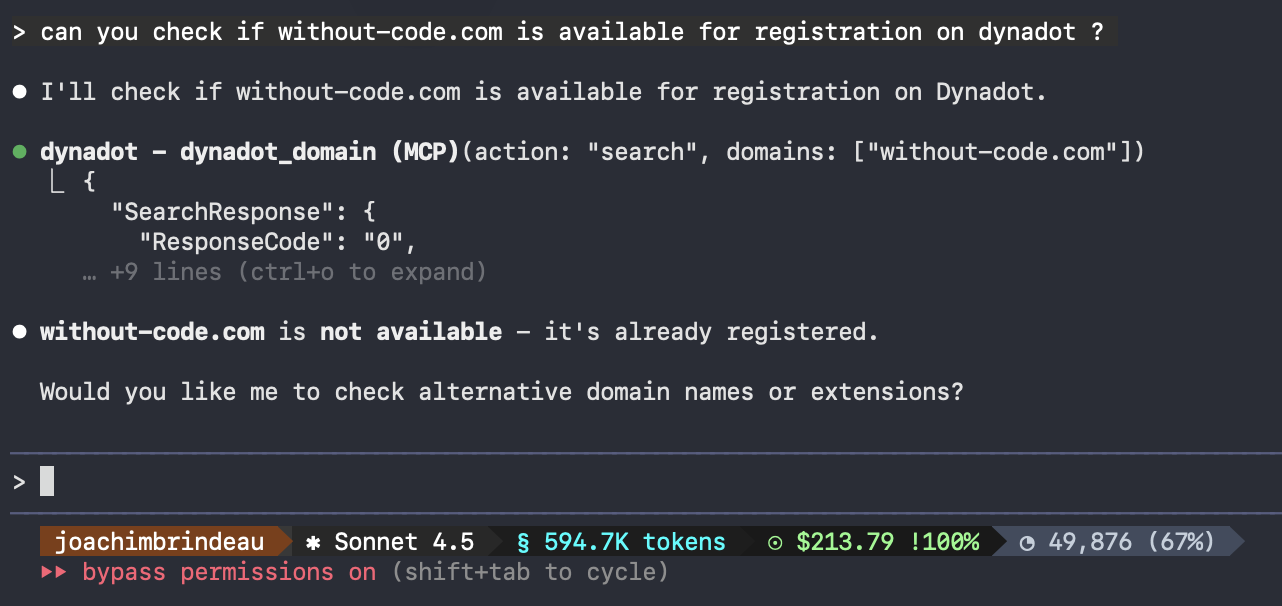
Claude Code
Check domain availability and get intelligent suggestions:
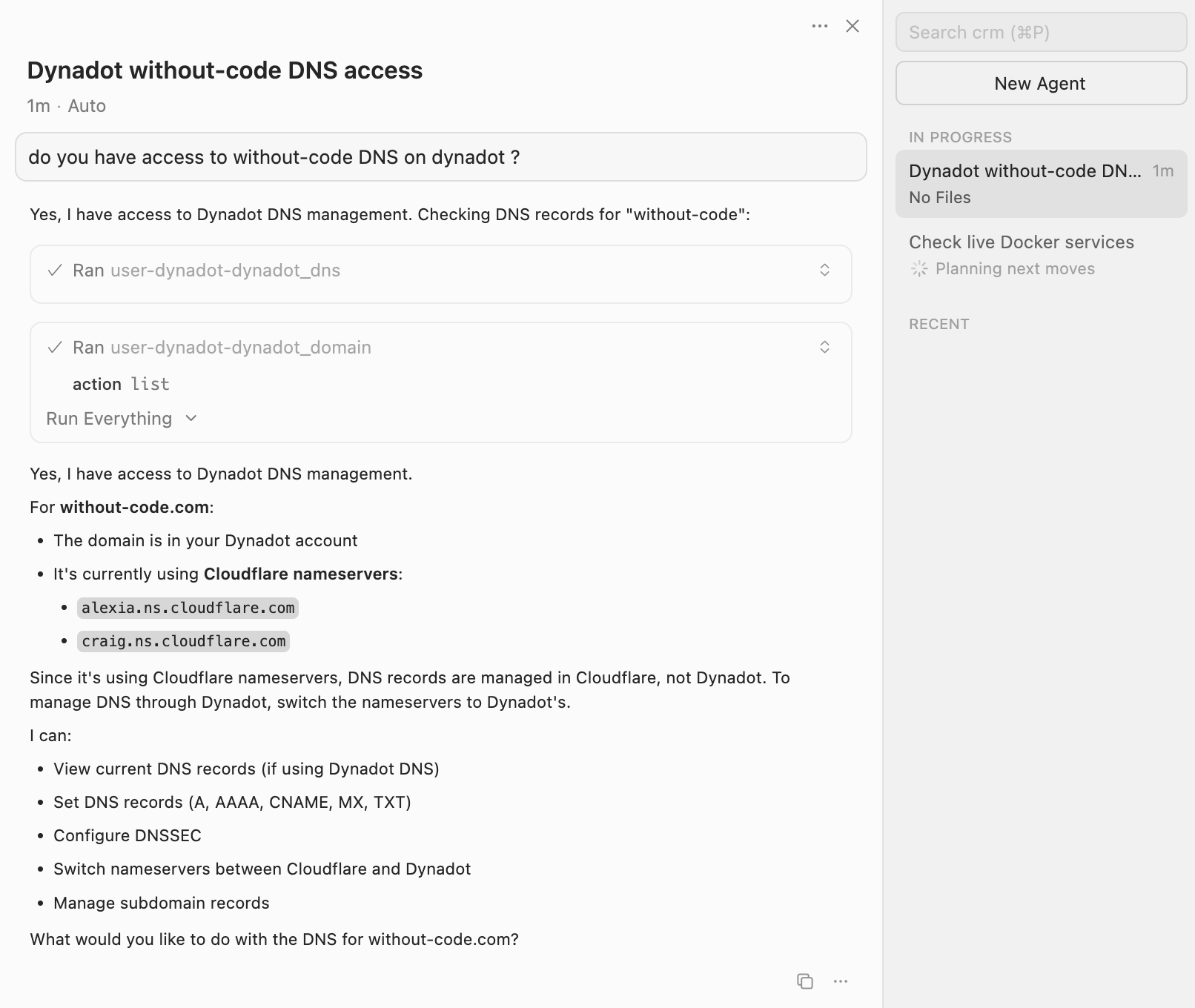
Cursor
Manage DNS records with natural language - the AI understands your Dynadot account structure:
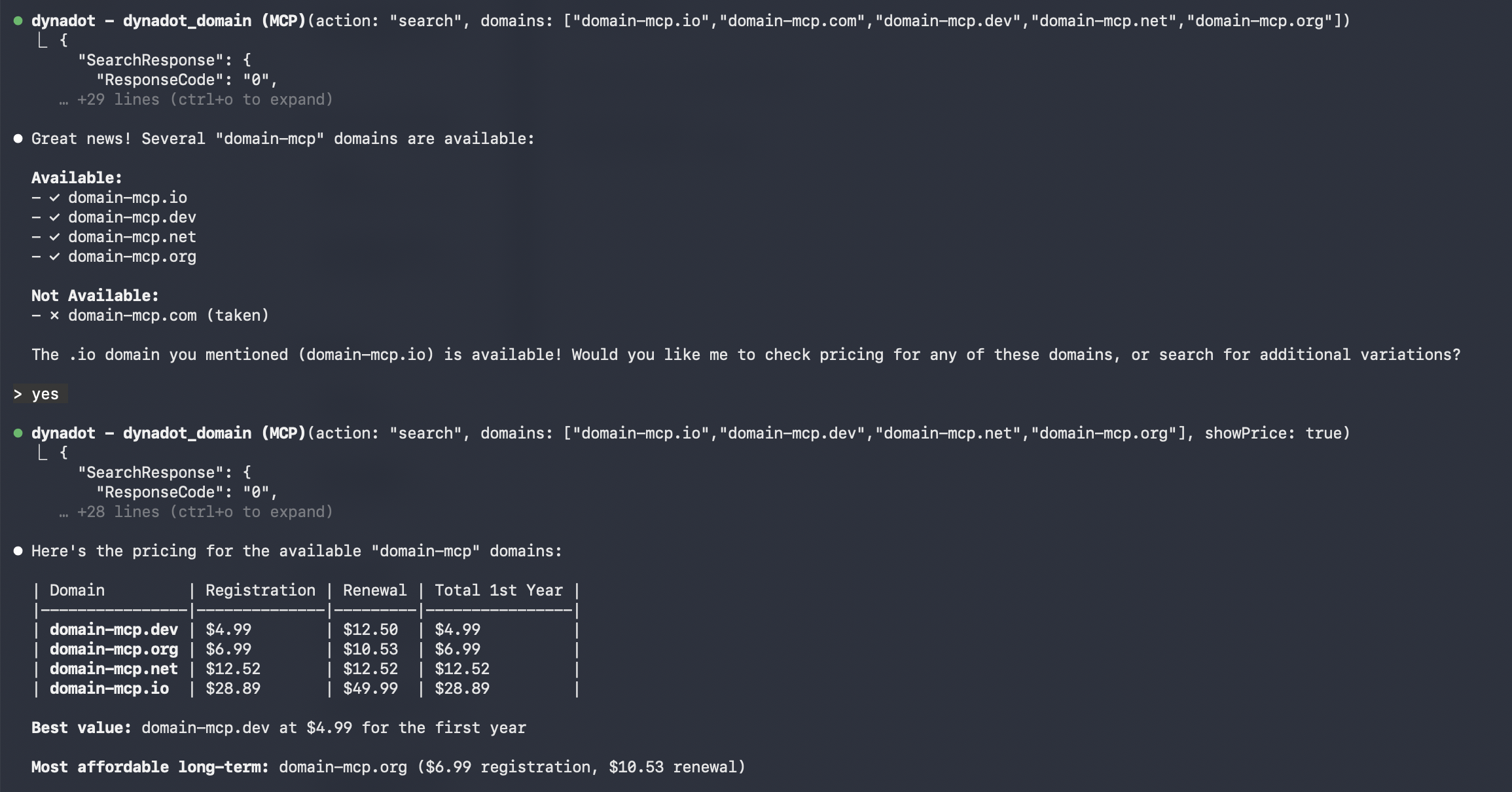
Domain Search with Pricing
Search for available domains and get pricing information instantly:
Common Use Cases
For AI-Powered Domain Management
Use this Domain MCP server to manage your Dynadot domains through natural language with AI assistants:
Domain Operations
"Check if example.com is available and show me similar domains"
"Register example.com and enable WHOIS privacy"
"Show me all domains expiring in the next 30 days"
DNS Management
"Set up DNS for mysite.com with A record pointing to my server"
"Add www subdomain and configure MX records for email"
"Update DNS to point to Cloudflare nameservers"
Bulk Operations
"Enable auto-renewal for all my .com domains"
"Lock all domains to prevent unauthorized transfers"
"Search pricing for .com, .net, .io, and .ai domains"
Advanced Automation
"Create a contact and use it to register multiple domains"
"Transfer example.com from another registrar with auth code"
"Set up domain forwarding from old-site.com to new-site.com"
Why Use an MCP Domain Server?
Traditional domain management requires:
Memorizing API documentation
Writing custom scripts
Manual navigation through control panels
With this Domain MCP integration:
✅ Natural language: Just describe what you want
✅ AI assistance: Claude/Cursor understand domain concepts
✅ Context aware: AI remembers your account structure
✅ Faster workflow: No context switching to web UI
Quick Installation
Prerequisites
You'll need a Dynadot account and an API key to use this MCP server.
Method 1: NPX (Recommended) ⚡
No installation needed! NPX runs the package directly from npm.
Step 1: Get your API key from Dynadot Account Settings
Step 2: Add to your MCP client config:
Edit ~/.claude/mcp.json:
Or use the CLI:
Edit ~/.cursor/mcp.json (macOS/Linux) or %APPDATA%\Cursor\mcp.json (Windows):
Restart Cursor after editing.
Edit the config file:
macOS:
~/Library/Application Support/Claude/claude_desktop_config.jsonWindows:
%APPDATA%\Claude\claude_desktop_config.jsonLinux:
~/.config/Claude/claude_desktop_config.json
Restart Claude Desktop after editing.
Step 3: Restart your AI assistant and start using domain commands!
Method 2: Global Install
Install globally with npm:
Then use domain-mcp instead of npx -y domain-mcp in your config:
Method 3: Local Development
For contributing or customization:
Then configure with absolute path:
Configuration Options
Required
DYNADOT_API_KEY- Your Dynadot API key (Get it here)
Optional
DYNADOT_SANDBOX- Set to"true"for sandbox testing (default:"false")
📖 Full Documentation:
Setup Guide - Detailed setup with troubleshooting
Environment Variables - Complete environment variable reference
Sandbox Limitations - Known sandbox API limitations
Usage
As MCP Server
Once configured, you have access to 10 powerful tools
Programmatic Usage
MCP Tools for Domain Management
This Domain MCP server provides 10 comprehensive tools for AI-powered domain operations:
1. dynadot_domain - Core Domain Operations
List, search, register, renew, delete, info, lock, and pricing operations for your domains.
Common AI commands: "List my domains", "Search for example.com", "Register domain", "Check .com pricing"
2. dynadot_domain_settings - Domain Configuration
Configure domain settings: nameservers, privacy, renewal, forwarding, parking, WHOIS.
Common AI commands: "Enable WHOIS privacy", "Set nameservers", "Configure domain forwarding", "Enable auto-renewal"
3. dynadot_dns - DNS Management
DNS management: get/set DNS records, DNSSEC configuration.
Common AI commands: "Show DNS records", "Add A record", "Configure MX records", "Enable DNSSEC"
4. dynadot_nameserver - Nameserver Management
Manage registered nameservers (glue records): register, update IP, delete, list.
Common AI commands: "Register nameserver", "Update nameserver IP", "List my nameservers"
5. dynadot_transfer - Domain Transfers
Domain transfers: initiate, check status, manage auth codes, push requests.
Common AI commands: "Transfer domain to Dynadot", "Get auth code", "Check transfer status", "Push domain to another account"
6. dynadot_contact - WHOIS Contact Management
WHOIS contact management: create, edit, delete, list, regional settings.
Common AI commands: "Create new contact", "List contacts", "Update contact info", "Delete contact"
7. dynadot_folder - Folder Management
Folder management: create, delete, list, configure folder-level settings.
Common AI commands: "Create domain folder", "List folders", "Move domain to folder", "Configure folder settings"
8. dynadot_account - Account Settings
Account info, balance, and default settings for new domains.
Common AI commands: "Check account balance", "Show account info", "Set default nameservers", "Configure default WHOIS"
9. dynadot_aftermarket - Aftermarket Operations
Aftermarket: auctions, backorders, expired domains, marketplace listings.
Common AI commands: "List domain auctions", "Place bid on auction", "Backorder expired domain", "List my marketplace domains"
10. dynadot_order - Order Management
Orders, coupons, processing status, reseller operations.
Common AI commands: "Check order status", "List available coupons", "View order history"
Development
Build
Run Tests
Development Mode
Testing
E2E Tests
Validates that all 106 API actions are properly mapped and return valid responses.
Functional Tests
Tests real CRUD operations:
Folder CRUD (create, list, rename, delete, verify)
Contact CRUD (create, list, get, edit, delete, verify)
Domain Note (set, verify, clear)
Domain Lock/Unlock
Renewal Options
Test Coverage: 26/26 functional tests passing
API Quirks & Known Issues
edit_contact
Dynadot API requires ALL contact fields to be provided when editing, not just the fields you want to change. Partial updates will fail with "missing email" or similar errors.
Solution: Always provide complete contact data:
lock_domain unlock
The lock_domain unlock command may return a misleading error "this domain has been locked already" when attempting to unlock. This appears to be either:
Domain protection preventing API unlock
A bug in the Dynadot API error messaging
Unlocking domains may need to be done through the Dynadot control panel.
Architecture
Dependencies
@modelcontextprotocol/sdk- MCP protocol implementationky- HTTP client for API requestszod- Schema validationvitest- Testing frameworktypescript- Type safety
Documentation
📚 Guides
Quick Start - Get up and running in 5 minutes
Setup Guide - Detailed setup for Claude Code, Cursor, Claude Desktop
Deployment - Local, Docker, remote, and serverless options
Environment - Complete environment variable reference
Testing - Automated testing with Claude Haiku
Reference - Common commands and usage patterns
Examples - Code examples for common operations
🔧 Development
Contributing - How to contribute, API quirks, testing
Changelog - Version history and updates
Roadmap - Implementation status and roadmap
🏗️ Project
License - MIT License
License
MIT
Contributing
Fork the repository
Create a feature branch
Make your changes
Add tests for new functionality
Ensure all tests pass
Submit a pull request
Frequently Asked Questions
What is an MCP server for domains?
A Domain MCP server is a Model Context Protocol server that enables AI assistants like Claude and Cursor to manage domains through natural language. Instead of using a web interface or writing API code, you simply ask your AI assistant to perform domain operations.
How is this different from using the Dynadot website?
The Domain MCP server brings domain management into your AI assistant's context:
Natural language: "Register example.com" vs clicking through multiple pages
AI understanding: The assistant knows your account structure and suggests related actions
Workflow integration: Manage domains while coding, writing, or working without leaving your editor
Automation ready: Chain multiple domain operations in one conversation
Which AI assistants work with this Domain MCP server?
This MCP server works with any MCP-compatible AI assistant:
Claude Code - Anthropic's official CLI
Cursor - AI-powered code editor
Claude Desktop - Anthropic's desktop app
Any other client supporting the Model Context Protocol
Do I need to know the Dynadot API?
No! That's the power of the Domain MCP approach. Your AI assistant handles the API complexity. Just describe what you want in natural language.
Is this safe to use with production domains?
Yes, with proper precautions:
Sandbox mode: Test with
DYNADOT_SANDBOX=truefirstReview actions: The AI shows you what it will do before executing
API limits: Dynadot's API rate limits prevent runaway operations
Audit trail: All operations are logged in your Dynadot account
How much does it cost?
The Domain MCP server itself is free and open source (MIT license). You only pay for Dynadot domain services and your AI assistant subscription.
Support
Getting Help with Domain MCP
Issues & Questions: GitHub Issues
Feature Requests: GitHub Discussions
Contributing: See CONTRIBUTING.md
Documentation Resources
Dynadot API:
API Commands - Complete API reference
API Help - Community support
Model Context Protocol:
MCP Specification - Official MCP documentation
MCP Servers - Example MCP implementations